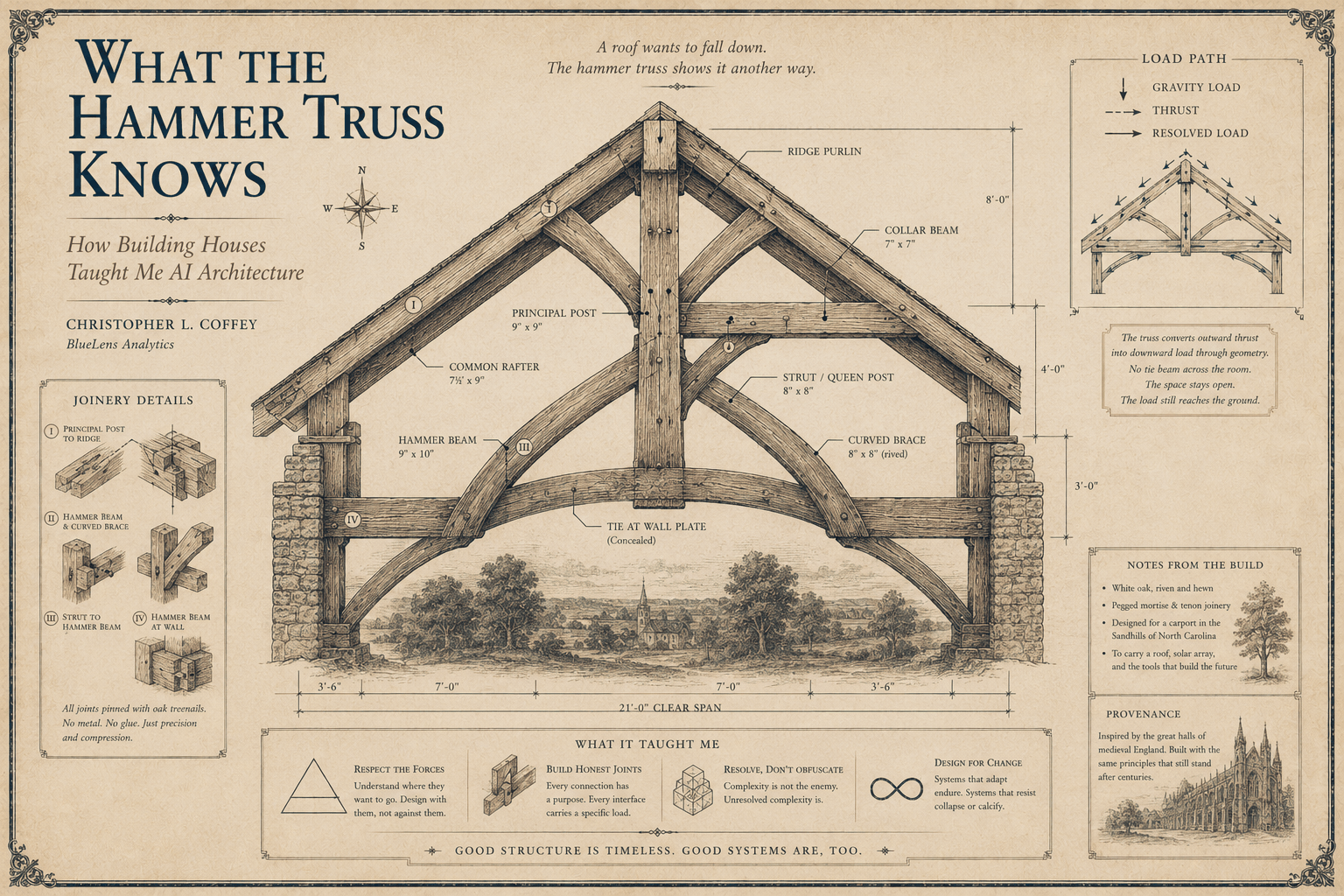
There is a white oak on my property in the Sandhills of North Carolina that is becoming a roof.
I felled it, bucked it, and I will rive and hew the timbers with a broad axe and an adze, the way it was done before sawmills and long before YouTube. Those timbers will become a hammer truss at the gables of a carport I am building on a hilltop overlooking downtown Robbins. Under that roof my 22 year old truck can rest in the shade, protecting its Rust-Oleum farm implement matte black paint job. On top of it: three kilowatts of solar panels that will run my workshop, my tools, my servers, my screens, and the air conditioning that makes a Carolina summer survivable.
A medieval roof structure carrying a photovoltaic array that powers off-grid environmental climate control systems in a remotely controllable distributed online network. If that sentence sounds like a contradiction, stay with me. It is one of the most coherent things I have built in years, and I think it is a better framework and thought structure for AI architecture than most of what is getting published and discussed on the topic.
The problem the hammer truss solves
A roof wants to fall down. More precisely, it wants to push outward. Rafters in a pitched roof thrust against the walls that hold them, and if nothing resists that thrust, the walls splay and the ridge drops and the whole thing settles into the ground over a few decades or a few seconds, depending.
The obvious fix is a tie beam. Run a horizontal timber across the building at the wall plate, connect to the rafters above the top plate at the bird’s mouth, and the thrust pulls against the beam instead of the walls. Triangles are honest. This works.
But a tie beam crosses the space. And sometimes the space is the point. The carpenters who built the great medieval halls of England wanted soaring open rooms, and a tie beam at plate height would have cut those rooms in half. So they developed the hammer truss: short horizontal hammer beams projecting from the walls, supported by curved braces beneath, carrying posts that step the load up and inward until the geometry itself resolves the thrust. No beam crosses the room. The load still gets to the ground. It just takes a smarter path.
Westminster Hall has carried its roof this way since the 1390s. Nobody who built it could compute a load path using modern engineering mathematics. They understood something better. They understood where the forces wanted to go, and they built a structure that gave the forces somewhere to go.
Two ways to build
I spent years as a carpenter before I spent years building intelligence systems, and nearly all of it was custom work. Timber frames, fine joinery, mortise and tenon work, cabinetry and furniture. But as a young man I ran trim in tract houses, and trim work is where you learn the truth about production building, because trim is where every hidden error finally surfaces. Nothing is square. Nothing is plumb. Every miter is a negotiation with somebody else’s shortcuts. There is no shame in production work. Somebody has to house this country. But the two kinds of building handle complexity in opposite ways, and the difference is the difference that matters.
Production building manages complexity with volume and fasteners. Thousands of small members, thousands of nails, redundancy by repetition. No single piece matters much. Nobody on the crew needs to understand the load path because the spec sheet understood it for them, approximately, for the average house on the average lot. Then it all disappears behind sheathing and vinyl and nobody ever sees the structure again. Which is why the errors wait there, patient, for the trim carpenter to find.
Timber framing manages complexity by resolving it. Few members, each one consequential. Every joint is designed for the specific forces that will pass through it. A mortise and tenon in white oak is not a fastener. It is an agreement between two timbers about which loads each will carry and in which directions. Cut it wrong and it fails, maybe not today, maybe in fifteen years when the wood has finished moving. Cut it right and it outlives you. And because the structure is the resolution of real forces, you leave it exposed. It is the most beautiful thing in the room. The beauty is not decoration. The beauty is what resolved load paths look like.
The part where this becomes about AI
I build geospatial AI pipelines for a living. Satellite radar change detection, sensor data flowing through preprocessing and feature extraction and export. And I will tell you what I see across the industry right now: tract houses. Everywhere.
Prompt-chained scripts nailed together as fast as the model can generate them. Glue code holding glue code. Systems where nobody can tell you the load path, meaning nobody can tell you what happens to the whole thing when one assumption changes, because no one designed for the forces. They specified components and fastened them together and sheathed it in a demo. It stands up. So does every tract house, on day one. Ask me again when I show up with the trim.
The load in a software system is not gravity. It is change. New sensors, new data formats, new models, new requirements. That is the thrust pushing your walls apart. And there are two responses to it, same as in carpentry.
You can fight change with volume: more code, more patches, more fasteners, rewrite the whole wall when it splays. Or you can resolve it with structure. Decide where change is allowed to enter the system. Build joints there, real interfaces, designed for the specific forces that will pass through them. In my own pipeline, a SAR change detection system called AURORA, that meant accepting a humbling realization: the detection algorithm I was proud of was not the valuable part. The valuable part was the structure around it, the adapter layer that lets any sensor in and any model in, the portable output format that lets everything downstream stay ignorant of what happened upstream. The joinery, not the timber.
A clean interface is a mortise and tenon. It is an agreement between two components about which loads each will carry and in which directions. Cut it wrong and it fails later, when the system has finished moving. Cut it right and you can swap a sensor the way you would replace a rafter, without touching the truss.
The hammer truss is the deepest version of the lesson. The medieval carpenters had a constraint that seemed absolute: a span this wide requires a tie beam through the room. They refused the constraint and resolved the forces another way, through geometry, through understanding. Every good architecture decision I have ever made looked like that. The constraint everyone accepts, this system requires that dependency, this pipeline requires that vendor, examined closely enough to find the smarter path the load could take instead.
What the tools do not change
I should be clear about something, because this is where the argument usually gets hijacked by nostalgia merchants. I am not one of them.
I hew beams with an adze and I also run a chainsaw mill and a worm drive saw. I write code by hand and I also use large language models every working day. The old carpenters would have killed for my tools. Tools were never the question. The question is whether the person holding the tool understands where the load goes. An adze in ignorant hands ruins a beam. A nail gun in ignorant hands ruins the engineering through over fastening and missed application. It fires nails through hidden plumbing and wiring that you don’t find til the bums who put them there have moved on. A language model in ignorant hands generates ten thousand lines of structure-free code at unbelievable speed, which is just a faster nail gun.
The understanding does not come with the tool. It never has. It comes from standing under your own work.
A roof over Robbins
We are told the world is getting more complex, and it is, and the standard response is to throw more material at it. More compute, more dashboards, more abstraction layers, more content. Sheathing over sheathing. It is the production framing response, and it works the way tract houses work, which is to say it stands up and it is nothing and in thirty years someone will bulldoze it without a second thought.
The other response is older. Understand the forces. Give them somewhere to go. Build few things, build them consequential, and let the structure show. That is how humans have always actually made sense of complexity, not by covering it but by resolving it, and the proof is that the resolution is beautiful every time. Westminster Hall is beautiful. A well-factored pipeline is beautiful in the only way code can be. They are beautiful for the same reason.
Downtown Robbins sits in the valley below my hill. It is a blighted little mill town, the kind of place the last forty years happened to rather than for. It does not need another metal carport from the farm store, and God knows it does not need more trailers, apartments, and tract homes.
But a hilltop where a hand-hewn white oak hammer truss holds three kilowatts of solar glass against the sky, shading the trucks, cooling the shop, carrying its loads down paths a carpenter worked out six hundred years ago. That, it might look up at.
The roof will outlast me. The forces are resolved. That is the whole job, in oak or in code.
The architecture described here is documented in a technical brief at bluelensanalytics.com/aurora.
Christopher Coffey is the principal of BlueLens Analytics, a geospatial intelligence practice in the North Carolina Sandhills. He builds SAR change detection pipelines and, occasionally, timber frames and log cabins.