BlueLens Analytics
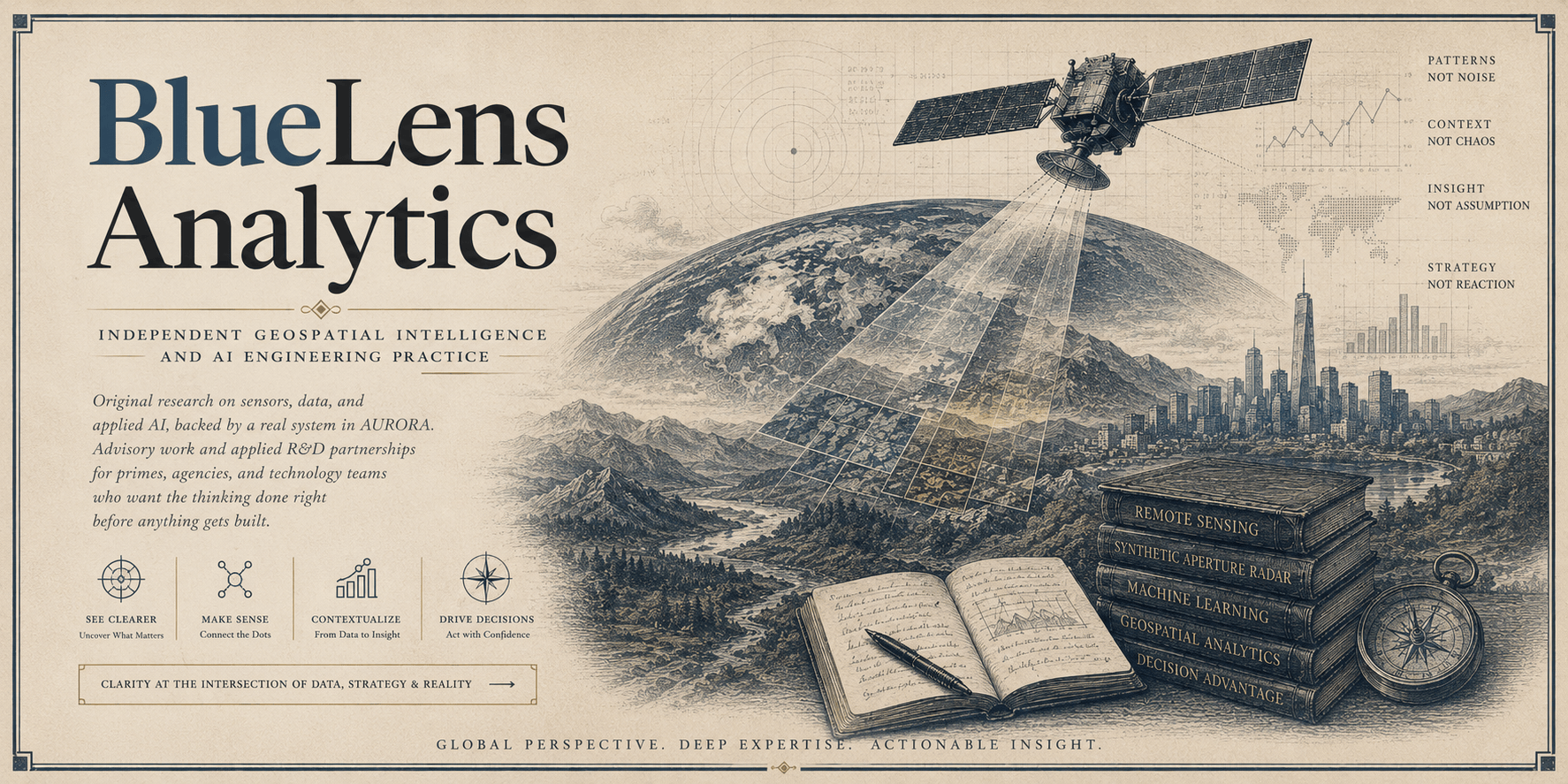
An independent geospatial intelligence and AI engineering practice. Cleared. Senior. Independent. Original research on sensors, data, and applied AI, backed by a real system in AURORA. Advisory work and applied R&D partnerships for primes, agencies, and technology teams who want the thinking done right before anything gets built.
The Practice
BlueLens Analytics is an independent geospatial intelligence and applied AI research practice. The model is the small technical practice, not the venture-backed startup: one principal, real depth, engagements chosen for the problem rather than the invoice.
The practice does three things. It builds real systems, AURORA foremost among them. It publishes original technical and policy analysis on sensors, data, and applied AI under "The Edges of the Map." And it works directly with primes, agencies, and technology teams that want senior geospatial and AI expertise on a specific problem.
That order matters. Most technical practices ask you to take their expertise on faith. BlueLens would rather you read the work first.
The Principal
Christopher L. Coffey, GISP, GA-II. Three decades in geospatial work, twelve of them inside the National Geospatial-Intelligence Agency, including Tech Lead for Project Maven. Deep experience with SAR and multi-sensor fusion, production computer vision at theater scale, and the operational realities of getting a GEOINT capability through accreditation, fielding, and analyst adoption.
Current focus is applied geospatial AI, with AURORA (sensor-agnostic SAR change detection) as the flagship build, and a running technical-report series on sensors, energy, and applied AI. Full background, deployments, and credentials are on the About page.
Research
BlueLens publishes original technical and policy analysis under The Edges of the Map: sensor architecture and onboard AI, energy and infrastructure economics, and the occasional detour into network science and pattern-of-life analysis. It's how the practice's thinking gets tested before any engagement starts.
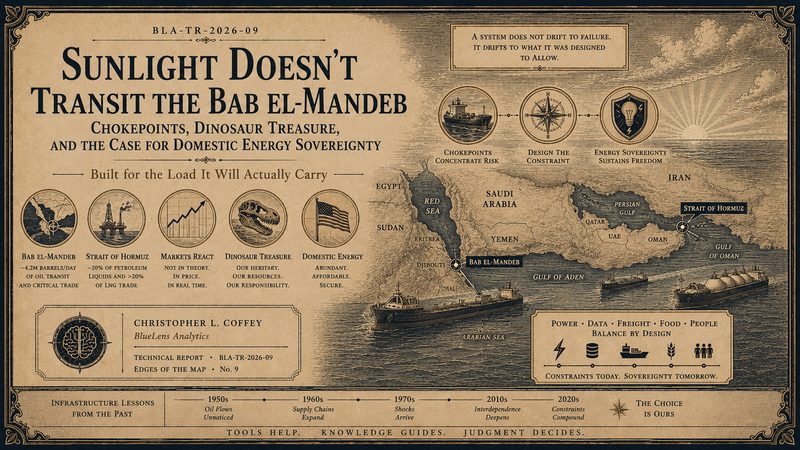
Sunlight Doesn't Transit the Bab el-Mandeb
The physical and economic case for pairing small nuclear reactors with solar-plus-storage, argued from two oil chokepoints closing within five months of each other.
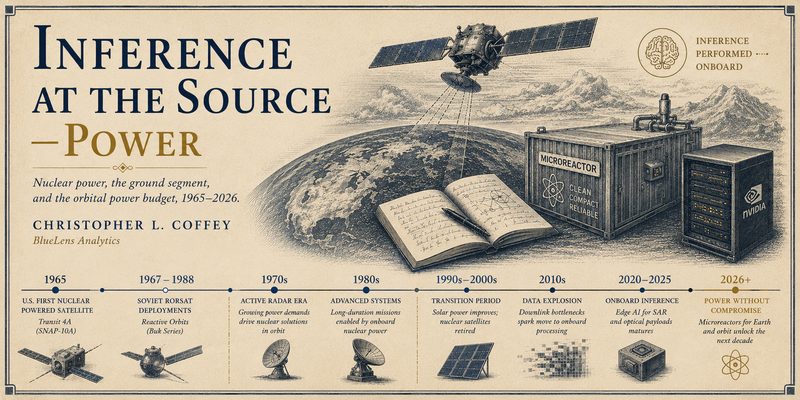
Inference at the Source — Power
What small nuclear reactors coupled directly to AI hardware mean for the power budget, on the ground and in orbit.
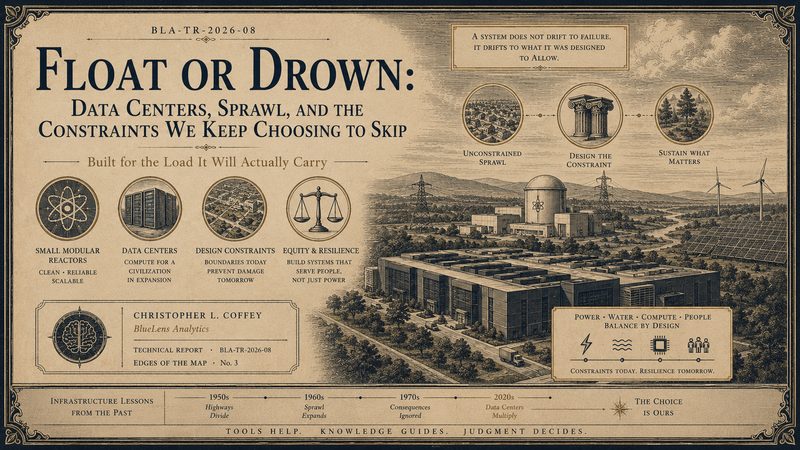
Float or Drown
Data center buildout is repeating a siting failure the US has run three times before. A case for designing the constraint in before it gets discovered under load.
The Pattern Underneath
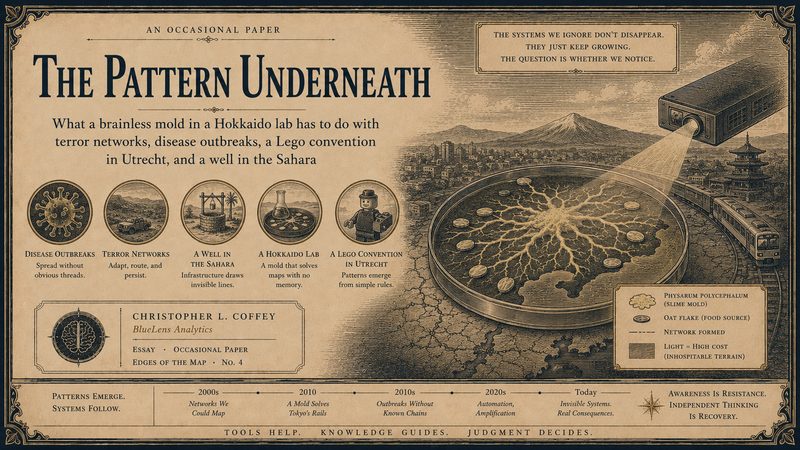
A brainless slime mold that redesigns rail networks turns out to explain trafficking corridors, disease spread, and pattern-of-life analysis.
Capabilities
Six areas of sustained technical depth, grounded in fielded systems, published research, and current engagements. Capability claims are bounded by what can be cited.
SAR & Multi-Sensor GEOINT
Synthetic aperture radar processing, change detection, multi-sensor fusion. Sentinel-1, ICEYE, Capella, Umbra. End-to-end pipelines from raw acquisition through analyst-ready polygon output. Operational discipline in radiometric calibration, geocoding, and provenance management.
Computer Vision & ML Engineering
Production-grade computer vision systems at theater scale. Project Maven lineage. Feature extraction, object detection, segmentation. PyTorch and segmentation-models-pytorch stack. Honest about what generic warm-starts can and cannot do; serious about domain-specific pretraining when accuracy matters.
GIS Engineering & Development
Strong open-source GIS posture. QGIS, GDAL, GeoPandas, rasterio, PostGIS. Custom geoprocessing pipelines, spatial data engineering, coordinate-system discipline, custom plugins and toolchains for QGIS deployment inside federal environments.
Production ML Systems
Model deployment, inference pipelines, scheduler-driven monitoring, alerting, REST integration. Citability-gated provenance enforcement so analytical claims survive proposal review and customer audit. ML that ships rather than ML that demos.
Targeting & Mission Support GEOINT
Senior tradecraft for the GEOINT product layer that targeting cells, JSOC elements, and theater J2 directorates depend on. Object characterization, pattern-of-life analysis, and change monitoring delivered at operationally relevant tempo. Useful GEOINT is judged downstream by the consumers, not upstream by the people who produced it.
Cost Engineering
Open-source GIS replacement of vendor-licensed tooling. ESRI license-cost engineering. Cloud cost discipline on geospatial workloads. Where commercial GEOINT platforms charge per-acre or per-seat in perpetuity, BlueLens replaces them with auditable open-source pipelines the customer actually owns.
Current Work
What the practice is actively building. Public-facing portion below. Other engagements are subject to customer disclosure preference.
AURORA
Sensor-agnostic synthetic aperture radar change detection system. Operational today on Sentinel-1. Designed to accept the imagery you actually have, not the imagery you wish you had. In an active SBIR Phase I pursuit against the DoD SBIR 26.1 cycle, and the clearest evidence of what an applied R&D partnership with BlueLens produces.
The system processes paired SAR acquisitions, applies adaptive Otsu thresholding with component-aware edge handling, and produces analyst-ready change polygons with full provenance metadata. Five-stage pipeline backed by a SQLite scheduler, multi-channel notifier, analyst-in-the-loop queue, and Flask REST API. Built for theater-scale monitoring without the cost structure of commercial GEOINT platforms.
Read the Technical Brief →Engagement
Four ways to work with the practice. Each is scoped to the customer's actual problem, not to filling a seat.
Inquiries
Inquiries from primes, federal stakeholders, and serious technical collaborators are welcome. A direct email with the problem, the context, and the timeline will get a substantive response within one business day.
BlueLens does not respond to mass capability statement requests, generic teaming-partner directories, or unsolicited body-shop intermediaries. Inquiries from SaaS aggregators, dashboard integrators, or organizations seeking to white-label any current or future BlueLens capability will not be answered.
Direct Contact
Robbins, NC 27325-8504
NC SOS Entity 2058755