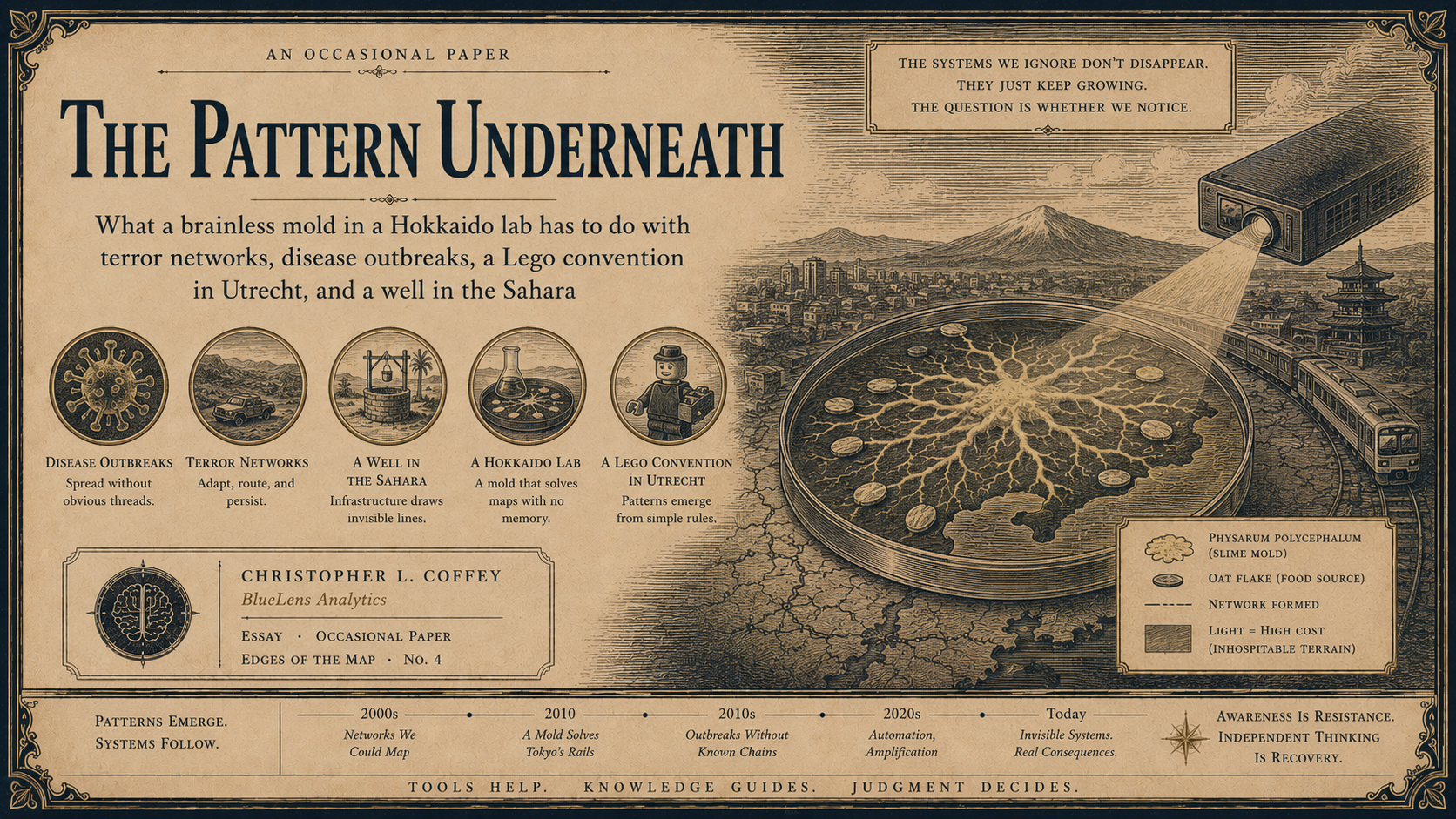
I want to tell you about a slime mold, a single-celled organism called Physarum polycephalum, that redesigned Tokyo’s rail system, but I have to tell you first where this actually started, because it was not the mold. I was out at the shop this morning, in a decent mood, having just gotten a piece of my off-grid setup working a little better than it worked yesterday, when I made the mistake of checking the news. The current Ebola outbreak in the Democratic Republic of the Congo, centered in and around Goma and Lake Kivu, has gotten bad enough that as of this week, more than eighty percent of new cases cannot be traced back to any known chain of transmission at all. Health officials are watching the virus surface again and again with no visible thread connecting it to anything they already know about, in some of the most isolated terrain on the continent.
Reading that language sent me straight back a decade, to a different Ebola outbreak, a different country, and to noticing something I have been circling for most of my career without ever quite having good language for it: the systems I have spent years staring at on a map, whether they were carrying disease, weapons, wildlife, or people, kept looking like something else. Something organic. Something growing. It turns out there is a name for that resemblance, and a real experiment behind it, and once you see it you cannot stop seeing it everywhere. So bear with me, this one wanders a little, on purpose, by way of a field hospital in West Africa, a well in the Sahara, a Japanese research lab, a British railway museum, and a Lego convention floor in the Netherlands.
The diorama
In 2010, a team of researchers led by Atsushi Tero at Hokkaido University built a scale model of the Greater Tokyo Area. Not a digital model. A physical one, on a wet surface, bounded by a cutout of the actual Pacific coastline. They placed oat flakes at the positions of the cities surrounding Tokyo and a small colony of Physarum polycephalum, a single-celled slime mold with no brain, no neurons, and no nervous system of any kind, at the point representing the city itself.
Then they turned on a projector. Physarum avoids bright light, and the researchers used that aversion to build a terrain-cost layer directly into the physical model: light where the ground was inhospitable, shade where it was passable. It is worth taking the time to think deeply about what this really means, because the vocabulary already exists in a different field. It is a friction surface. It is a weighted cost raster, the same kind used to compute a least-cost path across hostile terrain, except instead of a Geographic Information System engine calculating penalty values cell by cell, the penalty was photons, and the thing solving the routing problem was a slime mold.
Over roughly a day, the mold did what it does everywhere: it grew outward in every direction at once, a dumb and total flood of the available space. Wherever a tendril reached food, nutrient began to flow back through that channel, and the channel thickened in response, the same way a river carves itself a thalweg, the deepest, fastest-running channel of a streambed, cutting itself precisely where the most water keeps moving through. Wherever a tendril reached nothing, flow stopped, and the tendril withered. No planning. No memory. No representation of the map anywhere inside the organism. Just a rule applied locally and uniformly: reinforce what works, starve what doesn’t.
What came out the other side was a network connecting the food sources that closely resembled the actual Tokyo rail system, a system that took human engineers decades of iteration to arrive at. Researchers have since repeated the experiment against the Iberian motorway network, the Mexican federal highway system, Route 20 in the United States, Germany’s Autobahn 7, and major urban transport corridors in China. Different continents, different terrain, different cultures of engineering. The mold keeps arriving at structurally similar answers, because there are only so many efficient shapes for a network to take when it is built to connect scattered demand points cheaply, under a cost penalty, with some tolerance for failure. Oxford cell biologist Mark Fricker, who worked on the follow-up studies, put the actual engineering problem plainly: connecting every city with the shortest possible track forces some travelers onto badly indirect routes, and a single wrong deviation from the optimal graph can isolate a large part of the network. That is a real tradeoff between efficiency and resilience, the same one a human transportation planner has to solve on purpose. The mold solves it by accident, or rather by a process that does not require intention to produce an outcome that looks exactly like intention from the outside.
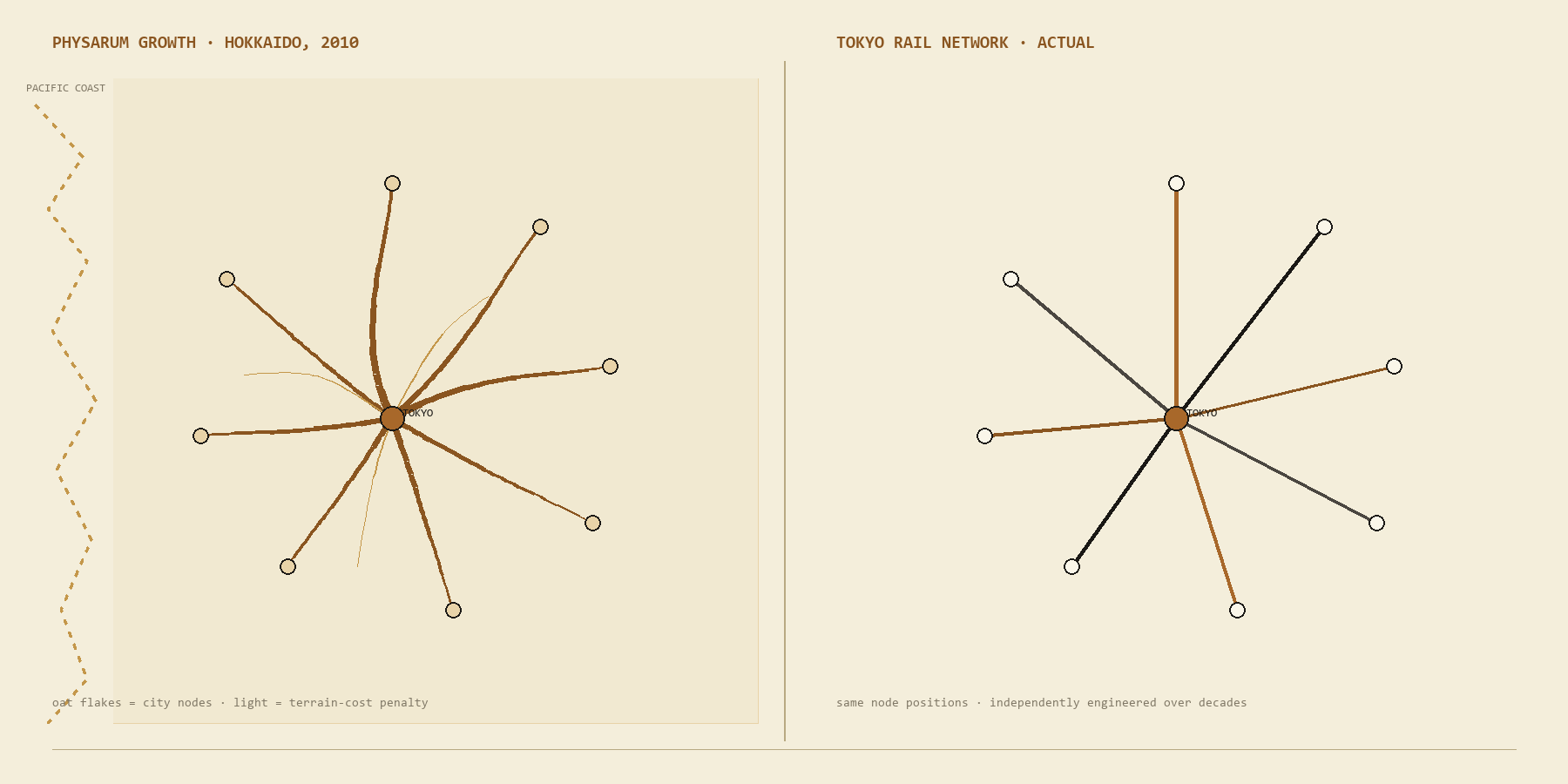
Figure 1. A schematic of the Tero et al. (2010) Hokkaido University experiment: a slime mold colony grown across a physical model of the Greater Tokyo Area, oat flakes marking surrounding cities, light standing in for a terrain-cost penalty. The resulting nutrient network closely echoed the real Tokyo rail system, built independently by human engineers over decades. Diagram by the author, after Tero, A. et al., “Rules for Biologically Inspired Adaptive Network Design,” Science 327 (2010).
Lights in a model village
When we lived in England, my son Logan and I made a habit of the National Railway Museum in York, one of the best collections of donated model train layouts anywhere in the world. What has stuck with me longest, more than the trains themselves, was the lighting and the electrical systems behind it. The good layouts wired working lights into everything, stationhouses, level crossings, the windows of model cottages glowing warm in a permanently dusk-lit case. Some of the crossings were fully functional control systems in miniature, gates that actually lowered, lights that timed themselves to the approach of a train, occasionally synced with electric slot cars running their own circuit through the same scene, so that a toy car would obediently stop at a gate closing for a train that was really nothing more than a very small motor and a length of track. It was not decoration. It was information and automation, built entirely by hand out of relays and timers.
That is the same aesthetic instinct that makes Wallace and Gromit-style claymation so satisfying to watch, a rawness to a physically built, physically lit model that a digital render cannot fake. When I first read about the Tokyo experiment and got to the part about the projector, the light-as-mountain-range trick, my mind went straight back to those museum cases in York before it went anywhere near a Geographic Information System textbook. Tero’s team was not importing a terrain layer from a shapefile. They built a physical model village and used actual light the way the York builders used actual light, to encode information directly into the physical world of the diorama, no abstraction layer required. The mountain was dark because the mountain was dark. The mold read that the same way you or I would read a lit window as “someone’s home.” Somebody built the Tokyo diorama the same way a model railroader builds a layout: physical terrain first, then let the thing moving through it tell you whether the routing actually works.
The Great Ball Contraption
Logan was between four and nine while we lived in England, which turned out to be exactly the right age for Lego conventions, so we chased those too, all over England and out to Utrecht, Amsterdam, and one in Belgium. What we loved most at every one of them was the Great Ball Contraption, the GBC, a machine built by dozens of separate builders who each design one module in isolation, months in advance, with no coordination beyond an agreed interface standard at each end: a ball enters this module at this height and direction, exits at that height and direction. That is the entire contract. Nobody sees anybody else’s module until the convention floor, when the whole thing gets bolted together into one enormous chain with a single job, keep the balls moving, indefinitely, without a jam.
Nobody designs the whole machine. Nobody is in charge of it. Each builder shows up with a small, self-contained idea, a lift built from a servo motor, a spiral ramp, a catapult, and the emergent result, an entire convention hall’s worth of Lego moving a continuous stream of balls through dozens of unrelated mechanisms without ever jamming, is doing exactly what the slime mold is doing and what those York museum cases were doing with light. A resource, balls in one case, nutrient in another, information in a third, flowing through a structure nobody centrally designed, held together by nothing but local rules and the requirement that flow keep moving. When a module jams, the entire downstream half of the machine grinds to a halt while balls pile up at the bottleneck, the exact visual signature of a network losing a hub node, made of plastic bricks, in front of a crowd of kids who have no idea they are watching a live demonstration of network resilience theory.
What the wells remember
For a long stretch of my career, the actual work was cross-country mobility analysis and network routing across the Sahel and Sahara, modeling where movement through that terrain was physically possible, and building network analysis on top of that to understand how illicit goods actually moved through it. The specific problem kept arriving dressed up as something new. One customer wanted the arms-smuggling picture. Another, working wildlife trafficking, wanted the routes ivory and pangolin scales were taking out of Central Africa. Another wanted the drug corridors, another the human smuggling routes toward the Mediterranean. Each one came to me convinced their particular illicit good defined a unique problem.
It does not. Doing report after report for a rotating cast of specialists who rarely talked to each other, I noticed the outcome probability maps I produced for each of them kept looking the same. Arms, wildlife, narcotics, people, it did not matter what was moving. The high-probability corridors and chokepoints converged on the same geometry almost every time, because the network was never really organized around the commodity. It was organized around the terrain, and on a map, the branching structure of those routes looked like coral. Not metaphorically. Structurally: a small number of high-connectivity hub nodes, a long tail of low-connectivity nodes hanging off them, growth following the path of least resistance toward whatever resource it needed, a border crossing, a market, a water source.
There is a persistent misconception, understandable if you have never had to route through it, that the Sahara and the Sahel are featureless enough to drive anywhere across them, open sand in every direction, unconstrained. Matthew McConaughey did not do us any favors here, and neither has Hollywood generally, which likes to depict the region as one uninterrupted dune sea you can point a Jeep at and drive. It is not close to that. Vast stretches of soft dune field are close to impassable without specialized preparation, and viable movement gets funneled onto firmer gravel plains, through specific wadi passes, and, above almost everything else, from well to well. Water is the actual governing constraint, the terrain-cost layer underneath the visible one, playing the same role in that landscape that the illumination mask played in the Tokyo experiment. It does not matter whether you are running camels, technicals, or a smuggling convoy. You are still routed by where the water is.
What struck me most, going back through it, is how old those routes are. The well-to-well caravan network across the Sahara predates any modern trafficking flowing through it by centuries, carried forward as oral, verbal cartography long before anyone drew it on a map. The people who actually hold that knowledge, the Bedouin, the Tuareg, the Toubou, get flattened in most outside coverage into a single distant caricature of jihadist foreign fighters. That framing erases what they actually are: custodians of a genuinely ancient trade geography, the same families and tribal networks who ran salt and spice caravans across those wells long before anyone was smuggling arms or people or ivory across them at all. The commodity changed. The route, and the reason it exists where it exists, did not.
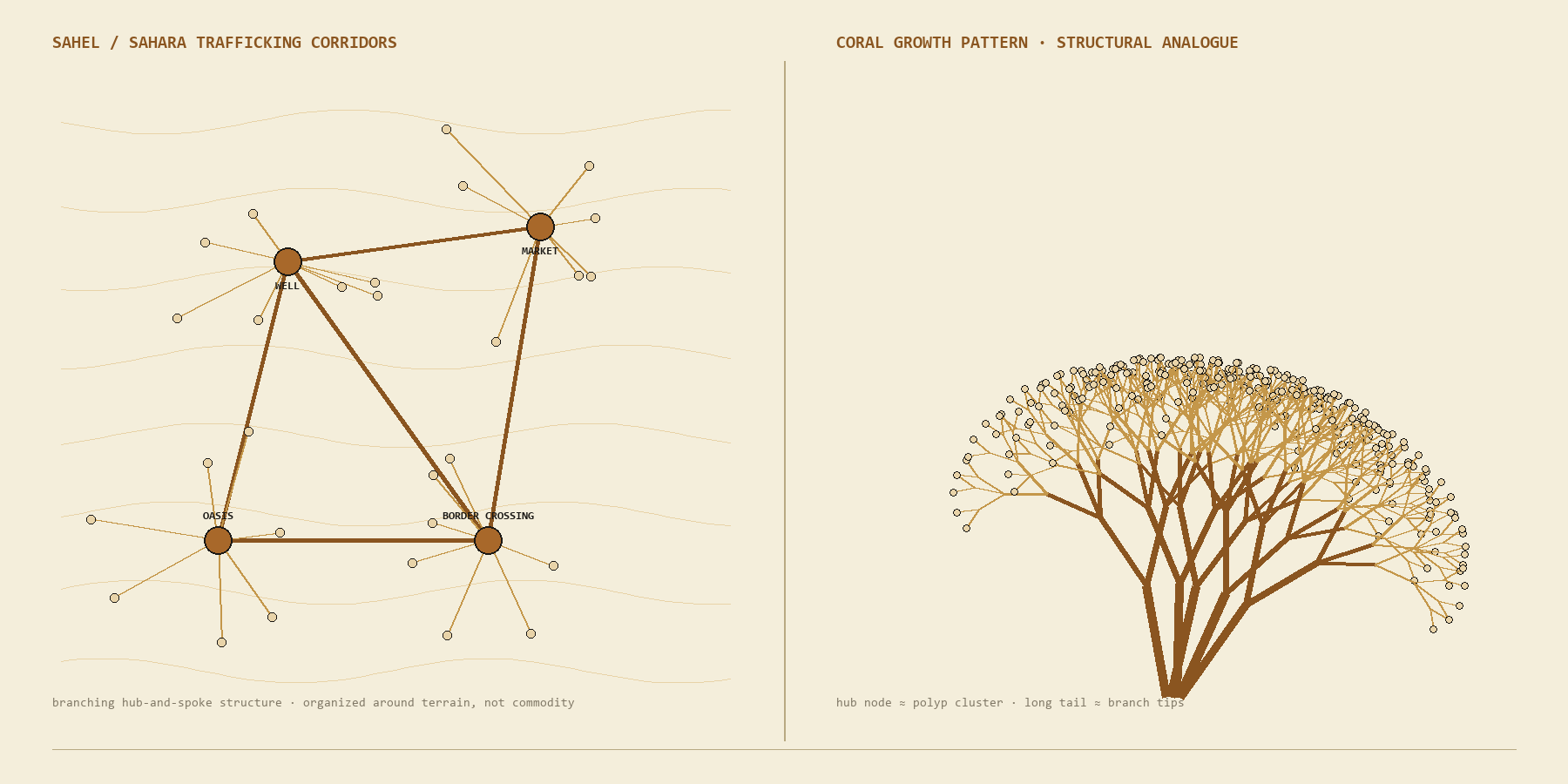
Figure 2. The branching structure of illicit-goods corridors across the Sahel and Sahara, organized around water sources and terrain chokepoints rather than the commodity moving through them: a small number of high-connectivity hub nodes with a long tail of low-connectivity nodes hanging off them. Set beside a recursively branching coral growth pattern to show the structural resemblance. Diagram by the author, generalized from cross-country mobility and network-routing analysis.
Liberia, 2015
Here is the part that this week’s news actually dragged up first, before the mold, before any of it. In 2015, I worked Ebola response geospatial analysis for the National Geospatial-Intelligence Agency, supporting a U.S. Special Operations Command effort during the West Africa epidemic, one of the more public and more purely humanitarian operations I have been part of in this line of work. Liberia was the hardest-hit country, and it was also one of the least forgiving places to try to move anything quickly. There were almost no paved roads outside the capital. Before you could get a field hospital anywhere, you had to figure out where a plane or a helicopter could actually put down at all, and a meaningful part of the job was plotting viable airfields across a country never built to support that kind of access. Terrain was the first obstacle standing between a sick population and the people trying to help them, and the work of plotting where movement was even possible was the same accessibility and mobility analysis I would spend years building for trafficking interdiction, except this time the thing racing the clock was not a smuggler, it was the virus itself, and the good being denied a route was medical care that could not reach people fast enough.
I did not draw the connection at the time. It took reading about Goma this week, and the same “we don’t know where these cases are coming from” language I remembered from a decade earlier, to put the two side by side and recognize they were never different problems wearing different clothes. A smuggler moving weapons across the Sahara, the analyst trying to track him, and a virus moving through an unmapped contact network in eastern Congo are all, mechanically, doing the same thing: finding the path of least resistance through a resource-constrained landscape. This is also why a disease outbreak and a signals-intelligence link-analysis graph get analyzed with the same mathematical toolkit. Degree distribution, betweenness centrality, community detection, none of it cares what is moving through the edges. A contact-tracing graph and a call-detail-record graph are both instances of the same structural problem, something propagating through unevenly connected nodes, and the job is to find the hubs, the bridges, and the parts of the graph you cannot yet see. That last piece is where the real analytic danger lives. A case with no traceable link to anything known does not mean nothing happened. It means the model has a hole in it, an unobserved node quietly extending the graph in the dark, whether that node is a virus’s true patient zero or a trafficking contact who has gone silent.
Finding the key
If I rewind past all of that, my susceptibility to seeing this pattern goes back further than any of it, to chaos theory, which I found as a high school kid in the late 1980s and never fully let go of. Strange attractors. Sensitive dependence on initial conditions. The Mandelbrot set, with its property of infinite, self-similar detail no matter how far you zoom in. Lewis Fry Richardson’s coastline paradox, the discovery that the measured length of a coastline depends on the length of the ruler you use, because a coastline is fractal and does not have a single well-defined length at all.
That last one is almost too on the nose. The Tokyo experiment used an actual coastline as the physical boundary of its diorama, a jagged, self-similar line that Richardson would have recognized instantly, and the mold grew inside that boundary using the same branching, self-similar logic that makes a coastline resist a simple ruler in the first place. Fractal geometry describes the shape. The slime mold’s growth algorithm generates the shape. Chaos theory told a teenager that simple deterministic rules could produce structures that looked, on the surface, wildly complex, and were not, underneath, anything of the sort. That was the seed. Everything since, the Sahel roads, the disease graphs, the mold, the museum lights, the Lego balls, has just been the same argument in a new costume.
Deception is also a pattern
There is a comforting belief, common outside this field, that a person or a network can defeat pattern-of-life analysis simply by behaving unpredictably. Vary the route, change the schedule, go dark for a while, and the theory goes that the analyst loses the thread. It rarely works that way. Deliberate unpredictability is itself a pattern, often more visible than the behavior it was meant to conceal. A node that breaks its own baseline, rerouting through unfamiliar intermediaries or going dark at an unusual moment, produces an anomaly against that baseline, and anomalies are exactly what a graph model is built to surface. You do not need to know someone’s intentions to model them. You need a well-characterized baseline and a sensitivity threshold. It is worth holding that thought against the DRC’s untraceable eighty percent, because the two failure modes are mirror images of each other: a person going dark stands out against a known baseline, while a virus jumping into a population with no baseline at all leaves no anomaly to catch, only a hole.
None of what I have described here requires cognition, conspiracy, or a hidden order to the universe. It requires a resource-constrained system exploring possibility space through local trial and reinforcement, and that kind of system is everywhere once you know to look. A slime mold does not know it is solving a transportation problem. A trafficking network does not organize itself into an efficient branching structure on purpose. A virus has no strategy for finding the gaps in a contact-tracing net. They all arrive at structurally similar answers because there are a limited number of efficient ways to grow a branching, resource-seeking structure under constraint, and nature reaches for the same handful of solutions over and over, in biology, in geography, in a museum case in York, on a convention floor in the Netherlands, and in the deliberately hidden architecture of human networks trying very hard not to look like anything at all.
Back to this morning
I keep coming back to that small win outside my shop this morning, because it is a personal, mundane example of the same thing. Nobody centrally designed the exact configuration of solar panels, charge controllers, and battery banks sitting out there right now. I built it in pieces, over a long stretch of time, adding capacity where the system told me it was bottlenecked and leaving alone what was already working. It is the result of the same reinforce-what-flows, fix-what-doesn’t logic that built a rail network out of a slime mold and a working Lego ball machine out of forty strangers who never spoke to each other before the convention floor.
I should be honest about where this train of thought actually started, and not resolve it too neatly. The current DRC outbreak is Bundibugyo ebolavirus, not the Zaire strain most of the modeling literature was built around, and transmission dynamics, incubation behavior, and case-fatality patterns do not automatically carry over from one Ebola species to another. I am not suggesting they do. I have no model of my own for what happens in eastern Congo next, and I am not offering one here, disguised or otherwise. What I am pointing at is one level down from the epidemiology, at the level of the process itself: something propagating through a population by finding the path of least resistance through whatever local terrain of contact, water access, road, or trust happens to be there, reinforcing where it succeeds and dying out where it doesn’t. That part is not strain-specific, or even disease-specific. It is the same process a slime mold runs in a petri dish, a caravan ran for a thousand years, and forty strangers ran on a Lego convention floor without ever agreeing to. The specific numbers, the specific risk in Goma, are questions for people with better and more current data than I have. What strikes me, sitting out here with a functioning solar array and an old habit of noticing shapes, is how often the answer to a question that took a supercomputer’s worth of computational epidemiology to properly quantify turns out, underneath, to be running on the exact same logic as a brainless yellow mold in a dish.
I do not think that is a coincidence, and I do not think it is mysticism either, whatever my own instinct toward the poetic occasionally wants to claim. It is just what happens when you build things, or grow things, or hide things, or spread through things, under a real constraint, and let the parts that work keep working. The pattern was never hiding. It was just waiting for somebody to notice it was the same pattern wearing a different coat every time, whether that coat was a coastline, a crossing signal, a Lego module, a road through the Sahara that somebody very much did not want me to find, or a virus that, as of this week, nobody can quite find either.