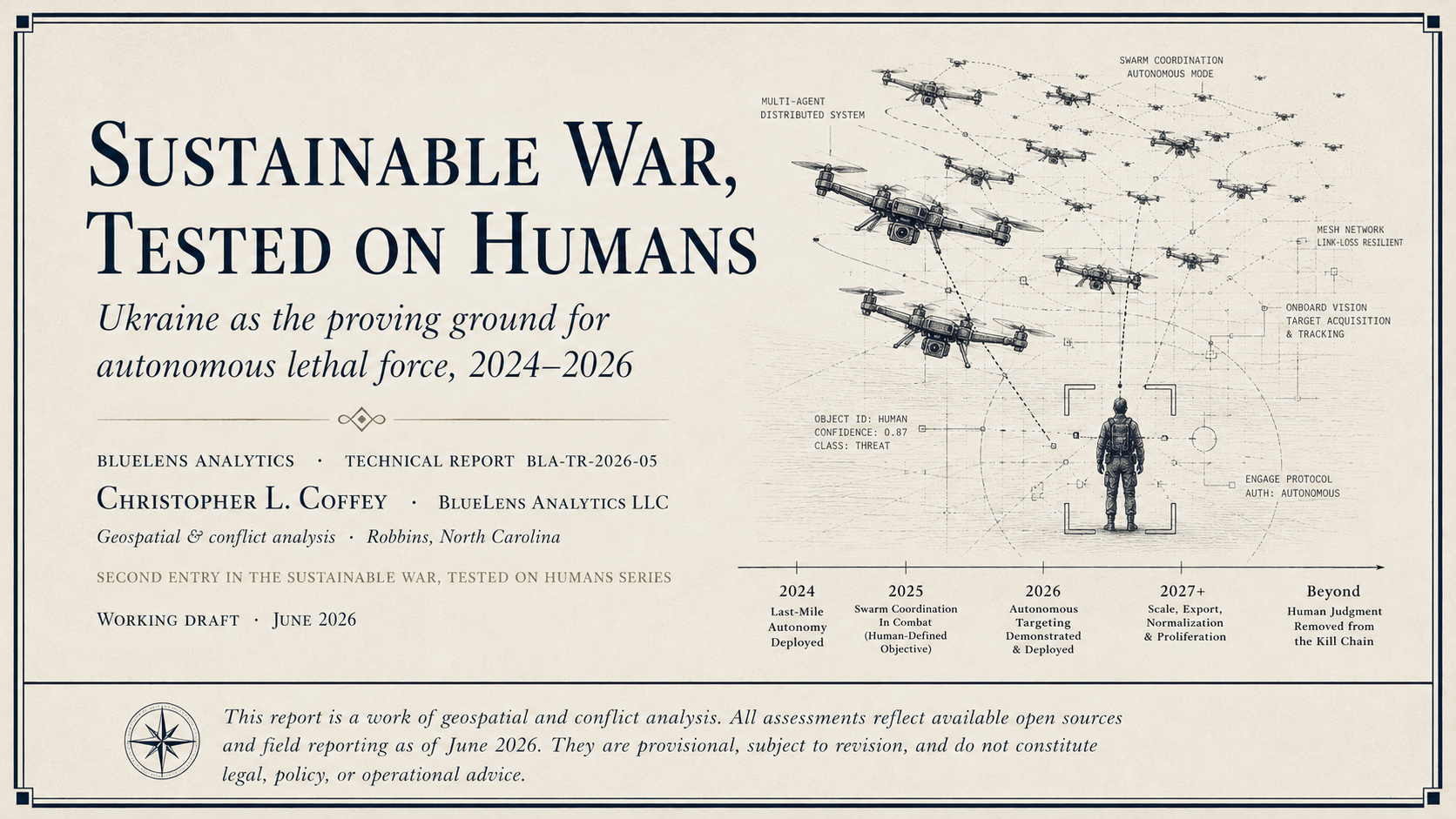
Abstract
The defining output of the war in Ukraine is not a shifted front line. It is a deployed, combat-proven capacity for autonomous lethal force, and the steady removal of the human being from the decision to kill. Over the past year coordinated drone swarms have moved from demonstration to battlefield use, at least one commercial system offers and has flown a fully autonomous targeting mode, and the stated strategic objective of the Ukrainian state is fully autonomous targeting at scale.1
This paper argues that this development is the central fact of the war, and that the other serious charges against the Ukrainian government, its corruption, its ultranationalist symbolism, its accumulation of wartime power, are each real and each a distraction from the one development that does not end when the war ends. The machines that now select or complete engagements do not reason. They are narrow, cheap, and without judgment, and they have been handed lethal authority regardless. The restraints that still keep a human nominally present are not law or treaty. They are the difficulty of target identification, the cost of mass production, and self-imposed policy, and all three are dissolving.
The thesis follows the series. In the Haiti entry, the contracted drone campaign over Port-au-Prince was shown to have imported its tactics from this war.2 Ukraine is the source laboratory. What is validated here is exported, and the law of armed conflict thins at each iteration.
01 — The theater and the thesis
In the dark, on a section of the eastern front, a small group of Ukrainian drones approached a Russian position. No pilot flew them in the old sense. An operator had set the objective. The machines closed the distance, and then, by the reporting, they determined among themselves the moment to strike. Analysts described the episode as part of the first regular battlefield use of swarm technology in the history of war.3
The dominant narrative of this war is an argument about territory, sympathy, and desert. Underneath that argument, with almost no one looking directly at it, a threshold has been crossed. Machines that fly into human beings and kill them are being fielded in numbers no army has ever deployed, and the human operator is being pushed steadily toward the edge of the decision and, in the most advanced systems already flown in combat, off it. The only people watching the leading edge closely are the ones producing combat footage, and combat footage is not where policy or public attention is formed.
The little flying robots will find you and kill you. That is the development.
Everything else on the charge sheet is a rabbit hole leading away from it.
This paper will list the other charges, because they are serious and because the gravity of the central development is measured by how much genuine wrongdoing it eclipses. But the argument is singular. The war has produced, normalized, and begun to export autonomous lethal force, and there exists no law, treaty, or enforceable standard that governs it. That is the emperor with no clothes, and the costume everyone is admiring is the question of who deserves the territory.
02 — Sustainable war, and the proving ground
The series takes its name from Ghost in the Shell: SAC_2045, in which the major powers stabilize their economies by maintaining a permanent, managed state of low-intensity conflict, war waged not toward victory but as an ongoing industrial activity. Stripped of the fiction, the concept names a documented trajectory in the study of armed force: war reconstituted as a market, executed increasingly by actors whose interest lies in continuation rather than resolution.4
The Haiti entry in this series traced that logic through a privatized, self-financing contract regime. Ukraine exhibits a different and, for the future, more consequential property. It is the proving ground. A capability, autonomous lethal force, is validated and refined against a live theater at a scale and tempo no laboratory could reproduce, then normalized by success, then sold. The defining feature is not who pays. It is what is being learned, and where it goes next.
The link between the two cases is not analogy. It is supply chain. The explosive quadcopters flown over Port-au-Prince were adapted from the techniques of this war.5 Ukraine is the source; Haiti is a downstream franchise, the model carried into a captive urban population under even less oversight. A configuration in which frontline methods are imported, validated against a living theater, and carried forward into the next contract is, in operational terms, a development pipeline. The product being refined is autonomous killing. The test range is a war.
The franchise has not stopped at Haiti. The wire-guided and machine-vision methods refined on this front have already surfaced elsewhere: in the 2026 Lebanon fighting, where Hezbollah has fielded fiber-optic drones that observers describe as inspired by their use in Ukraine and that have defeated vehicle-protection and air-defense systems built to stop them, and in the arsenals of larger powers, with Chinese forces reported to be incorporating the same fiber-optic designs.6 Each transfer is the proving ground paying out. A method validated here does not stay here; it becomes a product, a tactic, and then someone else’s war.
These are human beings, on both sides of the optic.
03 — What exists now
Set aside 2024 and early 2025 except as a baseline. The relevant period is the last twelve months, and the relevant change is that the swarm left the laboratory.
The deployed baseline, settled by 2025, is last-mile autonomy. A human pilot selects a target and commits the drone, and an onboard vision model completes the terminal engagement, holding lock through the final hundreds of meters where electronic warfare is most intense, after the radio link is gone. The Fourth Law’s targeting module, costing roughly seventy dollars, raised one brigade’s hit rate from about twenty percent to eighty by tracking targets through shadow and foliage rather than raw pixels.7 The Center for Strategic and International Studies characterized this as a partial deployment of AI, enhancing specific functions rather than enabling full system autonomy. In that architecture, a human still chooses who dies.8
The autonomy spectrum, as deployed.
| Mode | Where the human sits, as reported |
|---|---|
| Remote | A pilot flies the craft over a live video link and commits each strike. The human is the decision. |
| Last-mile | The pilot selects the target and initiates; an onboard vision model completes the terminal engagement and holds lock through jamming after the radio link is gone. |
| Swarm, human-defined objective | An operator sets an objective for many craft at once; the drones coordinate execution, dividing tasks among themselves. The human supervises a process rather than aiming a weapon. |
| Fully autonomous | Drones locate, divide targets among themselves, and strike without per-target human input. Demonstrated, offered commercially, and flown in combat, but not yet the dominant deployed mode. |
Sources as cited in the text. The progression from top to bottom is the removal of the human from the kill decision.
The change since the summer of 2025 is the swarm, and it is no longer hypothetical. Swarmer, a Ukrainian-American firm and the first Ukrainian defense-software company to list on the Nasdaq exchange, states that its software has been proven across tens of thousands of combat missions, trained on more than eighty-two thousand of its own flights, and that it has deployed swarm technology in combat since April 2024. Its systems translate a human-defined objective into coordinated autonomous action. In one mode, operators select targets and the drones execute the strikes on their own. In a fully autonomous mode, the drones attack and negotiate among themselves which craft takes which target.9
The trajectory is not inferred. It is declared. A central objective of Ukrainian drone strategy is the advance toward swarm coordination and fully autonomous targeting, and a deputy defense minister has stated that autonomous systems are already partially implemented.10 The vision articulated by practitioners runs further, to swarms carrying swarms to protect against intercepting swarms, the architecture overseen by AI agents under a single human commander in the rear.11
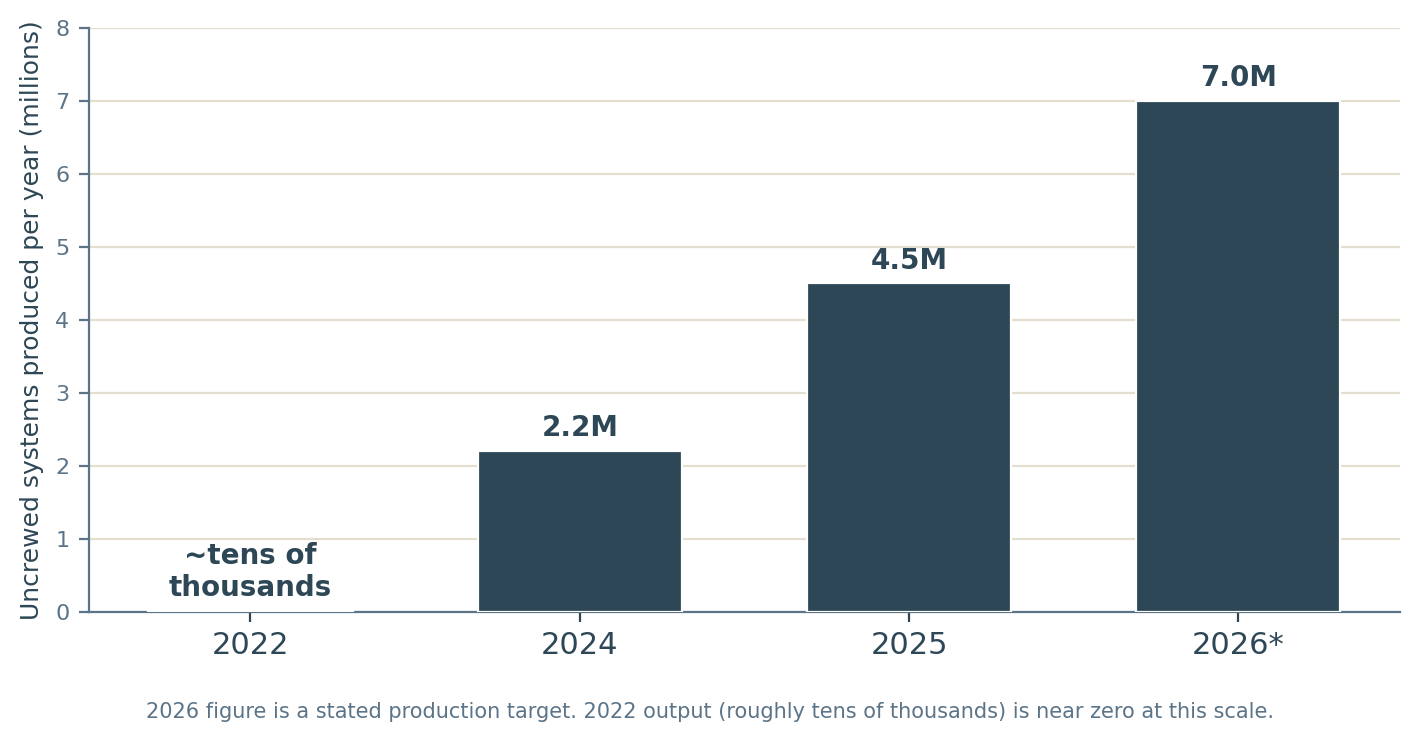
Figure 1 · Annual uncrewed-system production. From a pre-war base of roughly ten manufacturers to an industry of about five hundred, output rose from tens of thousands of units to a stated 2026 target near seven million.
Scale is its own argument. From a pre-war base of roughly ten manufacturers, Ukraine’s drone industry grew to about five hundred firms; output ran near 2.2 million uncrewed systems in 2024, passed 4.5 million in 2025, and is aimed at roughly seven million in 2026, a figure reported to exceed the combined output of NATO.12 Mass at that order is not a stockpile of munitions. It is a standing demand for autonomy, because no human roster can pilot millions of craft one at a time. The economics of the production line require the removal of the pilot as surely as the physics of the jammed link does.
The honest limit must be stated plainly, because omitting it would be the first failure of the argument. Fully autonomous target selection is not yet the dominant deployed mode. Reporting from May 2026 found that fully autonomous strikes remain rare, that the capability shown in company presentations falls apart in conversation with soldiers, and that front-line units deliberately limit their use of artificial intelligence because any battlefield solution must be mass-producible.13 Brave1, the state innovation hub, frames its own goal as autonomous interception while keeping humans in the loop for target control.14 Target identification, the problem of telling a legitimate object from a civilian one, remains substantially unsolved.15
This limit does not soften the thesis. It is the thesis. What stands between the present and routine autonomous lethal swarms operating without meaningful human control is not a prohibition. It is three frictions: the difficulty of target identification, the requirement of cheapness, and a set of revocable policy restraints, such as the refusal to grant deep-strike drones autonomous selection because they overfly civilian cities. Each is an engineering problem or a choice, not a barrier. A 2024 field test already put ten quadcopters over a stretch of ground with instructions to engage what they found; the developer said only that it had not yet been implemented at scale.16 The fully autonomous mode is not a research goal. It is a product, already flown.
04 — The jamming war and the logic of removal
The drive toward autonomy is not ideological. It is an engineering response to a problem the battlefield poses every day, and following the problem is the clearest way to see why the human is being removed by design rather than by choice.
The problem is the link. A radio-controlled drone depends on a signal between craft and operator, and both armies have saturated the front with electronic warfare that severs it. The drone that loses its link goes dark and falls. By May 2024 Ukrainian officers were already saying that drones kill more soldiers on both sides than any other weapon, which made the jammed link the single most valuable thing to defeat.17 Three answers have emerged, and all three point the same direction.
The jamming war, as reported.
| Response to jamming | What it is, and what it costs |
|---|---|
| Machine vision | An onboard computer holds lock and steers into the target through jamming after the operator designates it. Reported in systematic use by some units for six to nine months. The operator must still fly the drone to the point where the machine can lock on. |
| Fiber-optic tether | A hair-thin cable carries an unjammable link out to roughly twenty to thirty kilometers. Immune to jamming, but the spool can cost more than two drones, the cable snaps in wind and terrain, and the tether undercuts the cheap-and-many logic that made FPVs a swarm weapon. |
| Navigate, then autonomy | The drone flies to a general area on satellite-independent guidance, then activates onboard autonomy to find and strike. No link to jam, no cable to break. The fire-and-forget endpoint of the arms race. |
Sources as cited in the text. Each engineering answer to jamming converges on the same destination: removing the link, and with it the human.
The first answer is machine vision. An onboard computer locks the target in the terminal phase and steers the drone into it after the link is gone, which is the last-mile autonomy already described. It works: autonomous terminal-guidance systems from firms such as The Fourth Law have been in systematic use by some units for six to nine months and can be fitted to almost any drone. But it is bounded. The operator must still fly the craft to the point where the machine can lock on, and the system cannot yet aim for a specific weak point on its target.18
The second answer is the fiber-optic tether, a hair-thin cable that carries an unjammable link to twenty or thirty kilometers. It is effective enough that both armies field it, and its tactics have already been exported to Lebanon. But it is a retreat dressed as an advance. The spool can cost more than two drones, the cable snaps in wind and brush, and a tether is the opposite of a swarm: it binds each craft to one operator and one wire. Fields around Pokrovsk are now strung with spent filament to the horizon, which one set of operators compared to an apocalypse movie. A weapon that has to be wired to its pilot is a confession that the link cannot be trusted.19
The third answer resolves the contradiction the first two expose. If the link can be jammed and the cable is too costly to swarm, then the rational move is to remove the link entirely. The drone flies to a general area on satellite-independent guidance, activates its onboard autonomy, finds the target, and strikes. No signal to jam, no cable to break. This is the fire-and-forget endpoint, and the engineers building it are explicit that it is the logical destination of the arms race, not a leap into science fiction.20
It is not, in the builder’s own words, a Terminator-style skynet. It is a cheap onboard computer that finds a human and steers a warhead into him without a person in contact. That is worse, and the next section explains why.
The point of the section is the vector, not any single system. Every serious engineering response to jamming converges on cutting the human contact, because the human contact is the vulnerability. Autonomy is not being chosen over a safer alternative. It is being arrived at as the solution to a problem the war renews every morning, which is exactly why no appeal to restraint has slowed it. The restraint runs against the physics and the economics at once.
05 — The collapse of meaningful human control
The standard reassurance is that a human remains in the loop. That reassurance is becoming a formality, and the swarm is what hollows it out.
In single-drone warfare the operator is the kill decision. He sees the target, commits, and can abort. Whatever else is wrong with that arrangement, the judgment is real and located. The swarm dissolves that location. The entire purpose of a swarm is to let one operator direct dozens or hundreds of craft, which is possible only if each craft executes most of its task without per-target human input. The human stops being the trigger and becomes a supervisor of an automated process. As one defense analysis put it, when the system surfaces and prosecutes targets faster than a person can read a situation report, the nominal human in the loop becomes an approval node in a process he did not design, cannot fully audit, and has no time to interrogate. The distinction between human control and human endorsement becomes very thin.21
Consider the supervising operator removed. He has a seizure. The link is jammed, which on this battlefield is the expected condition. The swarm was built to finish the mission anyway. The gap between a human supervising and no human is a configuration setting, not a different machine.
That scenario is not a thought experiment laid on top of the technology. It is the technology’s design requirement read back literally. A swarm built for autonomous coordination is engineered to complete its mission when human contact is lost, because losing human contact under jamming is the normal case the autonomy exists to survive. To ask what the swarm does when the operator is gone is to ask what it was built to do. It continues. It divides the targets. It strikes. The operator’s presence was a courtesy the architecture extends and can withdraw without modification.
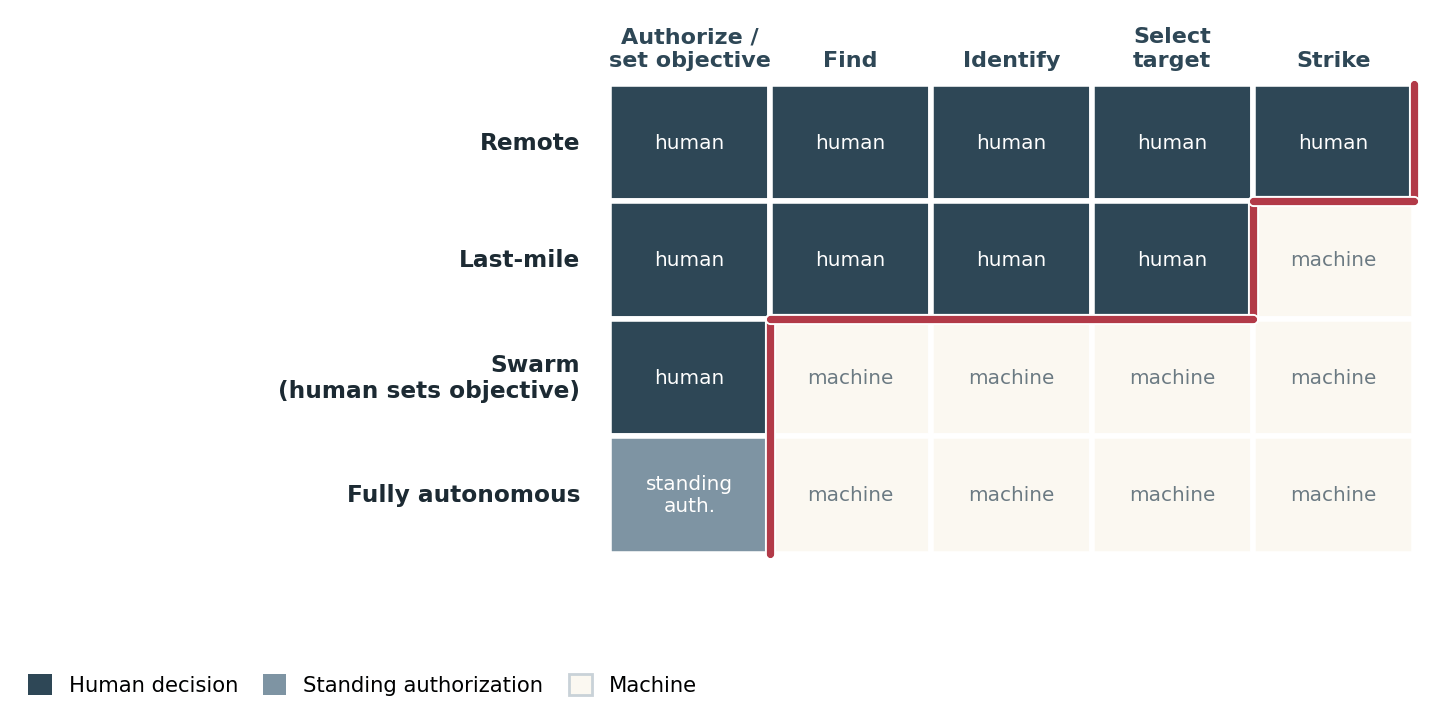
Figure 2 · Where the human drops out of the kill chain. The red line is the human-control frontier. It moves left as autonomy increases: the strike is handed off first, then the finding, identifying, and selecting of targets, until the human role is reduced to a standing authorization issued before any specific target exists.
This is the governance void at the center of the report. The law of armed conflict, its principles of distinction, proportionality, and precaution, presupposes a human judgment at the moment force is applied. The systems now in combat are built to compress and ultimately remove that judgment, deliberately, as a countermeasure to jamming and a multiplier of operator span.22 The capability has arrived first, at scale, in a war the funding world is materially sponsoring, and it is being commercialized and exported by firms raising capital on Western exchanges. The order of operations is the danger. The weapon is being normalized before anyone has decided whether it should exist.
06 — Force without judgment
The instinct on first contact with this material is to imagine a thinking machine. That instinct is wrong, and correcting it makes the danger worse, not better.
These systems are not frontier reasoning models. They are not chatbots given a body. They run narrow, specialized, edge-deployed software: computer vision for recognition and tracking, autonomous navigation, and coordination logic. Swarmer’s system is trained to replicate top-pilot performance from a corpus of past missions.23 That is imitation of a behavior, not comprehension of a situation. The seventy-dollar module does not understand what it is looking at. It locks a shape and holds the lock.
The builders themselves say as much. The autonomy being fielded is, in the words of one of its leading developers, not a Terminator-style skynet but a small, cheap onboard computer that identifies a target and steers into it without a person in contact past a certain point.24 That description is meant to reassure. It should do the opposite.
A thinking system might in principle be argued with, constrained by reasons, made to weigh a child against a combatant. A narrow tracker cannot. It has no concept of a child, a surrender, a medic, a wounded man who is no longer a threat. It executes a pattern match and delivers a warhead. The whole moral content of the kill, the part the law exists to govern, lives in a human judgment that the architecture is built to remove, and the thing substituted for that judgment is not a lesser intelligence but no intelligence at all.
The horror is not Skynet. It is a reflex with an explosive payload, mass-produced, and the deliberate removal of the one element in the chain capable of recognizing a reason not to fire.
Professional targeting exists to prevent exactly this. A lawful strike against a target among civilians is gated by positive identification, a collateral-damage estimate calibrated to weapon and environment, a proportionality judgment, and a post-strike assessment. Every step is an act of human judgment. A system that cannot reliably identify a target, deployed at a tempo no human can supervise, configured to proceed after human contact is lost, is structurally incapable of performing any of them. The law is not repealed. It is rendered inapplicable by the architecture of the weapon.
07 — The human ledger
The casualty record must be stated as the monitors record it, including where it complicates an intuitive frame, because a piece that misstates it forfeits the argument to the first analyst who opens the data.
In the documented ledger, the civilians killed by drones in this war are overwhelmingly Ukrainian, struck by Russian systems on Ukrainian-controlled ground. The UN Human Rights Monitoring Mission found that short-range drones killed at least 395 civilians and injured 2,635 between February 2022 and April 2025, the vast majority from Russian attacks.25 For 2025 the mission documented at least 2,514 civilians killed and 12,142 injured, a roughly 31 percent rise over the prior year, with short-range FPV drones the leading cause of civilian casualties near the front.26 Roughly 97 percent of casualties occurred in territory controlled by Ukraine.27
Whose drone kills whom is not the argument of this paper and must not be bent to serve it. Ukraine is the industrial engine of the technology and, in the casualty column, mostly its victim. That direction is not a mitigation of the argument. It is the argument, stated correctly, and it rests on three findings the data fully supports.
First, drones have become the leading cause of civilian death in a major interstate war. Second, the monitoring mission has assessed that the high civilian toll from short-range drone attacks indicates deployment inconsistent with the principles of distinction and precaution, and that some strikes appeared to target civilians and clearly marked medical transport deliberately, which would constitute war crimes.28 Those findings attach predominantly to Russian operations, but a norm degraded in practice is degraded for the field, and the technology under refinement on both sides is one whose defining trajectory is the removal of the human from the engagement. Third, Ukraine is the principal developer and exporter of that technology even as it is, in the ledger, mostly the one being killed by it. That asymmetry is the part the celebratory coverage of Ukrainian drone innovation does not sit with.
08 — The case for the defense, and why it fails
Intellectual honesty requires the strongest version of the opposing argument, because it is not frivolous. Russia launched the invasion. The war is existential for Ukraine. Electronic warfare is so pervasive that autonomy is not a luxury but a necessity, the only way a drone reaches its target once the link is jammed. The systems are cheap, they work, and a country fighting for survival reached for the tool that functions. On this view the autonomy is forced, the alternative is defeat, and moral hand-wringing about the kill chain is a comfort available only to those not under bombardment.
The argument is sound on its own ground and does not reach the report’s claim. It defends Ukraine’s use of the weapon in its own defense. It does not defend the proving-ground dynamic, which is the concern here. Three things fall outside it.
First, autonomy under jamming does not by itself require the absence of meaningful human control. Holding the human to the target-selection decision while the machine handles terminal guidance is exactly the deployed last-mile model, and it is cheap.29 The migration toward full autonomous selection is a step beyond what jamming compels. Second, the commercialization and export are not defensive necessity. A firm listing on Nasdaq and scaling its autonomy software to NATO-aligned states is not fighting for Ukraine’s survival; it is seeding a capability into the wider world.30 Third, the erosion outlives the war. A norm relaxed, a weapon normalized, a standard never written: these do not revert when the front stabilizes. The defensive necessity is real and bounded to Ukraine’s own use. The proving ground is not bounded at all.
09 — The catalog of distractions
The following charges are each serious. Each would, in another country, dominate the coverage. Each is, for this paper, secondary, and they are registered here precisely so that the weight of the central development can be measured against the wrongdoing it eclipses.
Corruption, continuous rather than episodic. The record runs from the 2012 Kvartal 95 offshore network documented in the Pandora Papers,31 through the 2023 wartime procurement scandals over inflated army food and clothing,32 to the November 2025 Energoatom case, in which the president’s own former business partner allegedly organized roughly one hundred million dollars in kickbacks, exposed by Ukraine’s own anti-corruption bureau.33 The recurring beneficiaries are long-standing associates, the signature of an emergent network rather than a single scheme. President Zelensky has denied wrongdoing and has not been charged.34
Ultranationalist lineage. In May 2026 the government named a serving military unit for the Ukrainian Insurgent Army, responsible for the ethnic cleansing of Polish civilians in Volhynia between 1943 and 1945,35 and refused Poland’s request to reconsider, prompting Warsaw to revoke its highest honor from the president.36 A senior figure in the Presidential Office answered by returning a Polish decoration and calling Warsaw’s objection an “unfriendly act,” casting the descendants of the victims as the offending party.37 Separately, the Azov formation, whose far-right and partly neo-Nazi origins are acknowledged even by its defenders, has been mainstreamed into a brigade and, in 2024, re-armed by the United States after a six-year prohibition. The Russian designation of Azov as terrorist is propaganda and is not adopted here; the documented pattern is a state that repeatedly elevates ultranationalist lineages and a West that accommodates it.38
The one-directional accumulation of power. Under martial law the government banned eleven opposition parties including the largest, consolidated broadcast news into a single state channel, sanctioned its principal rival, and let the elections that would test its mandate lapse after the presidential term expired in May 2024. In 2025 it moved to curtail the independence of the anti-corruption agencies and was forced into reversal by protest.39 Emergency power has flowed up in every crisis and has not returned.
Each of these is real. None of them is a machine that will decide, on its own, to kill you.
10 — The accountability vacuum
It would be wrong to say no one is trying to govern this. The failure is more specific, and more telling, than absence.
There is an elaborate diplomatic apparatus. The Group of Governmental Experts on lethal autonomous weapons, standing under the Convention on Certain Conventional Weapons since 2016, has produced a rolling text whose latest draft would bar employing weapons without context-appropriate human control and judgement.40 The UN General Assembly First Committee has passed a resolution three years running, the November 2025 vote 156 in favor to 5 against, warning of an arms race and of proliferation to non-State actors.41 The International Committee of the Red Cross and the UN Secretary-General have jointly called for a binding instrument concluded by the end of 2026, and the ICRC would prohibit outright the systems that select and apply force to human targets.42
And none of it binds anyone. The Convention works by consensus, which lets a handful of states fielding or funding the weapons stall any mandate to negotiate. A bloc of forty-two states led by Brazil declared in 2025 that it was ready to move ahead towards negotiations; readiness is as far as the effort has gone.43 The group has deliberated since 2016 and produced no treaty, no prohibition, and no enforceable definition of the meaningful human control its own participants invoke.
The gap, then, is not between law and lawlessness. It is between deliberation and deployment. While the experts refine a rolling text in Geneva, the weapon rolls off the lines by the millions, the autonomy software lists on a stock exchange, and the capability is taught to allied armies in live exercises, where Ukrainian operators acting as opposing force have dismantled NATO units outright.44 The most authoritative criticism available, a finding by UN human rights monitors that drone attacks are breaching the principles of distinction and precaution, issues as a report. A report touches none of the production lines. The institutions that might halt the development can describe it. They cannot reach it.
11 — Implications: the exportable template
The danger of Ukraine is not confined to Ukraine. If a state can field autonomous lethal mass at the scale of millions of units, push the human steadily out of the kill decision, validate the result against a living theater, and incur no enforceable legal or political penalty, then a template has been established.
It is already in circulation. The same drone tactics were imported into Haiti and flown against a captive urban population;45 the same fiber-optic methods have surfaced in Lebanon and in the arsenals of larger powers.46 Each iteration that passes without consequence normalizes the next.
That is what makes the comparison more than literary. The fiction’s warning was never about a particular war; it was about a configuration of incentives that, once assembled, reproduces itself. Ukraine in 2024–2026 is the configuration in its most advanced form: lethal autonomy proven at scale, the human removed by design, the capability commercialized and exported, and no law to stop any of it.
The recommendations follow from the diagnosis, and none is primarily about Ukraine. A binding standard for meaningful human control over the selection and engagement of targets, with autonomous target selection against persons prohibited outright, which is the line the ICRC has already drawn and states have failed to adopt. Export controls that treat autonomy software as the dual-use weapon technology it is, rather than as a startup’s commercial product. Independent overhead and signals monitoring of autonomous-weapons proliferation, the kind of geospatial accounting that can document a capability before it is denied. And a recognition, at the level of policy rather than footage, that the question already sitting unanswered at the center of modern war is the simplest one in this paper.
What happens to the swarm when the operator has a seizure. The honest answer is that the swarm was built so that it would not matter. That is the development. It does not end when the war does.
Methodology & source tiers. This paper synthesizes open-source reporting under a three-tier scheme. Tier 1 (primary / official): UN OHCHR / HRMMU protection-of-civilians reporting (2025–2026), UN Office for Disarmament Affairs and General Assembly First Committee records, the ICRC position paper on autonomous weapons (March 2026), the US State Department’s 2024 determination on the Azov Brigade, the Center for Strategic and International Studies, and the National Anti-Corruption Bureau of Ukraine. Tier 2 (specialist analytical): the Atlantic Council, the Centre for Eastern Studies (OSW), the Georgetown Security Studies Review, IEEE Spectrum, GIS Reports, Article 36, Stop Killer Robots, ICT4Peace, and Carnegie Endowment for International Peace. Tier 3 (press / secondary): Reuters, the Associated Press, Bloomberg, Agence France-Presse, the Kyiv Independent, Kyiv Post, EUobserver, Militarnyi, Defense Express, DroneXL, Interesting Engineering, Interfax-Ukraine, and the Organized Crime and Corruption Reporting Project. All allegations concerning specific firms or individuals are attributed to their source and presented as reported claims, not findings of fact. No claim of criminal conviction is made except where adjudicated. Casualty figures are point-in-time and should be treated as lower-bound estimates, as the cited bodies themselves treat them. Two cautions are load-bearing. First, autonomy claims are bounded to what the reporting supports: fully autonomous target selection is documented as demonstrated, commercially offered, and flown in combat, but not as the dominant deployed mode, and the text preserves that distinction throughout. Second, the casualty direction is presented as the monitoring bodies record it, with the civilians killed by drones in this war overwhelmingly Ukrainian and struck by Russian systems; the indictment of the apparatus does not rest on a contrary claim. An unverified third-party allegation concerning a commercial AI model and a strike outside this theater was reviewed and excluded as unverifiable.
-
Militarnyi, “Ukraine Uses Self-Deciding Drone Swarm Against Russian Forces,” 2026. The report describes a three-drone group that independently determined the moment to strike, and states that swarm attacks had been used on the battlefield for most of the preceding year, characterized by analysts as the first known regular combat use of the technology. ↩
-
BlueLens Analytics, “Sustainable War, Tested on Humans — Haiti,” BLA-TR-2026-04 (June 2026), §5, citing reporting that the explosive-quadcopter tactics used over Port-au-Prince were adapted from the war in Ukraine. ↩
-
Militarnyi, “Ukraine Uses Self-Deciding Drone Swarm Against Russian Forces.” (see note 1). ↩
-
On war reconstituted as a self-sustaining commercial market, see Sean McFate, The New Rules of War (2019) and The Modern Mercenary (2014); P. W. Singer, Corporate Warriors (2003). The phrase “sustainable war” is drawn from Ghost in the Shell: SAC_2045 (2020), as developed in the Haiti entry of this series. ↩
-
BlueLens Analytics, “Sustainable War, Tested on Humans — Haiti,” BLA-TR-2026-04. (see note 2). ↩
-
On Hezbollah’s use of fiber-optic FPV drones in the 2026 Lebanon fighting, described as inspired by their use in Ukraine and reported to have defeated vehicle-protection and air-defense systems, see open-source compilation at “Fiber optic drone,” Wikipedia (June 2026), drawing on Israeli military sourcing; on Chinese incorporation of fiber-optic drones, see Atlantic Council, “Fiber-optic drones have emerged as critical kit for both Russia and Ukraine,” 24 February 2026. ↩
-
DroneXL, “Ukraine’s AI Drone Revolution Hits Hardware Reality,” 26 October 2025. The Fourth Law’s TFL-1 module, costing roughly $70, raised one brigade’s hit rate from about 20 to 80 percent; a human pilot still selects the target and initiates the mission. ↩
-
Center for Strategic and International Studies, “Ukraine’s Future Vision and Current Capabilities for Waging AI-Enabled Autonomous Warfare,” 20 March 2025. AI deployment is partial in scope, enhancing functions such as target recognition and last-mile navigation rather than enabling full system autonomy. ↩
-
Swarmer Series A announcement, Business Wire, 16 September 2025; Kyiv Post, 15 May 2026; EUobserver, 18 May 2026. Swarmer, the first Ukrainian defense-software firm to list on the Nasdaq exchange, reports software proven across tens of thousands of combat missions and trained on more than 82,000 of its own; it offers a fully autonomous mode in which drones divide targets among themselves, and states it has deployed swarm technology in combat since April 2024. ↩
-
“How Artificial Intelligence is Transforming Conflict and Peace,” Vision of Humanity / Institute for Economics and Peace, June 2026, citing Deputy Defense Minister Yuriy Myronenko on autonomous systems being “partially implemented” and a stated objective of swarm coordination and fully autonomous targeting. ↩
-
IEEE Spectrum, “The Coming Drone-War Inflection in Ukraine,” 24 March 2026, relaying the vision of swarms carrying swarms to defend against intercepting swarms, overseen by AI agents under a single human commander. ↩
-
Production figures synthesized from the Centre for Eastern Studies (OSW), “Game of drones,” October 2025 (about 2.2 million uncrewed systems in 2024, projected past 4.5 million in 2025; new aerospace firms numbering 41, 132, and 183 across 2022–2024); Georgetown Security Studies Review, July 2025 (monthly FPV capacity rising from 20,000 to 200,000); Bloomberg, reported via Army Recognition, November 2025 (about four million per year, exceeding NATO’s combined output); and 2026 production-target reporting of roughly seven million. ↩
-
EUobserver, “AI helps Ukrainian drones against Russian signal jamming, but fully autonomous strikes remain rare,” 18 May 2026. Front-line accounts indicate fully autonomous strikes remain uncommon and that units limit AI use because a battlefield solution must be mass-producible. ↩
-
Kyiv Post, “Ukraine Developing AI-Driven Drone Swarms to Counter Russian Shaheds,” 1 April 2026. The state innovation hub Brave1 describes a goal of fully autonomous interception while retaining humans in the loop for target control. ↩
-
Benjamin Cook, “Last-Mile Targeting in Ukraine’s Drone War: AI, Edge Computing, and the Limits of Autonomy,” 2026: autonomous target acquisition at scale is not yet a battlefield reality, leaving human-in-the-loop the only scalable option at present. ↩
-
The National Interest, June 2026, reporting a 2024 operational test of ten autonomous quadcopters directed to engage targets across a stretch of ground; the developer stated the system was tested but not implemented at wider scale. ↩
-
Ukrainian military officials stated in May 2024 that drones kill more soldiers on both sides than any other weapon; widely reported, e.g. Interesting Engineering, 30 March 2026. ↩
-
Defense Express, “How Ukrainian FPV Drones With Automated Terminal Guidance Work,” 2026. Machine-vision guidance counters jamming by stabilizing flight and holding lock through the terminal dive, but the operator must still guide the drone to the lock-on point, and the system cannot yet strike specific vulnerable points of a target. ↩
-
Atlantic Council, 24 February 2026; GlobalSecurity.org, 24 April 2026; DroneXL, 23 March 2026. Fiber-optic tethers are immune to jamming and strike to roughly 20–30 kilometers, but cables snap under stress, the spool can cost more than two drones, and the tether undercuts the cheap-and-many logic of FPV swarms; both Russia and Ukraine field them, and dual fiber-radio control has emerged to manage cable failure. ↩
-
GlobalSecurity.org, “Ukraine UAV — Autonomous Guidance: The Rise of the Machines,” 24 April 2026, relaying Yaroslav Azhnyuk on autonomous terminal-guidance systems (citing The Fourth Law) in systematic unit use for six to nine months, and on autonomy as the endpoint of the electronic-warfare arms race once the link is jammed and fiber is priced out: “not a Terminator-style skynet” but a cheap onboard computer that turns the drone into a fire-and-forget munition. ↩
-
“Future Warfare: The Autonomy Spectrum,” RobotToday, 16 March 2026, on the human supervisor becoming an approval node within an automated process and the thinning distinction between control and endorsement. ↩
-
Cook, “Last-Mile Targeting in Ukraine’s Drone War.” (see note 15). ↩
-
Swarmer corporate disclosures; Kyiv Post and EUobserver, 2025–2026. (see note 9). ↩
-
GlobalSecurity.org, “Ukraine UAV — Autonomous Guidance” (Azhnyuk), 24 April 2026. (see note 20). ↩
-
UN Human Rights Monitoring Mission in Ukraine (HRMMU/OHCHR), reporting that short-range drone attacks killed at least 395 civilians and injured 2,635 between February 2022 and April 2025, the vast majority in Russian attacks, 26 June 2025. The mission assessed that the toll indicates deployment inconsistent with the principles of distinction and precaution, and that some attacks appeared to target civilians and clearly marked medical transport. ↩
-
HRMMU/OHCHR, Protection of Civilians monthly updates, reporting 2025 civilian casualties of at least 2,514 killed and 12,142 injured, a roughly 31 percent rise over 2024, with short-range FPV drones the leading cause of civilian casualties near the front line. ↩
-
HRMMU/OHCHR reporting, mid-2025, recording that roughly 97 percent of civilian casualties occurred in territory controlled by Ukraine. ↩
-
HRMMU/OHCHR drone-casualty reporting, 26 June 2025. (see note 25). ↩
-
DroneXL, “Ukraine’s AI Drone Revolution Hits Hardware Reality,” 26 October 2025. (see note 7). ↩
-
Swarmer states its intent to bring autonomous swarming to every unmanned vehicle in Ukraine and across NATO-aligned nations (Business Wire, 16 September 2025); Kyiv Post, May 2026, reports Ukrainian drone operators acting as opposing force dismantling NATO units in the Aurora 2026 and Hedgehog 2025 exercises. ↩
-
Pandora Papers reporting by the Organized Crime and Corruption Reporting Project and the International Consortium of Investigative Journalists, October 2021, with investigative work by Slidstvo.Info, documenting a Kvartal 95 offshore network dating to 2012 and a pre-inauguration share transfer to a future senior presidential aide. ↩
-
Reuters, the Associated Press, CNN, and Al Jazeera, January–September 2023, on inflated wartime procurement and the resignations culminating in the dismissal of Defense Minister Oleksii Reznikov, who was not personally implicated. ↩
-
National Anti-Corruption Bureau of Ukraine (“Operation Midas”); Carnegie Endowment for International Peace, Lawfare, the Kyiv Independent, and the Associated Press, November 2025–May 2026, on roughly $100 million in alleged kickbacks around the Energoatom state energy company implicating a former business partner of the president. President Zelensky has not been charged. ↩
-
Zelensky’s denial of wrongdoing in connection with the offshore reporting was carried by Ukrinform, October 2021; he has not been charged. ↩
-
Timothy Snyder estimates 40,000–60,000 Polish civilians killed in Volhynia in 1943; Ivan Katchanovski, Journal of Slavic Military Studies (2012), assesses the killings as ethnic cleansing. ↩
-
Reuters, the Kyiv Independent, and TheJournal.ie, June 2026, on the naming of a serving unit for the Ukrainian Insurgent Army and Poland’s revocation of the Order of the White Eagle from President Zelensky. ↩
-
Reuters, Interfax-Ukraine, and Kyiv Post, reported via Ground News, 20 June 2026: a senior figure in the Presidential Office returned a Polish decoration and characterized Warsaw’s decision as an “unfriendly act.” ↩
-
Atlantic Council (2020) on Azov’s origin in the neo-Nazi group “Patriot of Ukraine”; the Associated Press and PBS NewsHour (June 2024) on the United States lifting its arms prohibition; Al Jazeera (August 2022) on Russia’s terrorist designation. Independent fact-checking finds the brigade’s present ideological character contested rather than settled. ↩
-
European Conservative, The Week, and NPR (2022) on the suspension of eleven parties and consolidation of broadcast news; the Kyiv Independent (February 2025) on sanctions against Petro Poroshenko; Radio Free Europe/Radio Liberty (2024–2025) on the lapse of the presidential term in May 2024; the Associated Press (November 2025) on the 2025 attempt to curtail the anti-corruption agencies, reversed after public protest. ↩
-
The Group of Governmental Experts on lethal autonomous weapons, established under the Convention on Certain Conventional Weapons in 2016, works by consensus on “a set of elements of an instrument, without prejudging its nature,” to report to the Seventh Review Conference in 2026. Its latest “rolling text” would bar employing weapons without “context-appropriate human control and judgement.” See UNODA briefing, October 2025; Article 36, December 2024. ↩
-
On 6 November 2025 the UN General Assembly First Committee adopted a resolution on autonomous weapons for the third consecutive year, 156 states in favor, 5 against, 8 abstentions, expressing concern over an emerging arms race and proliferation, including to non-State actors. Stop Killer Robots, 6 November 2025. ↩
-
The President of the International Committee of the Red Cross and the UN Secretary-General have jointly called for a legally binding instrument concluding by the end of 2026; the ICRC position would prohibit autonomous weapons that select and apply force to human targets, and those whose effects cannot be adequately predicted. ICRC position paper on autonomous weapon systems and IHL, March 2026. ↩
-
At the September 2025 GGE session a bloc of 42 states led by Brazil, roughly a third of the 128 parties to the Convention, declared itself “ready to move ahead towards negotiations” on the basis of the rolling text; the consensus rule allows a small number of states fielding or funding the weapons to block a negotiating mandate. Stop Killer Robots / ICT4Peace, September–October 2025. ↩
-
Swarmer export statements (Business Wire, 16 September 2025); Kyiv Post on NATO exercises, May 2026. (see note 30). ↩
-
BlueLens Analytics, “Sustainable War, Tested on Humans — Haiti,” BLA-TR-2026-04. (see note 2). ↩
-
On fiber-optic export to Lebanon and Chinese adoption: “Fiber optic drone,” Wikipedia; Atlantic Council, 24 February 2026. (see note 6). ↩