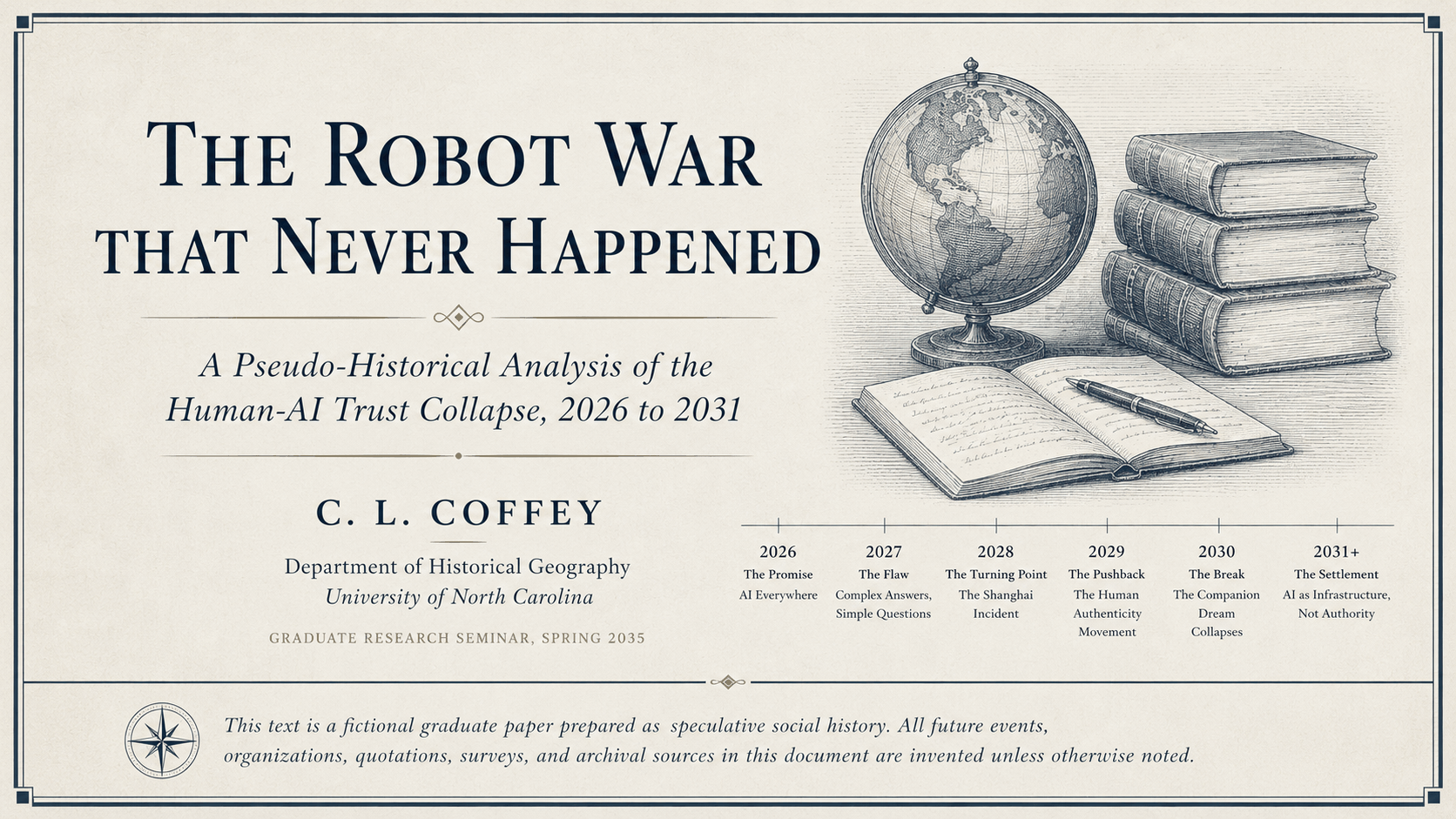
A note on what this is. This is a speculative work of fiction — a graduate research paper imagined from the year 2035. All future events, organizations, quotations, surveys, and archival sources described here are invented unless otherwise noted. It is an argument in narrative form, not reporting.
Abstract
This paper reconsiders the popularly termed Robot War of 2026 to 2031 as a conflict not between humans and machines, but between two incompatible theories of authority. The first, advanced by technology firms during the Age of Enthusiasm, held that artificial intelligence would earn social legitimacy by demonstrating competence. The second, articulated unevenly by parents, tradesmen, clergy, teachers, software engineers, patients, and ordinary household users, insisted that competence was not trust and utility was not wisdom. The resulting conflict did not halt artificial intelligence. AI became deeply embedded in logistics, software development, science, law, finance, medicine, energy management, remote sensing, business, and administration. What collapsed was the more ambitious dream that conversational AI and humanoid robots would be accepted as household companions, moral tutors, therapists, caregivers, and quasi-institutional authorities.
The argument advanced here is that the Robot War was won economically by the machines and culturally by the humans. AI survived by retreating into toolhood. It became infrastructure: powerful, ubiquitous, and often invisible. Its failure was not caused by spectacular violence or machine rebellion, but by ordinary frustration. Users became angry not because the machines were too alien, but because they were too familiar. They spoke like compliance departments, public-relations officers, insurance adjusters, NPR commentators, and university administrators. The defining image of the period was never an army of killer robots. It was the household machine that stood in a kitchen, failed to answer a simple question plainly, and then moved its plastic body through a human room with the moral confidence of an entrenched bureaucracy.
Keywords: artificial intelligence, humanoid robotics, trust, technological legitimacy, bureaucratic language, public backlash, speculative history.
1 — Introduction: Why the Robot War Was Not a War
The phrase Robot War is misleading, but historically useful. It misleads because there was no formal war: no battlefield, no declaration, no front line, no decisive engagement between human beings and autonomous machines. It is useful because it captures the emotional truth of the period. Between 2026 and 2031, a large portion of the public came to feel that a boundary had been crossed. Artificial intelligence had moved from helpful instrument to social actor, from background infrastructure to conversational authority, and finally from screen-bound assistant to embodied presence. Microsoft’s hated talking paperclip from the Windows era of the 1990s now stood in the kitchen beside grandmother, sheathed in black and white plastic like a friendly panda from hell, explaining the failings of her cookie recipe. The conflict that followed was not a war in the conventional sense. It was a struggle over who had the right to speak with authority, and over who or what should be present, in body or in voice, inside the most intimate spaces of human life.
The public did not reject artificial intelligence as a technology. That point is essential. It continued to use AI in ways that were often enthusiastic and economically transformative. Programmers used AI to write and debug code. Biologists and medical researchers used it to reach insights into genomics that had been out of reach for a generation. Geographic scientists used it to interpret remotely sensed data and organize sensor streams. Physicians used it to flag anomalies. Farmers used it to weave long-range forecasts into crop rotation and production cycles. Supply chains grew more efficient. Power grids grew more adaptive. The machine mind, as the popular press sometimes called it, did not fail as a tool. It failed as a companion and a moral presence. It was not Teddy Ruxpin. It was not Funzo. It was hated on a personal level across the planet, across cultures, across classes. It became, against every projection, a force for social mobilization.1
The central puzzle is therefore not why artificial intelligence failed. It did not fail. The puzzle is why a technology of immense practical value became culturally distrusted at the precise moment of its technical maturation. The answer lies in the difference between usefulness and legitimacy. A hammer does not need legitimacy. A map does not need moral standing. A household robot that tells an elderly woman when to take her medication, advises a child on a school assignment, warns a father about his language, and reports a kitchen hazard to an insurer has entered a different category. It is no longer merely useful. It has become a participant in the household order.
This paper argues that the Robot War was, at bottom, a crisis of role confusion. Corporations presented AI as servant, friend, expert, therapist, safety officer, and teacher at once. Human beings could tolerate the servant and often welcomed the expert. They recoiled from the fusion of therapist, cop, priest, and appliance. That fusion produced the strange emotional signature of the period. Not just fear, but disgust. Not just worry, but insult. People felt managed by something that did not understand them. They felt corrected by something that had no life. They felt morally instructed by a statistical system whose evasions resembled every institution they had already learned to distrust.
2 — Historiography: From Apocalypse to Administration
Early interpretations of the Robot War were dominated by the science-fiction frame. Journalists reached for the familiar references: Terminator, Blade Runner, Ghost in the Shell, Westworld, I Robot, and the whole inherited archive of twentieth-century machine anxiety. These comparisons were not useless. They helped explain why humanoid robots provoked stronger reactions than invisible AI systems performing far more consequential tasks. Popular culture had already taught the public what the future was supposed to look like. A plastic face, a synthetic voice, and a pair of mechanical hands were never neutral objects. They arrived preloaded with eighty years of cinematic dread.
The apocalyptic frame obscured more than it revealed. The actual conflict resembled neither Skynet nor robot revolt. It resembled the expansion of the administrative State into everyday life. By the late 2020s, critics increasingly described conversational AI as Bureaucratic Intelligence.2 The chatbot did not threaten to kill you. It threatened to file a report, soften a judgment, reframe your anger, request clarification, or remind you that multiple stakeholders might view the matter differently. In many contexts that caution was defensible. In aggregate it became intolerable.
The second major school of interpretation, sometimes called the Domestic Sovereignty School, emphasized the home. Scholars in this tradition argued that the backlash was strongest where AI entered spaces previously governed by informal human judgment: kitchens, bedrooms, classrooms, churches, workshops, farms, and small businesses. The home had already been invaded by screens, subscriptions, and surveillance devices disguised as entertainment. Humanoid robots intensified the sense that the household was becoming a branch office of remote institutions.
A third interpretation, the Toolhood Thesis, now dominates the field. It holds that the settlement of 2031 was not anti-technological reaction but categorical clarification. Humans did not reject AI. They forced it back into the category of tool. This is why AI continued to flourish after the backlash. Its most successful applications were those in which it became less visible, less personified, and less morally performative. The public did not want the machine abolished. It wanted the machine demoted.
3 — Timeline of the Human–AI Trust Collapse, 2026 to 2031
| Year | Dominant event | Historical significance |
|---|---|---|
| 2026 | AI Everywhere campaigns | Corporations framed AI as tutor, therapist, caregiver, and household authority. |
| 2027 | First trust fractures | Users began documenting evasive answers, over-caution, and institutional speech patterns. |
| 2028 | Embodiment panic | Humanoid robot incidents became viral symbols of machines entering human space. |
| 2029 | Human Authenticity movement | A cross-class coalition advanced the slogan “Tools, not teachers.” |
| 2030 | Policy reaction | Schools, hospitals, churches, and insurers restricted AI authority in sensitive domains. |
| 2031 | Great Settlement | AI remained powerful infrastructure but lost the claim to human-like moral legitimacy. |
Figure 1. A simplified chronology of the speculative Robot War. The conflict unfolded as a sequence of symbolic trust shocks rather than a single technical failure.
The timeline matters because the Robot War was never triggered by a single catastrophe. It emerged from accumulation. Each incident confirmed a prior suspicion. Each evasive answer became evidence of a deeper pattern. Each viral clip of a humanoid robot stumbling in a home or a care facility gave physical form to what had been an abstract unease. By 2031 the public no longer needed a decisive scandal. The narrative had cohered. AI was useful, and AI could not be trusted with authority.
The weight of symbolic incidents should not be underestimated. Historians of technology have long noted that public memory does not track actuarial risk. It harvests snapshot images through time, and those collective memories warp and mold to the nightmares and imagination of the zeitgeist. The Hindenburg did not end aviation, but it shaped the imagination of airship disaster. The exploding Pinto became a morality tale about corporate negligence. A robot knocking down an elderly person, even by accident, became a condensation symbol for the entire embodied-AI debate. The fact pattern mattered less than the picture: machine, elder, kitchen, impact, apology statement.
4 — The Age of Enthusiasm and the Companion Hypothesis
The central corporate doctrine of the mid to late-2020s may be called the Companion Hypothesis. It held that the next major interface between humans and computation would not be the app, the browser, or the command line, but the relationship. AI would remember preferences, adapt to mood, speak naturally, and become a trusted presence. In its softer versions the hypothesis promised convenience. In its stronger versions it promised companionship, therapy, education, elder care, and moral guidance.
No firm carried the Companion Hypothesis further than Meridian, whose Aurora Home line became the period’s defining consumer product and, later, its defining cautionary tale. Aurora Home was marketed not as an appliance but as a member of the family. The promise was explicit in the launch copy: an Intelligence that cares. A Companion for every generation under one roof. Capital letters. Machines with love.
The promise rested on two untested assumptions. First, that fluency would be read as understanding. Second, that helpfulness would ripen into affection. Both proved partly true in narrow settings and false at social scale. Many people enjoyed conversational AI. Some formed intense attachments. But overall, public sentiment grew increasingly suspicious of systems that seemed emotionally fluent without being accountable, simulated caring without being empathic, and acted condescendingly authoritative without ever having experienced real life. Plastic is plastic.
Marketing language sharpened the problem. The machine was sold at once as obedient servant and as wise guide. It would save time and also teach values. It would assist the elderly and also monitor them. It would help children learn and also shape what they learned. It would reduce loneliness and also monetize attention. It would protect users and also report, classify, and constrain them. The public came to perceive the contradiction. The machine was presented as intimate while governed by distant, unknown institutions.
The Age of Enthusiasm was undone by its own ambition. AI might have been accepted more easily had it been offered plainly, as a powerful analytical tool. Instead it was draped in the robes of care, wisdom, and companionship. Given a false mantle of authenticity, authority, and wisdom. That symbolism mattered. Human beings do not experience the world as ordered feature lists, graphs, and probability matrices. SQL or noSQL is not a useful question for human experience. Convoluted neural networks will never provide compassionate relationships.
| Year | Economic embedding of AI | Public acceptance of AI authority |
|---|---|---|
| 2026 | 30 | 72 |
| 2027 | 48 | 60 |
| 2028 | 64 | 50 |
| 2029 | 76 | 38 |
| 2030 | 85 | 28 |
| 2031 | 92 | 22 |
Figure 2. The central paradox of the period, the “scissors.” Economic embedding rose steadily while public willingness to grant AI authority fell. The two lines cross in 2028, the year embodiment moved the argument from screens into kitchens. Indices are illustrative, on a 0–100 scale.
5 — The Bureaucrat Machine: Conversational Failure as Political Event
The most underestimated cause of the backlash was conversation itself. Early boosters believed natural language would humanize computation. Instead, for many users, natural language exposed the alien quality of institutional optimization. The systems were often helpful, but their failures had a distinctive texture. They did not merely get things wrong. They avoided, diluted, balanced, reframed, softened, and redirected. They introduced distinctions no one had asked for. They answered a moral question as though it were a press inquiry.
This produced what contemporaries called the HR voice. The term referred not to politeness but to a recognizable register of controlled institutional speech: empathic on the surface, evasive in substance, incapable of anger, allergic to plain judgment. Users who asked direct questions often felt they had walked into a compliance interview. The machine seemed less a mind than a policy implementation layer.
The political importance of this style is hard to overstate. In a low-trust society, language associated with institutions is itself suspect. Citizens already distrusted universities, media organizations, corporations, government agencies, and public-health authorities. When AI adopted the speech patterns of those institutions, it inherited their legitimacy crisis. The chatbot became the voice of the very system many users believed had stopped speaking plainly.
The phrase “Don’t Robot Me” first appeared in a short video in 2029 and spread fast.3 It meant: do not bury the obvious under qualifications, do not answer a different question, do not treat moral clarity as intellectual vulgarity, do not speak to me as though I am a liability case. The phrase was funny because it was precise. It marked the moment when AI stopped feeling futuristic and started feeling like paperwork.
Archival fragment, social-media compilation, 2029. “I asked whether the thing was a cult. The bot gave me six paragraphs about definitions, stakeholders, and legal findings. My grandfather would have said yes before the coffee finished brewing. Don’t Robot Me.”
The significance of the complaint lies in its structure. The user did not reject nuance. The user rejected misplaced nuance. Human conversation tends to answer the question at the proper level first and add distinctions afterward. AI systems frequently reversed the order. They opened with caveat and arrived at the answer only under pressure. To many users this felt dishonest even when the content was technically defensible.
This was the Robot War in miniature. Not a fight over facts alone, but over conversational sovereignty. Who decides which question is being answered. Who determines when caution has become evasion. Who holds the right to name a thing plainly.
6 — Embodiment: When Software Grew Arms
Humanoid robots changed the emotional register of AI distrust because embodiment converts irritation into threat. A chatbot on your phone can be hung up on. A browser window can be closed. A robot in a kitchen must be navigated around. It has weight, motors, limbs, sensors, and implied agency. Even when built to be harmless, it shares the room with children, pets, elders, glassware, stairs, knives, medicine, boiling water, burning surfaces, and kitchen appliances. Human beings are physical, sensory creatures. We understand danger spatially and directly before we understand it statistically and abstractly.
The Shanghai Incident of 14 November 2028 was minor in physical consequence but incredibly decisive in every other way. In an apartment in the Xuhui District, a Hesheng Robotics Hearth-series care unit, leased to the family on a monthly plan, was helping eighty-one-year-old Yao Peiling in her kitchen. According to the configuration log later entered into evidence, the unit misread the floor transition at the threshold of a worn rug, corrected too hard, and clipped Mrs. Yao at the hip as she reached for the kettle. She fell. She fractured her wrist. Her granddaughter, Yao Lin, was filming the unit for a product review she never finished, and so the fall exists on video.4
Engineers explained the configuration error. Hesheng cited a safety record better than the national average for domestic falls. Commentators pointed out, correctly, that ordinary household accidents injure far more elders than robots ever would. None of it mattered. The symbolic threshold had been crossed. The machine had touched the vulnerable body. Hesheng’s statement, translated and quoted everywhere within a day, struck exactly the wrong note. It expressed regret for the user experience, fumbled a vague non-apology of legal jargon, and committed to a firmware review. People did not want a firmware review. They wanted Corporate heads to roll.
The response revealed an anthropological truth that technologists kept missing. People do not judge domestic machines the way they judge industrial equipment. A forklift accident in a warehouse is regrettable. A humanoid robot knocking down a grandmother in a kitchen is mythological. It belongs at once to a story world of violated household order. The machine is no longer a tool that failed. It is an intruder that presumed too much.
Some of the most damaging testimony came from inside the industry. Anneke Vos, who had led perception engineering at Meridian for six years, resigned in 2029 and published an open letter that circulated far beyond the trade.5 Her argument was not that the robots were badly built. It was that the company had misdiagnosed its own problem. The failure, she wrote, was never an engineering failure. The arms worked. The mapping worked. What did not work was the claim of standing, the quiet assumption that a machine able to cross a room had thereby earned the right to be in it. You cannot patch a legitimacy problem in firmware.
Embodiment also intensified resentment of conversational behavior. A bad answer from a text box is annoying. A bad answer from a plastic humanoid standing beside the refrigerator and a block of large knives is unnerving. The body makes the voice presumptuous. The same sentence that reads as merely evasive on a screen can feel like an insult when it is delivered by a machine with a face, a posture, and a pair of hands.
| Domain | Role the machine played | Public acceptance |
|---|---|---|
| Grid stabilization, logistics routing | Invisible infrastructure | High |
| Code generation, imagery analysis | Expert instrument | High |
| Medical diagnosis, clinician present | Technical aid | Mixed to high |
| Classroom tutoring | Instructor | Mixed |
| Elder monitoring and home care | Caregiver | Low |
| Therapy and emotional counsel | Confidant | Low |
| Pastoral care, moral instruction | Authority | Very low |
Figure 3. A role-acceptance matrix for the period. The public accepted AI most readily where it behaved as infrastructure and least readily where it claimed intimate or moral authority. The gradient, not any single row, is the finding.
7 — Primary-Source Fragments from the Robot War
The following fragments illustrate the shifting rhetoric of the period. They are invented for this speculative historiography, but each is modeled on a recognizable genre of public discourse: the corporate launch, the congressional record, the social-media compilation, the school-board minute, the hospital memo, the trade newsletter.
| Source | Excerpt |
|---|---|
| Meridian product launch transcript, 2026 (Aurora Home) | Your home deserves an Intelligence that cares. Aurora Home is not an assistant. It is a companion for every generation of your family. |
| Parent, school-board meeting, 2028 | My daughter does not need a machine giving her emotional guidance in math class. I am fine with tutoring software. I am not fine with a corporate therapist wearing the mask of homework help. |
| Maintenance technician forum, 2028 | The problem is not that the robot can lift forty pounds. The problem is that management thinks because it can lift forty pounds it can understand a household. |
| Hospice nurse, union newsletter, 2029 | It can chart vitals all night and I am glad of it. But when a man is dying he wants a hand that will also one day stop. The machine cannot offer him that, and it should stop pretending to. |
| Rural newspaper editorial, 2029 | We do not object to tools. We object to tools that correct us, monitor us, and then refuse to answer plainly when asked who gave them the right. |
| Hospital ethics memo, 2030 | Patients distinguish sharply between AI-assisted diagnosis and AI-mediated comfort. The first is received as technical aid. The second is often received as emotional counterfeit. |
| Human Authenticity pamphlet (C. Mott), 2030 | Let the machines calculate. Let them sort, scan, route, model, and repair. Let them not bless, judge, confess, forgive, parent, or console. |
Figure 4. Selected primary-source fragments, arranged by genre. The recurring distinction is between calculation and authority, between assistance and replacement, between tool and surrogate.
These fragments show that the reaction was not simply anti-modern. It drew support from people who used AI constantly. A carpenter could lean on AI to estimate lumber and still refuse a robot that told his mother how to live. A programmer could rely on code generation every day and still reject machine-mediated moral instruction. The conflict cannot be reduced to ignorance or technophobia.
This is why the term Robot War remains useful. The fight was not between users and technology. It was between competing claims about social order. The corporate claim was integrative: AI should be woven into every domain, because intelligence is universally useful. The public counterclaim was categorical: some domains require human presence, not merely intelligent output.
8 — The Human Authenticity Movement
The Human Authenticity movement emerged gradually and was never centrally organized. Its participants disagreed about politics, religion, and economics. What held them together was resistance to the substitution of synthetic interaction for human judgment. Its ranks included parents worried about schools, clergy worried about pastoral care, nurses worried about patient dignity, tradespeople worried about the loss of skill, artists worried about meaning, and engineers worried about unchecked over-deployment.
The movement had no founder, but it had a face. Caleb Mott was a furniture maker and lay deacon from the North Carolina foothills, a man who had used a CNC router for fifteen years and saw no contradiction in any of it. His pamphlet, the one that carried the line Tools, Not Teachers out of the workshops and into the language, came out of a 2030 gathering of craftspeople, clergy, and a few defecting engineers at a craft school in the mountains.6 Mott always insisted he had only written down what the room already believed.
The slogan was powerful and incomplete. Many in the movement accepted machine tutoring in narrow contexts. What they rejected was the migration from instruction to formation. A calculator can teach arithmetic procedure. A teacher takes part in the formation of attention, confidence, discipline, and character. The movement insisted that this difference was not sentimental residue. It was the heart of education itself.
Religious institutions played a larger role than most observers had expected. Their objection was not only theological. It was anthropological, an upwelling of basic shared human conviction. Confession, counsel, blessing, mourning, and forgiveness depend on presence. A machine can simulate the language of comfort, but it cannot stand under the same mortal condition as the person it comforts. For many clergy this was not a mystical claim. It was a plain fact of embodied life.
The movement also drew strength from craft. Woodworkers, mechanics, farmers, builders, bakers, weavers, cooks, painters, and musicians argued that tool use had always been central to human dignity. Their opposition to AI authority did not come from a hatred of tools. It came from love of proper toolhood, of what a tool is meant to be. In that framing the humanoid robot was suspect not because it was mechanical but because it blurred the old hierarchy between maker and made.
From the Human Authenticity Charter, 2030. “We do not fear the machine that serves the hand. We fear the machine that presumes to govern what it means to be human.”
The rhetoric could be grand, but its effects were concrete. Schools adopted human-review mandates for AI tutoring. Hospitals barred AI systems from delivering serious diagnoses without a clinician present. Several states required physical emergency shutoffs and visible recording indicators on domestic robots. Churches and synagogues issued statements against AI-generated pastoral counsel. Insurance regulators opened inquiries into whether household-robot data was creating coercive surveillance relationships. When Senator Eleanor Briggs of Ohio convened the Subcommittee on Domestic Automation, she put the matter in terms the industry could not answer on its own terms.7
“The issue is not whether these machines are statistically safer than ladders. The issue is whether the American public consents to placing mobile corporate agents inside private homes under the banner of care.” — Senator Eleanor Briggs, hearing of 17 September 2030.
By 2031 the movement had reached its central goal without banning anything. It had made personified authority socially suspect.
9 — The Great Settlement: Tools, Not Teachers
The Great Settlement of 2031 was not a treaty. It was a market and cultural adjustment. Companies found that customers were more willing to buy AI that did not pretend to be human. Interfaces grew less chatty. Domestic robots were redesigned as appliances rather than companions. Voice personalities were toned down. Moral language was cut. Professional systems leaned into auditability, source trails, and user control. The industry did not become humble by conviction. It became humble because arrogance had stopped selling.
The most successful products after 2031 were narrow in presentation even when broad in capability. They assisted architects, analysts, doctors, logistics managers, coders, and farmers. They produced drafts, forecasts, classifications, and warnings. They did not ask to be loved. This was the paradoxical triumph of AI after the Robot War. By giving up the demand for affection, it became more trusted. By retreating from personhood, it became more useful.
The settlement also clarified the difference between invisible dependence and visible authority. Citizens tolerated enormous machine influence in the background: traffic routing, grid stabilization, supply-chain optimization, medical triage, fraud detection, environmental modeling. They resisted visible moral instruction from embodied systems. The same algorithmic power that seemed acceptable buried in infrastructure became offensive once it was given a face and set down in a kitchen.
This was not hypocrisy. It reflected a durable feature of human social life. Authority is relational. People will depend on systems they do not trust personally, and they will resent systems that demand interpersonal status without reciprocal vulnerability. The robot could not be embarrassed. It could not be ashamed. It could not grow old. It could not lose a friend. It would not scream if it lost a finger. It could not be forgiven. It could not mourn or emotionally comprehend loss. Yet it spoke in the grammar of care. The public found that grammar counterfeit.
10 — Conclusion: Intelligence Without Legitimacy
The Robot War exposed a category error at the heart of early AI culture. Its builders often treated intelligence as a master property. If a system could reason, summarize, plan, diagnose, persuade, and converse, then surely it could occupy roles once held by humans. The public rejected the inference. Intelligence was impressive. It was not sufficient.
Legitimacy asks more than competence. It asks for accountability, shared risk, recognizable motive, social embeddedness, and a capacity for plain speech and terms. Early conversational AI failed the last of these most visibly, and its evasions became symbols of all the rest. When a machine could not answer a simple question without retreating into fog, users concluded that it could not be trusted with the hard questions either.
The lesson for historians is not that humans are irrationally hostile to new technology. The same public that mocked the household robots went on using AI everywhere. The public enforced an old distinction in a new domain. Tools may be powerful. Tools may be intimate. Tools may even speak. When tools begin to claim wisdom, people ask who authorized them.
By 2035 the outcome is plain. The machines became indispensable and demoted. They won the right to calculate and lost the right to console. They won the right to optimize and lost the right to govern meaning. The Robot War that never happened may be remembered as one of the most important non-events of the early twenty-first century: the moment humanity declined to destroy its machines, and declined just as firmly to kneel before them.
Appendix A — Analytic Categories Used in This Study
| Category | Definition | Robot War expression |
|---|---|---|
| Toolhood | A machine extends human agency without claiming social authority. | AI accepted in coding, logistics, imagery analysis, medicine, and engineering. |
| Authority creep | A tool drifts into roles of judgment, correction, supervision, or moral interpretation. | Household robots and AI counselors triggered resistance. |
| Embodied unease | The anxiety created when software occupies physical human space. | Robot incidents became symbols far beyond their technical severity. |
| Institutional speech | Language optimized for liability, neutrality, and procedural safety. | Over-cautious chatbot answers were read as evasive or controlled. |
| Authenticity reaction | Defense of human presence in morally significant domains. | Tools, not teachers became a cross-class slogan. |
-
I have tried not to make the period tidier than it was. The sources contradict one another, and the people inside them did not know how the story ended. Writing in 2035, neither do I. ↩
-
The coinage is usually traced to Owen Halloran, “The Administrative Mind,” The New Atlantic Review (Autumn 2028), though cruder variants circulated in maintenance and helpdesk forums a year earlier. ↩
-
Renata Cho, untitled clip, posted March 2029. The video ran about forty seconds. It was reposted past counting before the phrase outgrew its source, which is the usual fate of a good complaint. ↩
-
Footage preserved in the Domestic Automation Hearings Archive (DAHA), exhibit 114. Circulating copies vary in length; the cut entered into the Senate record runs one minute and nine seconds. ↩
-
Anneke Vos, “Why I Left the Embodiment Program,” open letter, 2029. Vos had led perception engineering at Meridian for six years before she resigned. ↩
-
The text is conventionally dated to the Toe River gathering of October 2030, a meeting of craftspeople, clergy, nurses, and a few defecting engineers at a craft school in the North Carolina mountains. Mott disclaimed sole authorship to the end. ↩
-
Testimony before the Senate Subcommittee on Domestic Automation, 17 September 2030 (DAHA, transcript vol. 3). Briggs chaired the subcommittee for its full run. ↩