Abstract
The first two papers in this series traced the migration of computation from the ground segment toward the sensor, first for synthetic aperture radar (SAR) and then for optical imagery. The reason for that migration is that the volume of data collected in orbit has grown faster than the capacity and the latency of the downlink. The SAR paper described the compute hardware, the sensor architectures, and the tip-and-cue applications that onboard processing enables. The optical paper described how onboard models inherit the cross-sensor harmonization problem that the ground pipeline has spent a decade solving.
Both papers ended at the same constraint. Every onboard inference architecture described in them operates inside a power budget set by solar arrays, batteries, and the thermal limits of a small spacecraft. On the ground, the data centers that train those models and process the imagery that still comes down operate inside a different power budget, one set by grid-interconnection queues, water permits, and a sharply rising tide of public opposition to new construction.
In June 2026, three microreactors reached first criticality in the American West within a single month, meeting a federal deadline set one year earlier. One of them, a high-temperature gas reactor built by a company founded in 2023, was then run on a live stage to power an Nvidia Blackwell-class desktop machine serving a public website. This paper takes that demonstration seriously enough to say plainly what it did and did not prove. The electrical output was trivial. What the event established is not a power rating but an architecture: a sealed, transportable, water-free fission source coupled directly to AI compute with no grid between them.
This paper examines what that coupling means for the processing pipeline this series has been describing. On the ground, behind-the-meter nuclear power addresses the two constraints now stalling data-center construction, which are grid capacity and water. In orbit, fission-electric power systems in the 6-to-20-kilowatt class are in preliminary design under Air Force Research Laboratory contract, and their designers claim roughly four times the payload power of a comparable solar array while holding that power through eclipse. There is a precedent under all of this. The first nuclear-powered satellites flew sixty years ago, and they flew because an active radar sensor needed more power than the solar cells of that era could supply. The sensor drove the reactor then. It is beginning to drive it again.
01 — Three reactors in one month
On June 18, 2026, at roughly 4:30 in the afternoon, the Ward 250 reactor built by Valar Atomics completed a zero-power fueled criticality demonstration at the Utah San Rafael Energy Research Center in Emery County.1 It was the second advanced reactor to reach criticality under the Department of Energy’s (DOE) Reactor Pilot Program, and, more consequentially, it was the first DOE-authorized reactor ever built and operated outside the national-laboratory system.12 Antares Nuclear’s Mark-0 had reached criticality at Idaho National Laboratory two weeks earlier, on June 4. Deployable Energy’s Unity reactor followed at the end of the month, also at Idaho National Laboratory. Executive Order 14301, signed in May 2025, had directed the Department of Energy to bring at least three advanced test reactors to criticality by July 4, 2026, and the program met that deadline with days to spare.3
Precision about Ward 250’s specifications matters, because the reactor has been described in the press in two different ways that do not agree, and the disagreement is the whole subject of this paper. Ward 250 is a Generation IV high-temperature gas-cooled reactor (HTGR). It is fueled with TRISO particles, cooled by pressurized helium, and moderated by graphite. Its builder reports its power in two figures that are easy to conflate: 100 kilowatts of thermal power in the initial test configuration, and a design scalable to five megawatts of electricity.1 Those are not the same quantity measured twice; they are the beginning and the end of a development road, and the distance between them is set entirely by how much heat the reactor makes versus how much electricity it can convert that heat into. No primary source I could find states the conversion technology Ward 250 will use to close that gap, and this paper does not assert one. The section that follows explains why that missing detail is the most important number in the story.
In February 2026 the reactor, without its fuel, was flown from March Air Reserve Base in California to Hill Air Force Base in Utah aboard an Air Force C-17 Globemaster III, in a joint Department of Defense and Department of Energy operation designated Operation Windlord.45 The fuel traveled separately from the Nevada National Security Site. It was, by the participants’ account, the first time a nuclear reactor had been moved by military airlift.4 The transport demonstrated a property that matters as much as the criticality milestone. A reactor that can be flown to a site and brought to criticality within a year of groundbreaking belongs to a different industrial category than a plant that requires a decade of construction and a river for cooling.
At a live event in early July, Valar announced a partnership with Nvidia and raised the reactor to a small fraction of its rated power to energize a Blackwell-class desktop unit that served a public website, which the company said would remain reachable only while the reactor ran.6 The honest accounting of that demonstration is worth setting down carefully, because it is the kind of event this series exists to interpret rather than repeat. A reactor operated at a fraction of a 100-kilowatt-thermal test rating, feeding whatever modest conversion hardware was on the stage, produces a few kilowatts of electricity at most, and a single Blackwell-class desktop draws somewhere between several hundred watts and a kilowatt. The wattage proved nothing that a wall outlet does not prove every day. What the demonstration established is the complete closed loop, from fission to helium to generator to GPU, in a sealed and transportable package that consumed no local water. The two companies stated the follow-on goal in terms that are checkable against physics rather than theater: a 30-megawatt closed-loop AI facility drawing nothing from the local water supply.6 Whether they reach it is a question for the decade. That they have stated it, with hardware already critical in the ground, is the fact worth recording.
02 — The vocabulary of reactor power
This series is written for readers fluent in sensors and machine learning but not necessarily in fission, and the developments below cannot be judged without a short, honest vocabulary. Every confusion in the popular coverage of the Ward 250 demonstration traces back to one distinction, so it is worth making that distinction first and precisely.
Thermal watts versus electric watts. A reactor is, in the first instance, a heat source. Its thermal rating, written kWt or MWt, is how fast it makes heat. Its electric rating, written kWe or MWe, is how much of that heat a conversion system turns into electricity. The ratio between them is the conversion efficiency, and for the small sources in this paper it is not close to one. This is why “100 kilowatts thermal” and “five megawatts electric” can both describe the same reactor program without contradiction: the first is today’s heat, the second is tomorrow’s electricity after the reactor is scaled up and paired with a real power-conversion cycle. When a headline reports a reactor’s “power,” it is worth asking, every time, which of the two it means.
TRISO fuel. TRISO stands for tri-structural isotropic particle fuel. Each particle is a poppy-seed-sized kernel of uranium wrapped in three successive shells: a spongy carbon buffer, a layer of dense pyrolytic carbon, and a shell of silicon carbide. Every grain of fuel is thereby its own pressure vessel and containment.7 In Department of Energy testing, TRISO fuel held together through more than 300 hours at 1,800 °C, a temperature well above anything a gas reactor would reach in an accident.7 That is the technical content behind the phrase “meltdown-proof”: the fuel cannot melt at the temperatures its reactor can produce. TRISO is what makes a small, sealed, high-temperature reactor a reasonable thing to fly on a cargo aircraft.
High-temperature gas reactors. An HTGR uses helium to carry heat away from a graphite-moderated, TRISO-fueled core at outlet temperatures far above those of a conventional water-cooled plant. Helium is chemically inert, stays a gas at any temperature the reactor can reach, and needs no water. The water-free coolant is the property that lets these designs be sited where there is no river, which is the entire premise of the ground-segment argument later in this paper.
How heat becomes electricity, and at what cost. The conversion step is where the thermal-versus-electric gap is set, and the space-nuclear field has three main options, in ascending order of efficiency and complexity:
- Thermoelectric conversion exploits the Seebeck effect: a temperature difference across a semiconductor junction drives a current, with no moving parts at all. It is supremely reliable and supremely inefficient, converting roughly 3 to 8 percent of thermal energy to electricity. This is the technology of the radioisotope thermoelectric generators (RTGs) that have powered Voyager, Cassini, and the Perseverance rover, and it is what SNAP-10A used in 1965.8
- Stirling convertors use the heat to drive a sealed piston oscillating against a linear alternator, reaching roughly 25 to 35 percent efficiency, several times better than thermoelectrics, at the cost of moving parts. This is the technology NASA and the National Nuclear Security Administration proved in the 2018 KRUSTY experiment, and it is the conversion method chosen for the orbital reactor programs described in Section 06.9
- Brayton and Rankine cycles, the closed-cycle gas turbines and steam plants, reach still higher efficiencies and are how any megawatt-class system, terrestrial or eventually orbital, will have to work. They are heavier and more mechanically involved, which is why they belong to the larger, later systems rather than the kilowatt-class demonstrators.
A single figure captures the stakes: a source that must reach five megawatts of electricity through thermoelectrics at, say, six percent efficiency would need to produce more than eighty megawatts of heat, an absurd proposition, whereas the same output through a thirty-percent Stirling or Brayton cycle needs under seventeen. The conversion technology is not a footnote to a reactor’s power rating. It very nearly is the rating.
Enrichment, briefly. Natural uranium is mostly U-238 with about 0.7 percent fissile U-235. Low-enriched uranium (LEU) is enriched below 20 percent U-235; high-assay LEU (HALEU) sits in the 5-to-20-percent band that many advanced reactors want; highly enriched uranium (HEU) is 20 percent or above. The threshold at 20 percent is not arbitrary. It is a nonproliferation line that, as Section 05 shows, governs how hard it is to get permission to launch a reactor at all.
03 — The ground segment
The context for the Valar demonstration is a siting problem that has become national in scope, and the numbers behind it are no longer soft. A Reuters/Ipsos poll conducted in June 2026 found that only about one in three Americans, 33 percent, thought it was mainly good to build data centers at a rapid pace, while 57 percent said they would oppose one being built in their own community and 77 percent worried that AI would make electricity more expensive.10 That unease is translating into blocked projects. Data Center Watch, a tracking project of the AI firm 10a Labs, found that community opposition blocked or delayed at least 75 data-center projects worth roughly $130 billion in the first quarter of 2026 alone, the most in any three-month period since it began tracking in 2023, as the number of active opposition groups more than doubled to 833 across 49 states.11 The industry’s response has been to build behind-the-meter generation that bypasses the interconnection queue and much of the public process attached to it. Most of that generation, so far, is natural gas.
The microreactor companies intend to occupy that same behind-the-meter position with a source that is carbon-free, refueled on a cycle of years rather than continuously, and, in the gas-cooled designs, independent of water. The water argument is the one with the hardest numbers. Nvidia’s own data-center cooling work quantifies what is at stake: a conventional evaporative, cooling-tower-based facility consumes on the order of 2.6 million gallons of water per megawatt per year, and Nvidia’s closed-loop, warm-liquid-cooled reference design is engineered to cut that on-site figure to nearly zero.12 The honest qualifier, which the promotional material tends to omit, is that “near-zero” refers to water consumed at the site; the water used to generate the electricity elsewhere is not eliminated by cooling the servers differently. A behind-the-meter reactor that is itself gas-cooled is one of the few arrangements that shrinks both halves of that ledger at once.
For the pipeline this series describes, the relevant node is not the hyperscale training campus. It is the ground segment. The architecture that emerged across the first two papers has three power-consuming stages: the spacecraft, the downlink ground station, and the processing infrastructure behind the ground station. Ground stations are sited for geometry and spectrum: on high ground, at high latitude, away from radio interference. That siting frequently places them far from robust grid capacity and municipal water. Raw data currently moves from those stations to distant processing centers because the power to process it is located elsewhere. A sealed reactor in the one-to-thirty-megawatt range that can be delivered by aircraft changes that arrangement. Co-locating inference and fusion processing with the downlink antenna removes a terrestrial data-movement step for the same reason that onboard processing removes an orbital one. The tip-and-cue latency budget that the SAR paper measured in minutes includes segments on the ground, and those segments are constrained by where processing power can be sited.13
None of this is operational today, and the honest reader should hold the timeline loosely. Ward 250 is a test reactor operating under DOE authorization, not a commercial unit licensed by the Nuclear Regulatory Commission (NRC), and Valar has joined litigation alongside Texas and Utah arguing that microreactors below certain thresholds fall outside NRC licensing authority altogether, a question that will take years to resolve. What is not in doubt is the rate of change. Between May 2025 and June 2026 the United States went from zero startup-built reactors at criticality to three, under a new authorization pathway that the Department of Energy has already extended into a successor program covering additional reactors, fuel fabrication, and enrichment.3
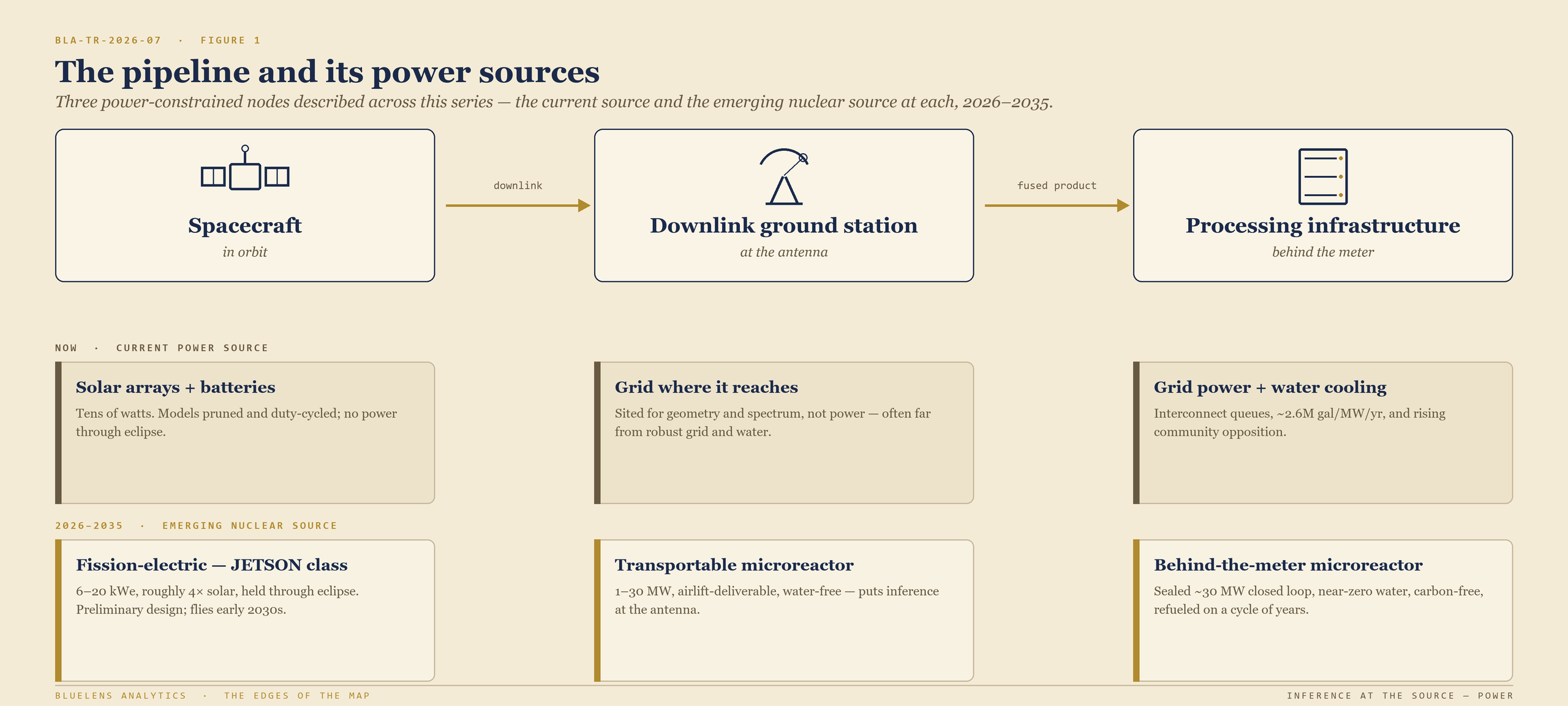
Figure 1. The three power-constrained nodes of the pipeline described in this series, with the current power source and the emerging nuclear source at each. Sources: AFRL JETSON program materials and Lockheed Martin; DOE Reactor Pilot Program announcements, June 2026; Valar Atomics and Nvidia announcements, February–July 2026; Nvidia data-center cooling documentation.
04 — The power budget in orbit
The orbital half of this subject begins with the constraint both prior papers encountered. Onboard inference today runs on tens of watts. The compute tiers surveyed in the SAR paper, from radiation-tolerant FPGAs to the Jetson-class modules flying on current hosted-edge missions, are bounded less by the silicon than by what a small spacecraft’s arrays can generate, what its batteries can buffer through eclipse, and what its radiators can reject.13 Every model that flies today is quantized, pruned, and duty-cycled to fit inside that envelope. The domain gap described in the optical paper is a software problem; the power gap underneath it is a physics problem.14
The current answer to the power gap is larger solar arrays, and that answer is being pursued at real scale. Starcloud launched the first Nvidia H100 GPU into orbit in November 2025 aboard a roughly 60-kilogram satellite, ran and queried a large language model on orbit that December, and has run inference on Capella Space SAR data in orbit, producing analytic products without downlinking the raw collection.1516 The company’s stated long-term design is a five-gigawatt orbital data center drawing on solar and radiator arrays roughly four kilometers on a side, and it has filed with the Federal Communications Commission for a constellation of up to 88,000 satellites.17 Nvidia has since announced a purpose-built space-computing product, the Space-1 Vera Rubin Module, which it states delivers up to 25 times the AI compute of the H100 for space-based inference; its named early adopters include Aetherflux, Axiom Space, Kepler Communications, Planet, Sophia Space, and Starcloud.18
The solar architecture works, and for sun-synchronous imaging constellations it will keep working, because an imager’s duty cycle matches the sun’s. Its costs, though, scale in ways that are unforgiving for a different kind of payload. Array area grows roughly linearly with power. Area produces aerodynamic drag at the low altitudes where imagers fly, shortening orbital life. Area enlarges the radar and optical cross-section of the spacecraft. The arrays are the largest and most fragile structures on the vehicle, and the batteries sized to carry operations through eclipse are dead mass in sunlight. For a power-hungry active sensor, a radar or a laser that must radiate on demand in any orbit and through eclipse, those penalties compound with the requirement rather than staying fixed. This is precisely the tradeoff that was identified at the very beginning of military space-power engineering, and the historical record on how it was resolved is specific and instructive.
05 — The Soviet precedent
The United States flew its first and only fission reactor in space in 1965. SNAP-10A launched from Vandenberg on April 3, 1965, into a roughly 1,300-kilometer orbit; the name comes from Systems for Nuclear Auxiliary Power, a program that covered both radioisotope generators and true reactors. It converted its heat with thermoelectrics, reached a peak of about 590 watts of electricity, and ran for 43 days before a voltage-regulator failure elsewhere in the spacecraft, not a fault in the reactor, shut it down for good. It is still up there.19 Five hundred and ninety watts is, tellingly, roughly the draw of the single desktop GPU that Valar lit up sixty-one years later.
The Soviet Union went much further. Its US-A program, designated RORSAT (Radar Ocean Reconnaissance Satellite) in the West, placed radar ocean-surveillance satellites in low orbit to track NATO surface fleets. Beginning in 1967 and continuing until 1988, 31 of these satellites flew with a BES-5 “Buk” fission reactor aboard, a fast reactor that used thermoelectric conversion to deliver a couple of kilowatts to the radar; two later satellites carried the more advanced TOPAZ thermionic reactor.20 The physics forced the choice. A radar’s return signal falls off as the fourth power of range, so the surveillance radar had to fly low to work at all, and at that altitude a solar array large enough to feed it would have dragged the satellite down. Active radar needed kilowatts, continuously, from a compact source. Photovoltaics of the era could not supply it. A reactor could. The sensor chose the power source.
The same program supplies the field’s permanent cautionary record. In January 1978, Kosmos 954 failed to boost its spent reactor into a high disposal orbit, re-entered, and scattered radioactive debris across a swath of northern Canada, triggering the months-long recovery effort known as Operation Morning Light and shaping every space-nuclear safety regime written since. A second reactor satellite, Kosmos 1402, met a similar fate in 1983.20 The mission logic was sound; the safety engineering was not; and both facts carried forward into current practice. Under National Security Presidential Memorandum-20, issued in August 2019, a launch is sorted into tiers by hazard, and a fission system fueled with low-enriched uranium, below the 20-percent line from Section 02, falls into a lighter-review tier than one using any other fuel.21 Current programs are designed to launch cold and inert, with startup prohibited until the spacecraft has reached an orbit high enough that the decay of fission products will outlast orbital decay by a wide margin. The lesson of Kosmos 954 is written directly into the rules.
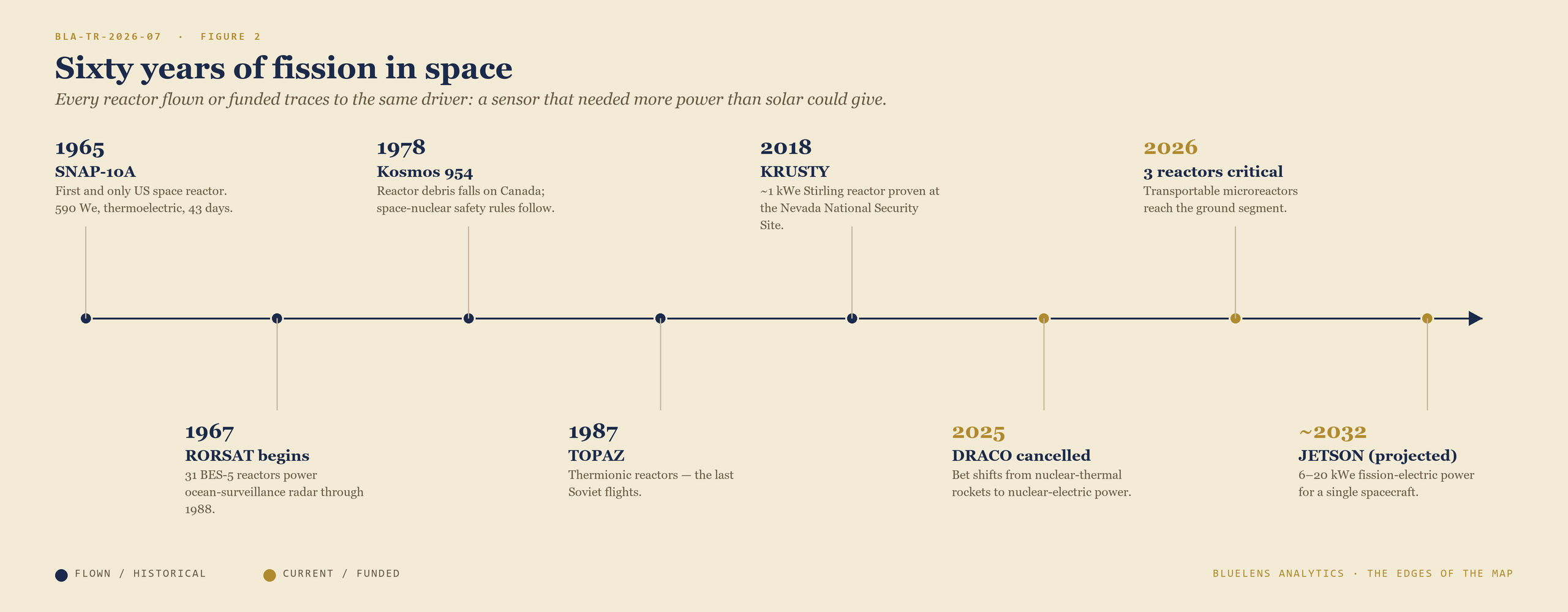
Figure 2. Six decades of fission in space, from SNAP-10A to JETSON. Navy marks reactors flown; gold marks current and funded programs. Across the whole span, the driver is constant: a sensor, or now a model, that needs more power than solar can supply. Sources: NASA and DOE SNAP and Kilopower records; the US-A / RORSAT program history; NSPM-20 (2019); DOE Reactor Pilot Program announcements (2026); AFRL and Lockheed Martin JETSON materials.
06 — Fission-electric programs in 2026
The near-term American effort is JETSON, short for Joint Emergent Technology Supplying On-orbit Nuclear power, run by the Air Force Research Laboratory (AFRL). Under a $33.7 million award, Lockheed Martin, with the reactor specialists Space Nuclear Power Corporation (SpaceNukes) and BWX Technologies, is designing a spacecraft power system that produces 6 to 20 kilowatts of electricity by using a fission reactor to drive Stirling convertors.22 The design draws directly on KRUSTY, the Kilopower Reactor Using Stirling Technology, a landmark 2018 experiment in which NASA and the National Nuclear Security Administration ran a small fission reactor with free-piston Stirling conversion. It is worth correcting a detail that circulates in the secondary coverage: KRUSTY was designed at Los Alamos, but it was tested at the Nevada National Security Site, where its full-power run took place on March 20, 2018. Its core was a 28-kilogram cast of 93-percent-enriched uranium, and it produced on the order of a kilowatt of electricity, a deliberately small proof that the physics and the conversion worked together.9 Lockheed Martin states that JETSON’s output would represent roughly four times the power of a comparable spacecraft’s solar arrays, available regardless of sun angle or eclipse; the program has passed through preliminary design review, with critical design review held as a contract option.22
A cancellation the same year clarified where the government believes space-nuclear investment should go. DRACO, the Demonstration Rocket for Agile Cislunar Operations, was a DARPA and NASA nuclear-thermal-propulsion demonstrator contracted to Lockheed Martin and BWXT; it was zeroed out in the FY2026 budget request finalized in the spring of 2025.23 DARPA’s own explanation was unsentimental: the precipitous fall in launch costs had eroded the original case for nuclear thermal rockets, and subsequent analysis pointed to nuclear-electric systems as the more valuable long-term investment, particularly for national-security missions, because on-orbit electrical power, not propulsion efficiency, is increasingly the scarce commodity. Small reactors generating electricity aboard a spacecraft, the agency noted, could remove the need for the large and fragile solar arrays that Section 04 described.23 AFRL’s program managers have made the payload argument in the same terms: a reactor can vary its output to drive a demanding sensor on command, where a solar array delivers a fixed, sun-dependent trickle that must be buffered through heavy batteries.
The engineering problem that no program escapes is heat rejection. A reactor’s virtue is continuous power; its penalty is that every watt of heat it does not convert to electricity must leave the spacecraft as infrared radiation, because in vacuum there is no other way for heat to go. Take the arithmetic from Section 02 into orbit: a 20-kilowatt-electric system running Stirling conversion at, say, 28 percent must shed on the order of 50 to 60 kilowatts of waste heat through radiators. A spacecraft that already struggles to cool a single inference accelerator would carry radiator panels as its new dominant structure. The design does not eliminate the solar array’s problem so much as trade it for a thermal one, and the trade closes differently in different orbits. In low, sun-synchronous orbits, solar power wins and will keep winning. In eclipse-heavy orbits, in medium and geostationary orbit, in the cislunar volume where Space Force surveillance interest is growing, and on any platform carrying an active sensor with a demanding duty cycle, fission-electric power becomes the better answer.
07 — What this means for inference at the source
Read together, the three papers in this series describe a pipeline with three power-constrained nodes, and nuclear power is arriving at the two ends of it first.1314
At the ground segment, behind-the-meter microreactors are the nearer-term change, plausibly within this decade at the current pace of the DOE authorization pathway. An AI processing facility co-located with a downlink station, powered by a sealed reactor drawing no local water, is now the stated program of a chip maker and a reactor company with hardware already critical in the ground. For geospatial-intelligence processing, that arrangement shortens the terrestrial portion of the latency budget in the same way onboard inference shortens the orbital portion: it removes a move.
In orbit the sequence is longer and the physics is stricter. Solar-powered onboard inference is operational now and expanding quickly, and for the imaging constellations it is enough. A fission-electric spacecraft of the JETSON class, if it flies in the early 2030s, changes what can be asked of a single platform. A 20-kilowatt payload bus supports radar that radiates on demand, laser crosslinks that operate through eclipse, and onboard compute that runs continuously rather than on a duty cycle. Under that power budget, models no longer have to be pruned to fit the platform; the platform can be sized to fit the model. The plausible architecture for the mid-2030s is heterogeneous: a small number of nuclear-electric spacecraft carrying the active sensors and the heavy inference, cueing constellations of inexpensive solar-powered collectors, with the fused product landing at reactor-powered ground stations. Every element of that architecture exists today as flying hardware, as critical hardware on the ground, or as a funded design review.
The historical symmetry deserves one plain statement. Beginning in 1967, the Soviet Union put reactors in orbit because a radar needed more power than solar cells could provide. In 2026 the same question has returned, and the component that now demands the power is the model that reads the radar.
In a desert hall in Emery County, Utah, uranium atoms are fissioning, heating pressurized helium that turns a generator that powers a chip that serves a webpage, and the page stays up only while the reactor runs. The whole system fits inside a building a person could walk around in a minute. The first two papers in this series described what the chip can do at the source. This one has described the power the rest of the architecture will require, on the ground within the decade and in orbit not long after.
§ § §
Methodology & source tiers
This paper synthesizes open technical, official, and press material under a three-tier scheme, and it was rebuilt from an initial draft specifically to raise its sourcing off the third tier wherever a stronger source existed. Tier 1 (primary / official): Department of Energy and national-laboratory materials (DOE’s TRISO fuel documentation; the SNAP program record); NASA and NNSA materials on the Kilopower/KRUSTY demonstration; the 2019 National Security Presidential Memorandum-20 governing space-nuclear launches; Nvidia’s own data-center cooling and space-computing announcements; and Lockheed Martin’s JETSON program materials. Tier 2 (specialist / institutional): World Nuclear News, the American Nuclear Society’s Nuclear Newswire, and POWER Magazine on the Ward 250 reactor, its airlift, and the DOE Reactor Pilot Program; SpaceNews and Aviation Week on the DRACO cancellation; Data Center Watch (10a Labs) on data-center opposition; and the Reuters/Ipsos polling on public sentiment. Tier 3 (press / promotional): trade and event coverage of the Valar–Nvidia live demonstration, used only for the fact that the event occurred and the goals the companies stated, and flagged as promotional throughout.
Three cautions are load-bearing. First, the Ward 250 power figures, 100 kilowatts thermal at test and five megawatts electric by design, come from the builder and its trade coverage; the reactor’s eventual power-conversion technology is not disclosed in any source located for this paper, and no efficiency or electrical output beyond the demonstration should be treated as established. Second, the live demonstration proved an architecture, not a capability: a sealed, water-free source driving AI compute directly. Its wattage is not evidence of anything, and this paper’s argument does not rest on it. Third, the orbital timeline is a reading of funded programs, not a forecast; JETSON is at preliminary design, no fission-electric payload of this class has yet flown, and the projection of a heterogeneous mid-2030s architecture is analysis rather than prediction.
-
POWER Magazine, “Valar Atomics’ Ward 250 Becomes Second Reactor to Go Critical Under DOE Pilot Program,” June 2026. Reports the June 18, 2026 criticality at the Utah San Rafael Energy Research Center, and the reactor as a Gen-IV TRISO-fueled, helium-cooled HTGR at “100 kWt initial test power and scalable to 5 MWe.” https://www.powermag.com/valar-atomics-ward-250-becomes-second-reactor-to-go-critical-under-doe-pilot-program/ ↩↩↩
-
World Nuclear News, “Valar Atomics achieves criticality in DOE Reactor Pilot Program,” June 2026. Confirms Ward 250 as the first DOE-authorized reactor built and operated outside the national-laboratory system. https://www.world-nuclear-news.org/articles/valar-atomics-achieves-criticality-in-doe-reactor-pilot-program ↩
-
World Nuclear News, “Criticality for third US reactor ahead of 4 July deadline,” July 2026. Covers the Antares Mark-0 (June 4), Deployable Energy Unity (late June), and Valar Ward 250 criticalities, Executive Order 14301 (May 2025) and its July 4, 2026 deadline, and the DOE Reactor Pilot Program’s successor covering additional reactors, fuel fabrication, and enrichment. https://www.world-nuclear-news.org/articles/criticality-for-third-us-reactor-ahead-of-4-july-deadline ↩↩
-
World Nuclear News, “US microreactor transported by air,” February 2026. Details the Operation Windlord airlift of Ward 250 (without fuel) from March Air Reserve Base, California, to Hill Air Force Base, Utah, aboard a C-17 Globemaster III on 15 February 2026, described as the first military airlift of a reactor, with fuel shipped separately from the Nevada National Security Site. https://www.world-nuclear-news.org/articles/us-microreactor-transported-by-air ↩↩
-
American Nuclear Society, Nuclear Newswire, “Ward250 reactor rides cargo to Utah,” 18 February 2026. https://www.ans.org/news/2026-02-18/article-7764/ward250-reactor-rides-cargo-to-utah/ ↩
-
Edgen, “Valar Atomics, Nvidia partner on nuclear data center with near-zero water use,” July 2026. Trade coverage of the live-stage demonstration and the stated goal of a 30-megawatt closed-loop AI facility with near-zero water use; used here only for the occurrence of the event and the companies’ stated goals, and treated as promotional. https://www.edgen.tech/news/post/valar-atomics-nvidia-partner-on-nuclear-data-center-with-near-zero-water-use ↩↩
-
U.S. Department of Energy, Office of Nuclear Energy, “TRISO Particles: The Most Robust Nuclear Fuel on Earth.” Describes the tri-structural isotropic particle (kernel plus carbon and silicon-carbide coating layers, each particle its own containment) and DOE testing showing survival beyond 1,800 °C. https://www.energy.gov/ne/articles/triso-particles-most-robust-nuclear-fuel-earth ↩↩
-
NASA, Radioisotope Power Systems, and the SNAP program record (U.S. DOE / ETEC): thermoelectric (Seebeck-effect) conversion, its ~3–8% efficiency, and its heritage in the RTGs flown on Voyager, Cassini, and Mars Science Laboratory / Perseverance, as well as SNAP-10A. https://rps.nasa.gov/ ; https://www.energy.gov/etec/system-nuclear-auxiliary-power-snap-overview ↩
-
NASA / National Nuclear Security Administration, Kilopower / KRUSTY (Kilopower Reactor Using Stirling technologY): free-piston Stirling conversion at roughly 25–35% efficiency; the full-power test conducted at the Nevada National Security Site on 20 March 2018; ~1 kWe output from a 28 kg, 93%-enriched uranium core; designed at Los Alamos National Laboratory; DUFF (2012) predecessor. https://en.wikipedia.org/wiki/Kilopower ↩↩
-
Reuters/Ipsos poll, reported June 11, 2026 (e.g., U.S. News & World Report, “Americans Wary of AI-Driven Data Center Boom, Reuters/Ipsos Poll Shows”): of ~4,531 respondents, 33% said rapid data-center construction is mainly good, 57% would oppose one in their community, and 77% worried AI would raise electricity prices. https://www.usnews.com/news/politics/articles/2026-06-11/americans-wary-of-ai-driven-data-center-boom-reuters-ipsos-poll-shows ↩
-
Data Center Watch (a project of 10a Labs), “Q1 2026 Report”; corroborated by NBC News, “Data center opponents have blocked or delayed projects worth nearly $130 billion in 2026, study finds,” June 2026. At least 75 projects worth ~$130 billion blocked or delayed in Q1 2026, the most in any quarter since 2023, with active opposition groups more than doubling to 833 across 49 states. https://www.datacenterwatch.org/q1-2026 ; https://www.nbcnews.com/tech/tech-news/data-center-opposition-sharply-rising-2026-study-finds-rcna349728 ↩
-
NVIDIA, “Hotter Than a Hot Tub: The 45 °C Breakthrough to Cool AI’s Biggest Machines” (NVIDIA blog). Conventional cooling-tower systems consume ~2.6 million gallons of water per MW per year; NVIDIA’s warm-liquid, closed-loop (dry-cooler) reference design reduces on-site cooling water toward zero. On-site water only; power-generation water use elsewhere is not eliminated. https://blogs.nvidia.com/blog/liquid-cooling-ai-factories/ ↩
-
BlueLens Analytics, “Inference at the Source: A Literature Review of Onboard AI in Earth Observation, 2019–2026,” BLA-TR-2026-02, on the onboard compute tiers, the SAR sensor architectures, and the tip-and-cue latency budget. ↩↩↩
-
BlueLens Analytics, “Inference at the Source — Optical,” BLA-TR-2026-06, on the cross-sensor domain gap that onboard optical models inherit from the ground harmonization pipeline. ↩↩
-
NVIDIA Blog, “How Starcloud Is Bringing Data Centers to Outer Space,” December 2025. https://blogs.nvidia.com/blog/starcloud/ ↩
-
CNBC, “Nvidia-backed Starcloud trains first AI model in space,” December 10, 2025; and Data Center Dynamics, “Starcloud-1 satellite reaches space, with Nvidia H100 GPU now operating in orbit,” 2026. https://www.cnbc.com/2025/12/10/nvidia-backed-starcloud-trains-first-ai-model-in-space-orbital-data-centers.html ↩
-
Starcloud design filings and coverage: a stated ~5-gigawatt orbital data-center design with ~4-km solar/radiator arrays and an FCC filing for a constellation of up to ~88,000 satellites (announced design targets, not operational systems). https://www.datacenterdynamics.com/en/news/starcloud-1-satellite-reaches-space-with-nvidia-h100-gpu-now-operating-in-orbit/ ↩
-
NVIDIA Newsroom, “NVIDIA Launches Space Computing, Rocketing AI Into Orbit,” March 16, 2026. Announces the NVIDIA Space-1 Vera Rubin Module, states “up to 25x more AI compute for space-based inferencing” versus the H100, and names Aetherflux, Axiom Space, Kepler Communications, Planet, Sophia Space, and Starcloud among adopters. https://nvidianews.nvidia.com/news/space-computing ↩
-
SNAP-10A / SNAPSHOT mission record (Wikipedia, “SNAP-10A,” citing NASA/DOE sources; DOE ETEC SNAP overview): launched from Vandenberg on 3 April 1965 into a ~1,300 km orbit; thermoelectric conversion; ~590 We peak; shut down after 43 days by a voltage-regulator failure unrelated to the reactor; the only US fission reactor operated in space, still in orbit. https://en.wikipedia.org/wiki/SNAP-10A ↩
-
US-A / RORSAT program record (Wikipedia, “US-A,” and “Kosmos 954,” citing primary and technical sources): 31 satellites with BES-5 “Buk” thermoelectric fast reactors flown 1967–1988, plus 2 later TOPAZ thermionic reactors; the low-orbit requirement driven by radar’s inverse-fourth-power range dependence; Kosmos 954’s January 1978 re-entry over Canada (Operation Morning Light) and Kosmos 1402 (1983). https://en.wikipedia.org/wiki/US-A ; https://en.wikipedia.org/wiki/Kosmos_954 ↩↩
-
National Security Presidential Memorandum-20, “Launch of Spacecraft Containing Space Nuclear Systems,” 20 August 2019 (The American Presidency Project). Establishes a tiered launch-authorization process in which fission systems using low-enriched uranium (<20% U-235) fall under a lighter review tier than systems using any other fuel, and creates the Interagency Nuclear Safety Review Board. https://www.presidency.ucsb.edu/documents/national-security-presidential-memorandum-the-launch-spacecraft-containing-space-nuclear ↩
-
Lockheed Martin, “Lockheed Martin Jets into Nuclear Electrical Spacecraft Power,” November 2023; and Space.com, “US military gives Lockheed Martin $33.7 million to develop nuclear spacecraft.” AFRL’s JETSON (Joint Emergent Technology Supplying On-orbit Nuclear power): Lockheed Martin with SpaceNukes and BWXT; 6–20 kWe via a fission reactor driving Stirling convertors; ~4× a comparable solar array without continuous sunlight; based on KRUSTY; in preliminary design review with a critical-design-review option. https://www.lockheedmartin.com/en-us/news/features/2023/lockheed-martin-jets-into-nuclear-electrical-spacecraft-power.html ; https://www.space.com/space-nuclear-power-tech-lockheed-martin-jetson-contract ↩↩
-
SpaceNews, “DARPA says decreasing launch costs, new analysis led it to cancel DRACO nuclear propulsion project,” 2025; and Aviation Week, “Proposed NASA Budget Zeros Out Nuclear Thermal Propulsion Tech.” DRACO (Demonstration Rocket for Agile Cislunar Operations), a DARPA/NASA nuclear-thermal-propulsion demonstrator contracted to Lockheed Martin and BWXT (~$499M), was zeroed in the FY2026 budget request (finalized spring 2025); DARPA cited falling launch costs and analysis favoring nuclear-electric systems for national-security missions. https://spacenews.com/darpa-says-decreasing-launch-costs-new-analysis-led-it-to-cancel-draco-nuclear-propulsion-project/ ↩↩