I.
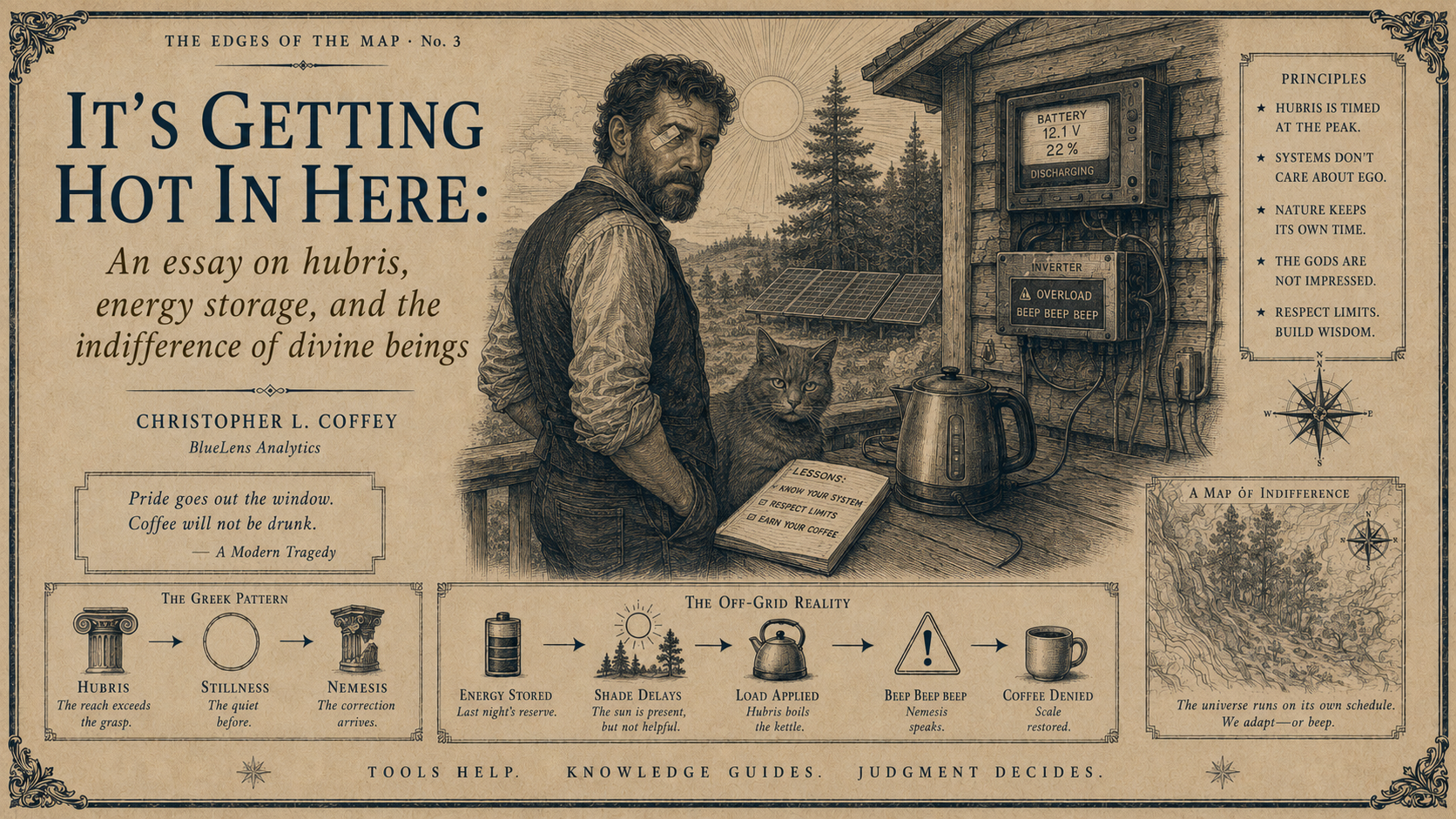
Eight in the morning, off-grid, in the Sandhills of North Carolina, and I am feeling good about myself.
This is the first mistake. I do not know it is a mistake yet. That is how it works.
The battery bank is a 400 amp-hour bank, lithium iron phosphate, and it is the only bank carrying the studio right now because the bigger 24-volt system is half-built and waiting on a part. Overnight it did what a bank does in the dark, giving and giving, the server rack and the fans drawing it down hour by hour, so at eight in the morning it is sitting near the bottom of its day, the leanest it will be for the next twelve hours.
Here is the thing a wiser man would have remembered before reaching for the kettle: my panels do not see the sun at eight in the morning. I have a tight, mean little window of good light out here, because the field is ringed in trees and I will not cut them down. I like the trees. The deer like the trees. The deer come through the greenway we cut for them, unhurried, wholly indifferent to my charging needs, nibbling on wisteria roots and shoots i’ve been fighting back for three years now.
It does not take a degree in optics to work out that a pine standing between the sun and a solar panel is, optically speaking, no different than a wall. So the quiet comedy built into this place is that no real power comes into the system until around ten o’clock. Until then the array sits in shade and the numbers on the Cerbo screen lie there flat, and I am, by my own hand, out of my own affection for trees, collecting about half the daily sun I could have if I were willing to run a chainsaw through everything I love. But I am not willing, so I wait. One day a timber-frame carport with hammer truss gable ends will lift these panels up over the shade and hand me back the morning. That carport is not built yet. Few of the things that would save me are built yet.
And yet. This is the morning, and this is the folly of it: I am standing on my front porch at eight o’clock in brilliant sunshine. The light is pouring down, total and gorgeous and free, all over the yard and the porch rail and my two coffee-less hands. The sun could not possibly be more present. It is simply, at this hour, on the wrong side of my trees, doing precisely nothing for my battery. I can stand bathed in it and not have one additional watt to run my kettle. I have run this place on sun and stored electrons for a while now, and this morning, full of light and empty of power, I think the thought the olde gods have been waiting all night for me to think.
I think: I’ve got this licked.
I reach over and I turn on the electric kettle.
For a second, nothing. The kettle draws its load, the inverter takes it, the numbers wobble but hold, and there is that small held breath, the exhalation of a man who has built a thing and watched it work. Hey. It’s working.
Then: BEEP BEEP BEEP
The inverter is a polite machine and it is telling me, politely, that I have asked the 400 amp-hour bank to shove a couple kilowatts of resistive heat through a circuit that does not, at this hour, on this bank, want to do that. I run for the inverter to switch it off and stop the hated BEEPing. The kettle goes cold.
Pride goes out the window. Coffee will not be drunk.
II.
The Greeks would have known my kettle on sight.
They built a dramatic literary machine engine we call Greek Theatre, and it ran in three movements. First the man swells up past his size: Hubris, the reaching that exceeds the grasp. Next comes the Stillness, the quiet before, a beat withheld and paused. Then the correction arrives and puts the man back down to scale: Nemesis. They staged it ten thousand times and the audience never got tired of it because the audience was made of people who had all, at one time or another, turned on the kettle expecting joy and received instead a stern correction from life.
Here is the part the playwrights understood that the self-help shelf and endless TikTok happiness influencers never will: the smug hubris does not arrive at a random moment, it arrives at the peak. It arrives precisely one second before the reach exceeds the grasp, not in the middle of the struggle, when a man is humble because he is busy, but in the instant just after he decides the struggle is over. The thought I’ve got this licked is not a reaction to having it licked. It is the thing that summons the beep. The pride and the fall are not cause and effect with some decent interval between them for the man to enjoy himself. They are the same event, seen from two sides.
The Greeks thought the gods arranged this timing on purpose, out of a kind of cosmic comic professionalism. We would say, in our modern technical mythology, that a system feels solved right up until the exact moment you load it past the one limit you forgot to test. Either way the timing is immaculate. Either way the coffee will not be drunk.
III.
Now I want to take my small kettle and place it next to a large one for comparison, because the cosmic comedy of the gods (and this thing we perceive as reality) does not care at all about size, and that is the whole point of this.
In the middle of April 2025, the nation of Spain ran its entire electrical grid on renewable energy. A full weekday. Sun and wind and water carrying fifty million people and all their kettles and screens, and a few days later solar alone covered nearly three-quarters of national demand. This was, by any honest measure, a genuine and remarkable thing, the kind of thing people have argued for forty years could not be done. Spain did it and Spain proudly told the whole world all about it in glowing terms. There was a press tour. There were shiny photographs of shiny panels. There was the exhalation of a nation that had built a thing and watched it work. It was a genuinely good moment in history.
On the twenty-eighth of April, at thirty-three minutes past noon, the entire Iberian Peninsula went dark.
It went dark in about five seconds. Trains stopped between stations. Airports in Madrid and Lisbon and Barcelona went quiet. Traffic lights died, ATMs died, phones died. Two countries, more than fifty million people, sitting in a sudden enormous silence at lunchtime on a Monday. It took the better part of sixteen hours to bring it all the way back.
Same machine. Same three movements. The swelling past one’s size, the press tour and the photographs. The held beat: it’s working. And then the correction, arriving at thirty-three minutes past noon with the punctuality the gods are famous for, and putting the nation back down to scale.
It was my kettle. It was exactly my kettle. The only differences were the body count of the audience and the size of the check it would take to fix it.
I want to be careful here, because the lazy reader and the lazy pundit will both want this to be a story about renewables failing, and it is not that story. The final report, when the engineers finished it nearly a year later, did not blame the sun or the wind. The chairman said it plainly: the problem was voltage control, not renewable energy. The grid had built itself a magnificent set of lungs and forgotten to build the diaphragm. It could generate. What it could not yet do, on that afternoon, was hold itself steady when something twitched, because the thing that holds a grid steady was the unglamorous part, and the unglamorous part had not been built out yet.
Hold that thought. The unglamorous part. We are coming back to it, because it is where I keep my ferrules. A ferrule is a small ring, cap, or sleeve—usually made of metal or plastic—used to fasten, join, seal, or reinforce materials, according to Google’s insta-AI wisdom. Ferrules are important, and a handful of wee ferrules, 18mm in length to be exact, are what is holding back the completion of my shiny new 24 volt solar + storage system. So ferrules and kettles, yes, just stuck with me and this should all make sense here shortly.
IV.
The first lesson the kettle teaches, and the first lesson Spain paid fifty million people to learn, is that timing is everything and the sun is not on your schedule.
I learned this in a stone and brick house in the UK, in a little village in Cambridgeshire, years before I ever owned a battery, during the brutal summer heat of 2015 and 2016, and the house taught it to me through its walls. Solid masonry, beautifully built, the kind of thermal mass that keeps a house cool and steady through any ordinary English summer. The trick of thermal mass is that it is slow. It takes all day to warm up. The trouble is that an English midsummer sun comes up around four in the morning and by ten o’clock the south and east faces of that lovely house had been drinking heat for six hours, and by evening the walls themselves had become a radiator, holding the day’s heat and breathing it back into the rooms long after the sun went down. The thing that made the house wonderful in April was the thing that made it an oven in August. The mass that kept us cool kept the heat. The sun and the misery did not keep the same hours.
The battery taught me the identical lesson on a smaller bench. One recent evening, proud of myself (there it is again, the pride; you can set your watch by it), I ran the air conditioner from my solar + small storage system from six to eight in the evening. A couple hours of cool air from lovely renewable sources; earned, I felt, by a good day of charging. And I sat there afterward in the dark watching the sad and rapidly declining state of charge of my battery bank and realized I had just spent half my stored power on cooling at the exact moment the panels were clocking out for the night, leaving nothing in the tank to coast through the long dark draw of the evening, the television, the server rack, the fans running till dawn. You idiot. You run the cooling in the morning, when the array is climbing and the bank is filling and the sun can pay you back. You pre-chill the mass while you have the surplus, and you let the building coast on its own inertia into the night. You turn the thermal mass that hurt you in Cambridgeshire into a flywheel that helps you. Same physics. Different posture toward it.
This is the duck curve, if you want the engineer’s name for it: the deep belly of midday solar surplus and the steep neck of demand that rears up after the sun is gone. Spain has it. My studio has it. It is the same curve drawn at different scales. And what it tells you, once it has finished embarrassing you, is the one thing worth carving over the door:
Generation is easy. Storage is the freedom to run the load when you actually need it, instead of only when the sun says you may.
V.
Now we come to the ferrules, and to the second lesson, which almost nobody writes about because it is boring, which is exactly why it is true.
The entire 24-volt system, the bigger bank and the inverter and the whole next stage of this place, is finished. Thousands of dollars of capability. It is sitting there, complete, ready, idle. It is waiting on a single pack of ferrules. Six AWG, eighteen millimeter, the little tinned sleeves you crimp onto the end of a stranded cable so it will seat properly in the terminal. A few dollars of stamped metal. Until that pack arrives in the mail, not one electron moves through that system. The whole magnificent thing is gated by the cheapest, least interesting part in the entire build.
This is not a flaw in my planning. This is the law of capricious nature, the whim of the gods. The binding constraint is never the glamorous component. It is never the battery or the panel or the thing you photograph. It is the ferrule, the fuse, the connector, the boring connective tissue that has a lead time and a shipping label and does not care about your timeline.
Spain is living the same parable, written large. The engineers looked at the blackout and said: we need storage, a great deal of it, on the order of twenty-some gigawatts of it by 2030. And here is the thing the headline-writers and the optimists and the doomsayers all miss from their separate directions: you cannot buy twenty-two gigawatts of storage off a shelf. There is no Spanish version of the hardware store where you back up the truck and load it. The moment you write that number on a national plan, you have not acquired storage. You have committed to a decade-long industrial mobilization: cell factories that do not exist yet, raw-material contracts, trained crews, permitting queues, transformers with eighteen-month lead times. A target is not a supply. An intention is not a capacity. The battery exists not because you decided you needed it but because somebody, three years earlier, built the factory that builds it.
My ferrule is their transformer queue. The shape is the same. The whole system, at every scale, runs at the speed of its most boring missing part.
VI.
The third lesson is the one about how we learn anything at all, and it is not flattering, and it applies to me and to Spain and to every human and every nation that has ever touched a stove.
The white papers were all there. Every one of them. For years before that Monday in April, the engineers and the analysts had written, clearly and repeatedly, that a grid with that much fast, light, non-spinning generation would need storage and inertia and voltage control to match, or it would be brittle. The warnings were filed. They were correct. They were also, functionally, invisible, because a warning on paper and a warning in the body are two completely different kinds of knowledge, and only one of them changes what you do.
Spain did not internalize the storage gap from a PowerPoint in 2022. Spain internalized it at thirty-three minutes past noon on the twenty-eighth of April, in the dark, with the trains stopped. That is when the knowing-about became the having-been-burned. And within a year of that single bad afternoon the battery storage on that grid had multiplied many times over, and thirteen and a half billion euros began moving toward the transmission network, and the law itself changed to require storage to be bolted to new generation. None of that moved when the papers said to move. All of it moved when the stove turned out to be hot.
I knew about C-rates for solar energy calculations before the kettle beeped at me. I could have told you, in the abstract, the morning before, that a single 400 amp-hour bank has a comfortable discharge rate and that an electric kettle is a rude and sudden load. I knew it the way Spain knew about inertia: filed, correct, invisible. And then the kettle beeped, and now I know it, in the place where knowing actually lives, which is somewhere south of the brain and considerably more honest.
The stove is hot. You can read that the stove is hot. You can be told, by people who love you, that the stove is hot. And then one day you touch the stove, and only then do you know it, and the knowing arrives with a small clear bell of pain that no amount of reading ever rang. Humans learn this way. Nations learn this way. There is, as far as I can tell, no other reliable way that either of them learns anything that matters.
VII.
So you get burned. The question, the only question that actually decides whether you grow or rot, is what you do with the size of the burn.
Because there are two ways to get it wrong, and they are mirror images, and they are both forms of refusing the actual lesson. The first is denial: it was a fluke, a one-off, I really did have it licked, nothing to learn here. The man who does this turns the kettle on again tomorrow with the same smug face and gets the same beep and learns nothing, forever. The second is despair: the whole system is broken, the project was always doomed, renewables don’t work, off-grid is a fantasy, burn it down. The man who does this throws away a working studio because of one cold cup of coffee.
Both of these are the same error wearing different masks. Both of them widen the burn. They take a narrow, specific, useful lesson and inflate it into a verdict on the whole enterprise. The stove taught you exactly one thing: that this surface, now, is hot. It did not teach you that fire is evil. It did not teach you that you are a fool. It taught you the oven mitt. That is all it taught you, and the discipline (the entire discipline, the thing the Greeks and the Taoists and the good engineers all circle from their different sides) is to learn the oven mitt and not one inch more. Keep the cut narrow. Run the AC in the morning. Order the ferrules. Let the rest of the working world keep working.
The hot stove should teach you the mitt. It should never teach you the fear of fire.
VIII. Hot in Here
I want to be honest about what I did next, because the dishonest version of this is the most popular essay on the internet and I would rather eat the ferrules than write it.
The dishonest version goes: and so, in my moment of frustration, I chose to step outside, and I found joy, and I manifested peace, and the universe rewarded my positive energy. You have read that essay nine hundred times. It is hubris with a gratitude journal stapled to the front. Its secret engine is always authorship: I rose above, I chose serenity, I manifested. It is the kettle-smugness relocated to the soul, which is a worse place for it to live. TikTok YouTube name-the-stream-feed regurgitation of nothing.
Here is what actually happened. The kettle beeped and I was not serene. I was annoyed. I was, frankly, a little angry, in the small stupid way you get angry at an inanimate object that has correctly told you something you did not want to hear. There was no joyful idea. There was no spiritual plan. There was a man whose coffee would not be drunk and who therefore decided, grumpily, to go move some things around in the storage trailer, because if the battery was going to make me wait then I might as well do something useful while it filled back up. That is the entire content of my heart at that moment. Resentment and a chore. I get no credit. I want that on the record. I get zero credit for what came next, because what came next was not mine.
I tapped the music. Not a song. Just music: shuffle, the machine’s choice, the algorithm’s indifferent hand. And what the machine served up, into the woods, into my sour little mood, at that precise and undeserved moment, was Nelly. Hot in Herre.
Now. If that is not the cosmos doing its best Vonnegut bit, some indifferent divinity leaning down through the canopy with a megaphone, I do not know what is. I did not choose it. That is the keystone of the whole thing, the load-bearing fact: I did not choose it. You cannot take credit for a joke that lands on you. The press tour came days before Spain’s blackout; the song came seconds after my smugness; same playwright, same impeccable timing, and in neither case did the man on the receiving end write the scene. Spain did not author its lightning and I did not author my grace. We were both just standing where the bolt came down. They got the dark one, I got the funny one, and the only difference between a tragedy and a comedy is which way the indifference of the divine happens to be pointing the megaphone that day.
And, my friends and dear readers, I danced. I shook my booty in the glorious shining morning light maple trees.
I want to correct a thing here, because in an earlier and lesser draft of my own self-image I might have given you the humble little picture: the middle-aged man flailing badly, dad-dancing among the pines. That would be a lie, and the lie would be a small vanity of its own, the false modesty that is just pride turned inside out. The truth is I can move. I can genuinely get down. Nelly would put me in the back row, no audition. Way in the back row, but I’d be there.
I threw it down out there in the Sandhills with real joy and absolutely no dignity, and my kitties watched. They were unmoved. Cats are the perfect audience for grace because they confer no status; you cannot perform for a cat, a cat will not clap, a cat does not file a review. There may, for all I know, have been a hiker on the trail fifty yards through the trees, phone out, filming, thinking look at that poor special needs man alone in the woods, and God bless that hiker, because that is exactly the right amount of audience for this: none that counts.
And that is the part that keeps it clean. That is the whole secret, and it is worth saying slowly. The grace stayed grace because nobody was watching who mattered. There was no press tour. There was no one to be smug toward, no camera I had earned, no soul to congratulate. The instant there is a real audience, the boogie becomes a brag and the peace becomes a post and the whole thing curdles back into hubris in a kinder mask. The cats kept me honest. Spain danced for fifty million people and the world’s cameras, and that is precisely how the smugness got in. I danced for three cats and a maybe hiker who thinks I need help, and that is precisely how it stayed innocent.
And while I danced (this is the line I want to leave you on), the battery bank filled itself. Quietly. Behind me. Not watched, not willed, not hurried by one watt of my frustration. The sun did the sun’s work on the sun’s schedule, which was never going to be my schedule, and by the time the song was over there was enough in the bank for the kettle, and the coffee, eventually, was drunk.
That is the asymmetry I keep coming back to, and it is the reason this small dumb morning is worth a chapter. I get to do this. A man on four hundred amp-hours in the Carolina pines gets to be annoyed, get ambushed by a 2002 club song, dance badly-well for his cats, and let the indifferent sun refill his battery in its own sweet time while he does something else. He gets equanimity, and better still he gets to keep it private, which is the only condition under which equanimity survives. Spain does not get this. Fifty million people do not get to wait in the woods for the sun to come back around. They get gas turbines spun up to hold the voltage, a thirteen-billion-euro check, and a hard year of learning the thing the white papers already said. The personal scale is granted a grace the national scale simply cannot afford. The bigger the kettle, the less you are allowed to dance while it fills.
I spend a great deal of my working life on the large kettles. On where the violence falls and who it falls on, on machines built to take the human being out of the killing decision, on the grim arithmetic of places coming apart. That work is real and it is heavy and somebody has to keep the map honest. But a man cannot live at that scale all day or it will cook him from the inside the way the August sun cooked the stone, slowly, through the wall, until the thing that held him steady becomes the thing radiating heat into his rooms at night. So once in a while some indifferent divinity leans down with the megaphone and plays you something stupid and perfect, and the only correct theological response, the only one that does not curdle, is to shut up, stop taking credit, and shake your ass in the woods while the sun does the rest.
The stove is hot. I knew it before; I know it now. The mitt is on the hook by the door. The ferrules are in the mail.
It’s getting hot in herre.