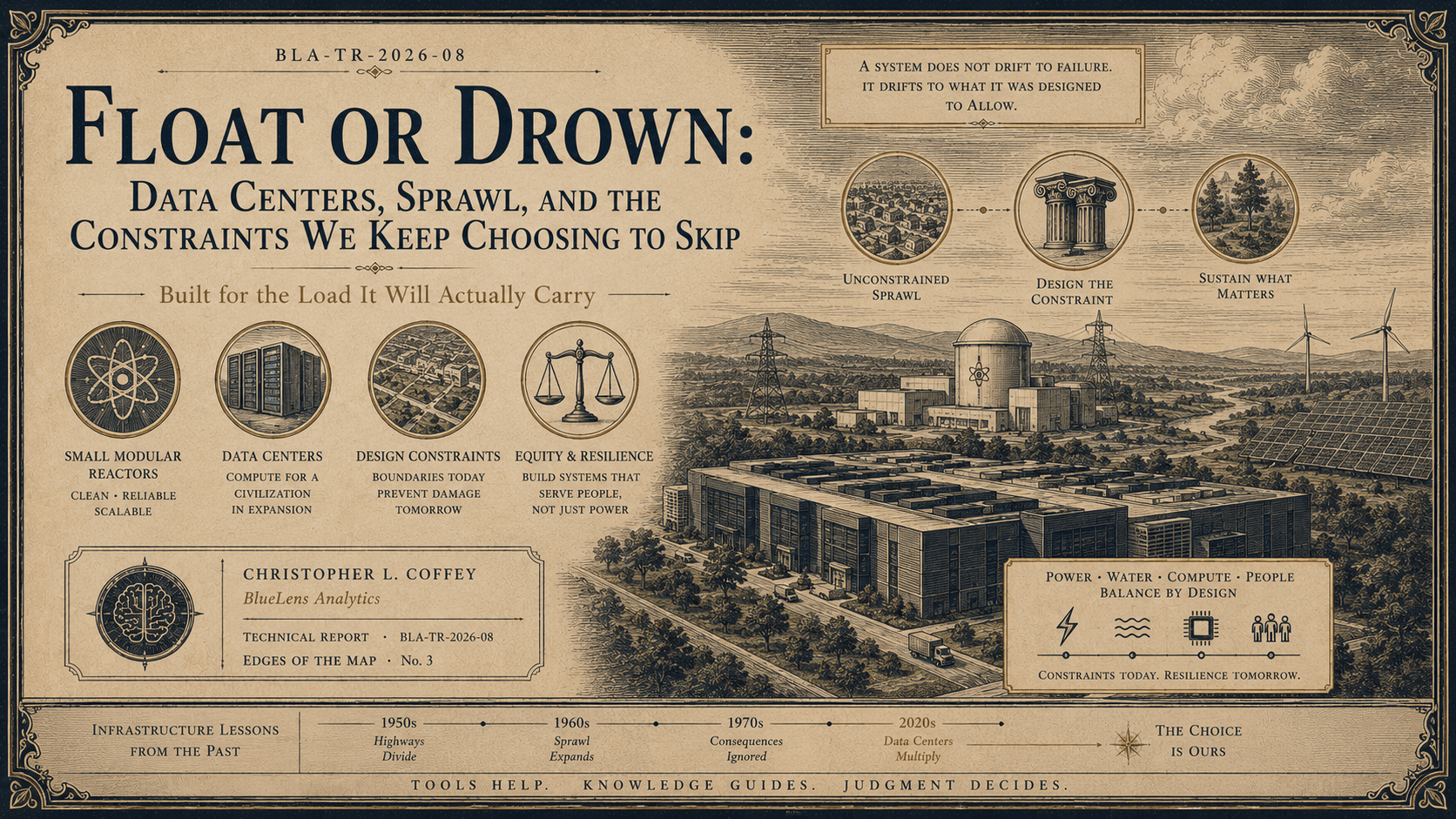
Built for the Load It Will Actually Carry
In June 2026, France’s electricity grid held, even though individual pieces of it did not. On June 23, France recorded its hottest day since national record-keeping began in 1947, with temperatures climbing past 111°F.1 The heat reached the rivers before it reached the grid: at the Golfech nuclear plant in southern France, operator EDF (Électricité de France, the state utility) shut down Unit 2 as a precaution on the night of June 22, after water in the Garonne River, the same water the reactor depends on for cooling, grew too warm to use safely, with other reactors ramped down or limited later that week.1 Even so, France’s grid operator, RTE (Réseau de Transport d’Électricité, the national transmission operator), reported that these outages and other limitations weren’t expected to be severe enough to threaten the country’s ability to meet demand.1 The reason is instructive: French electricity is roughly 95 percent low-carbon, with nuclear power alone supplying about two-thirds of it, so a grid built on that base has enough redundancy to absorb the loss of individual plants without losing the ability to meet demand overall.2
Belgium was the country that visibly strained. Its Uccle weather station logged its hottest stretch of the year, 95.5°F between June 20 and 25, and on June 24 Belgium’s electricity price spiked above €1 per kilowatt-hour at sunset as conventional power stations maxed out trying to cover the added air conditioning load.3 France’s own demand curve moves the same way under heat, RTE has found that consumption typically climbs by roughly 0.4 to 0.6 gigawatts for every degree Fahrenheit increase during a heat spike, which is what made the redundancy in its low-carbon baseload matter as much as it did that week.4 Dutch drawbridges failed and stranded shipping traffic that same week. Rail infrastructure buckled.3 Fifty-five people drowned in France, most swimming in unsupervised water, in a country whose building stock, thick stone walls and shuttered windows, was engineered for a climate that no longer exists.5 Even France’s own resistance to air conditioning, a longstanding belief that conditioned air causes what the French call choc thermique, is a cultural artifact of a system that was never designed to need it.3
None of this is really a story about air conditioning, or about France. It’s a story about what happens when a system is asked to operate outside the envelope it was built for. Reality doesn’t negotiate with the system’s original assumptions. It just applies load, and the system either has the constraint built in to absorb it, or it doesn’t.
That is the frame this report applies to a very different system: the American data center buildout, and specifically, the question of whether the infrastructure now being sited, permitted, and powered across the country is being engineered with its real operating envelope in mind, or whether it is repeating, in a new costume, a failure pattern the country has run before.
I. The Argument, Stated Plainly
Unconstrained systems, physical or social, drift toward their own failure mode. The only durable way to prevent that drift is to design the constraint in from the start, rather than discover it under load and clean up afterward.
Data center buildout is currently an unconstrained system. It is also, by most reasonable measures, an inevitable and civilization-advancing one. The compute being built is not a single-purpose tool for one field. It is the substrate underneath a genuine expansion of what we as humans can do: earth observation and satellite remote sensing, yes, but also protein folding and drug discovery in biology, materials science and battery chemistry, autonomous systems and robotics, climate and weather modeling, and the ordinary economic productivity gains that ripple out from all of it. The point of this report is not to argue against that expansion. The point is that we are at a narrow and unusual window in which the constraint-design conversation is still possible, before the pattern cements itself the way it did with highways, with company towns, with every prior infrastructure wave that arrived faster than the governance built to shape it.
II. We Have Run This Experiment Before
The instinct to let commerce settle wherever it lands, and to treat the resulting damage as an unfortunate accident rather than a designed outcome, is not new. The Federal-Aid Highway Act of 1956 authorized what was then the largest public works program in American history, and the interstate system that resulted displaced more than a million Americans in its first two decades.6 Historians who have studied the routing decisions, including New York University (NYU) law professor Deborah Archer’s research on the subject, have documented that highway planners in the 1950s knew which communities their routes would destroy, and frequently chose those routes precisely because the neighborhoods in the way were poor and Black.7 The official narrative that emerged in the 1970s recast this as a series of unintended consequences.8 The routing maps say otherwise.
The lesson is not that infrastructure booms are inherently destructive. The lesson is that when a system is allowed to expand without a designed constraint, the constraint gets applied anyway, just later, more expensively, and disproportionately against whoever has the least power to resist it. Sprawl is what unconstrained commercial settlement looks like when nobody with authority sits down first and decides where the edges should be. The Gilded Age company town and the post-WWII subdivision are different eras wearing the same failure mode: growth that answers to nothing but where the path of least resistance happened to run.
III. The Current Test Case: Data Centers Are Already Failing the Same Way
This is not a hypothetical risk. The evidence that data center buildout is repeating the unconstrained pattern is already accumulating, in four specific and measurable places: water, power, public consent, and heat itself.
Water. A large data center can consume up to five million gallons of water per day, roughly the demand of a town of 10,000 to 50,000 people.9 U.S. data centers directly consumed an estimated 17.4 billion gallons of water in 2023, a figure projected to rise to between 38 and 73 billion gallons annually by 2028.10 Loudoun County, Virginia, the world’s densest data center market, supplied roughly 900 million gallons of water to its data centers in 2023 alone, and its water authority has had to lean on potable supply because reclaimed water infrastructure hasn’t caught up.9 Roughly 40 percent of U.S. data centers sit in regions already classified as water-stressed.11 In Illinois this year, residents in Yorkville and DeKalb have been asked to conserve water on the same civic calendar their city councils have courted new water-intensive facilities, and the state is now considering legislation to mandate more water-efficient cooling.12 This is not a fringe concern. It is a structural mismatch between where compute demand wants to locate and where water can actually support it, playing out in real time in city council meetings that never make national news.
Power. The interconnection queue, the process by which any new generation or large load gets permission to connect to the grid, has become the binding constraint on the entire industry, more so than land or capital.13 As of early 2026, U.S. interconnection queues held roughly 2,600 gigawatts of proposed generation and storage, more than double the country’s entire installed capacity, with a median wait time approaching five years and, according to figures Google has reported, delays of up to twelve years for some data center connections.14 In ERCOT, the Texas grid operator, data centers account for somewhere between 73 and 87 percent of a 410-gigawatt large-load queue, a number roughly equal to the grid’s entire current peak demand.1516 Dominion Energy, which serves Northern Virginia, has reported average waits of seven years for a 100-megawatt connection.15 The industry’s near-term workaround, behind-the-meter natural gas turbines, requires roughly 500 million dollars in capital for a 350-megawatt deployment and takes decades to pay back, which tells you plainly that this is a stopgap, not a design.15 The average time from interconnection request to commercial operation has risen from under two years in 2008 to nearly five years in 2024, and only 19 percent of projects that entered the queue between 2000 and 2019 had reached commercial operation by the end of 2024.17
Public consent. Seven in ten Americans now oppose data center development in their communities, according to Gallup polling, citing water use as the top concern. In the first quarter of 2026 alone, at least 75 data center projects worth a combined 130 billion dollars were disrupted by local opposition, according to the tracking firm Data Center Watch.18 Maine became the first state to ban new data center construction outright, in April 2026.15 New York went further on July 14, 2026, when Governor Kathy Hochul signed an executive order freezing new permits for “hyperscaler” facilities of 50 megawatts or more for up to a year, the first statewide moratorium of its kind.19 Most coverage flattened this into a simple ban, but the legislature-passed bill sitting on Hochul’s desk at the same time, the Responsible Data Center Development Act, is considerably more specific than that framing suggests. It sets its own moratorium threshold lower, at 20 megawatts, requires a public hearing before any future permit is approved, creates dedicated electric and water rate classes for facilities above that threshold so the cost of new transmission and pipe capacity is billed to the data center operator rather than folded into residential rates, and requires any operator above 20 megawatts to fund a host-community-benefit program.20 Both the executive order and Hochul’s own public remarks framed the concern specifically around grid capacity and ratepayer cost-shifting, citing nearly 12,000 megawatts of proposed data center demand already sitting in the state’s interconnection queue, more than 8,000 megawatts of it added in 2025 alone, not opposition to data centers as a category.21 Worth noting plainly, since it bears directly on this report’s argument: as written, neither measure yet distinguishes a facility’s peak load by where its power comes from, so a behind-the-meter or reactor-supplied hub of the kind described in Section IV would likely still trip the same size threshold, even though it would create none of the grid strain or ratepayer cost-shift the law exists to prevent. That is a live legislative gap, not a settled advantage, and it is exactly the kind of provision a state legislature could close in either direction once a facility like this actually gets proposed. A Siena Research Institute poll taken the same month found 46 percent of New Yorkers supported a moratorium versus 21 percent opposed, with majorities in both parties, further evidence this is not a partisan reaction.19 None of this is partisan. It is the predictable political output of an industry siting itself the way sprawl always sites itself: wherever land is cheap and permitting is fast, with the resource and community consequences addressed after the fact, if at all.
Heat. The same complaint driving France’s air conditioning debate, mechanical cooling that solves a problem inside the fence line by exporting a larger one outside it, shows up at data center scale as a measured, published effect rather than a cultural anxiety. A March 2026 preprint from researchers at Cambridge, Singapore, and Hong Kong found that hyperscale AI facilities raise land surface temperatures in their surrounding area by an average of 3.6°F, with the worst-recorded sites reaching 16°F, warming detectable up to six miles out, an effect the researchers estimate already touches more than 340 million people worldwide.22 Ground-level measurements from Arizona State University researchers, taken by vehicle traverse around four Phoenix-area facilities, found downwind neighborhoods running as much as 4°F warmer than upwind areas nearby, with the warming still detectable 500 meters from the property line.23 Data centers are expected to roughly double in number by 2030, which means this is not a static problem being managed, it is a growing one still waiting on a design response.23
Put together, this is the same pattern as the interstate system and the same pattern as unregulated post-WWII suburban growth: fast, profitable, largely unconstrained expansion, generating a bill that gets paid later by whoever has the least say in the decision. The only real difference is the currency. In 1956 the bill was paid in displaced neighborhoods. In 2026 it is being paid in drawn-down aquifers, grids that can’t meet load without twelve-year waits, and heat exported into neighborhoods that never agreed to absorb it.
IV. The Narrow Window
Here is the more optimistic half of the argument, and it is not naive. Unlike the interstate system, unlike sprawl, the current data center wave is running into its resource and political constraints early, while the buildout is still in its first decade rather than its fourth. That timing matters. It means the constraint-design conversation is not theoretical, it is already being forced onto the industry by water tables, interconnection queues, and Gallup polls, and a handful of real, concrete tools already exist to answer it rather than merely survive it.
Water-free cooling is already deployed at scale. QTS’s facility in Fayetteville, Georgia runs a closed-loop system that, once operational, is projected to use no more water for cooling than about four households consume in a month.24 This is not experimental technology. It is a choice being made today, on a case-by-case basis, without any structural requirement forcing developers toward it.
Federal policy has already opened the brownfield and Superfund door. Superfund is the federal program, run by the U.S. Environmental Protection Agency (EPA), that identifies and manages cleanup of the country’s most heavily contaminated industrial sites. In July 2025, Executive Order 14318, “Accelerating Federal Permitting of Data Center Infrastructure,” directed EPA to identify Superfund and brownfield sites suitable for AI data center redevelopment.2526 EPA responded in January 2026 with “Guidance on the Redevelopment of Superfund and Brownfield Sites as AI Data Centers,” which identifies contaminated, already-industrially-zoned land as a candidate for reuse and points developers to EPA’s Superfund Redevelopment Mapper to screen sites.27 A hundred-megawatt campus needs roughly a hundred acres,28 land that, sited correctly, draws no water from a stressed aquifer, displaces no housing stock, and turns an existing environmental liability into a productive, taxed asset. This is the atonement case, and it is real, but it is a secondary benefit, not the core argument. The core argument is that this land, precisely because it is unwanted, is land where a constraint can be designed in without a fight over what it’s replacing.
Behind-the-meter and long-horizon nuclear co-location offer a path off the interconnection queue entirely, rather than a faster trip through it. Grid interconnection delay is not a paperwork problem that better software fixes. It is a physical capacity deficit, and the industry’s own analysts increasingly say so.13 A facility that generates its own power, whether through near-term gas bridging or through longer-horizon reactor co-location, sidesteps the queue rather than waiting in it. But which reactor technology matters enormously here, because it determines not just how the power gets made, but where the whole facility is allowed to sit. This is where the argument gets specific.
The HTGR Case
High-temperature gas-cooled reactors (HTGRs) are mechanically a different animal from the light-water reactors that make up essentially all of America’s existing nuclear fleet, and the difference is the whole argument for siting them close to where the demand actually is.
A conventional light-water reactor cools its core with pressurized water and depends on a stack of active systems, pumps, valves, backup generators, to keep that water circulating if something goes wrong. An HTGR instead uses helium gas as its coolant and graphite as its moderator, and its fuel is not a metal rod but millions of individual TRISO particles (short for tri-structural isotropic, referring to the particle’s layered construction), uranium kernels wrapped in multiple ceramic and carbon layers that function as their own miniature containment vessel, each one able to retain its fission products up to roughly 2,912°F.29 X-energy, the leading U.S. developer of this design, builds its Xe-100 reactor so that if the helium coolant is lost entirely, the reactor cools itself through passive conduction and convection alone, no pumps, no operator action, no external power required, and the fuel remains intact because the physics of the reaction itself shuts it down as temperatures rise.30 The company’s own description is blunt: the reactor is designed so that it cannot melt down.2930
That safety case is not a marketing claim sitting off to the side of the regulatory process, it is the mechanism that would actually let these reactors sit closer to people. Existing nuclear siting rules require a formal exclusion zone, a low-population zone, and a minimum separation from any city of 25,000 or more residents, all sized around the assumption that a severe accident could release a meaningful amount of radioactive material offsite.31 Regulators in the U.S. and internationally are actively revising that assumption for reactors with inherent, physics-based safety features. NuScale’s Emergency Planning Zone (EPZ) methodology, the first of its kind accepted by the U.S. Nuclear Regulatory Commission (NRC), showed a path to sizing that zone around actual, design-specific offsite dose rather than a blanket ten-mile radius.32 Researchers studying microreactor and advanced small modular reactor (SMR) deployment go further, noting that with sufficiently passive designs the emergency planning zone could shrink to the facility’s own site boundary, or a few hundred meters beyond it, which is the literal regulatory difference between a reactor that has to sit in the empty countryside and one that could sit at the edge of a city, or inside an existing industrial park.33 The International Atomic Energy Agency (IAEA)’s own working group on this question frames it plainly: EPZ sizing is now understood as something that should scale with a reactor’s actual safety features, not remain fixed at the distance a much less forgiving 1970s-era design required.34
This is not a hypothetical technology waiting on a lab bench. X-energy went public on the Nasdaq in April 2026, raising roughly $1.1 billion, and its own regulatory filings lay out a real, dated pipeline: a first-of-a-kind four-reactor deployment at Dow’s UCC (Union Carbide Corporation) Seadrift chemical site in Texas, with a construction permit application under NRC review since May 2025 and an expected approval in the first quarter of 2027; a project with Amazon and Energy Northwest in central Washington State, backed by Amazon’s direct equity investment in the company and an option for more than 5 gigawatts of additional capacity through 2039; a letter of intent with Talen Energy to deploy roughly a gigawatt of Xe-100 capacity within PJM, the regional grid operator coordinating electricity across Pennsylvania and a dozen other Mid-Atlantic and Midwest states, the same grid straining hardest under the interconnection queue crisis described above; and a collaboration announced in April 2026 with the Kentucky utilities LG&E (Louisville Gas and Electric) and KU (Kentucky Utilities) to explore deployment there as well.3536 Across its first three customers alone, the company reports an identified pipeline above 11 gigawatts. None of that is operating power yet, X-energy’s own guidance is that first commercial delivery lands in the early 2030s, and that honesty matters more than the announcement volume does. But the regulatory case, the capital, and the customer commitments are no longer speculative. They are dated, filed, and public.
The reactor’s output temperature is the second half of the argument, and it is easy to miss because it sounds like a technical footnote rather than a siting decision. An HTGR’s helium coolant exits the core at somewhere between 1,292°F and 1,742°F, compared to roughly 572°F for a light-water reactor.2931 That heat is hot enough to drive a more efficient gas-turbine power cycle, and hot enough to be sold directly as industrial process steam to a neighboring chemical plant or refinery, which is exactly what X-energy is doing at the Dow site.29 For a hub-and-spoke data center cluster, that means the same reactor doing double duty: baseload electricity for the compute campus, and, if the hub sits at the edge of an existing industrial corridor rather than in genuinely empty land, waste heat that a neighboring facility can use rather than reject. That is a second, independent reason the site doesn’t need to be remote to make sense.
Why This Changes the Shape of the Hub
Put the safety case and the temperature case together and the practical siting picture looks different than “SMR in the middle of nowhere, data center bolted on beside it.” A reduced Emergency Planning Zone means the hub itself could sit on the edge of a metro area rather than hours from one, on land that already has road access, an existing workforce commuting distance, and, if it’s sited on the industrial fringe rather than the urban core, proximity to the same brownfield and Superfund inventory discussed above. The data centers cluster tightly around that hub for the same reason any spoke sits close to its hub: shorter transmission runs lose less power and cost less to build, and a facility that never has to leave its own fence line to reach its generator never has to touch the interconnection queue at all.
This is not a new argument for BlueLens Analytics, only a wider application of one. BLA-TR-2026-07, “Inference at the Source — Power,” made the same case in miniature for satellite ground segments: a sealed, closed-loop reactor co-located with a downlink station collapses the terrestrial half of the latency budget the same way onboard inference collapses the orbital half. The scale is the only thing that’s changed. Synthetic Aperture Radar (SAR) processing, optical Earth observation, and general AI compute are three different workloads converging on the same underlying infrastructure need, and a hub built around that need doesn’t much care which sensor the data originally came from.
An HTGR cluster sized for a data center campus will, in most configurations, produce more power than the campus alone can absorb, and that surplus is where the model earns its keep beyond the compute itself. The same infrastructure that makes the hub commercially viable also makes it capable of feeding the surrounding grid, not as an afterthought but as a design choice, since the reactor’s output and the data center’s draw were never going to match exactly. A power source sized for compute, with capacity deliberately left over for the rural or exurban communities just outside the fence line, is the same logic behind every company town or mill village that ever worked well: power and industry concentrated at a hub, with a deliberate, bounded edge, instead of the sprawl that comes from letting commerce decide where the edge should be on its own.
None of this erases the hardest constraint in the whole picture, and it isn’t technical. It’s the same one Section III already documented: seven in ten Americans are skeptical of data centers in their communities before nuclear power even enters the conversation, and researchers who study community response to microreactor siting are candid that the regulatory case for proximity and the public’s willingness to accept it are two separate problems.33 A reduced EPZ is a permission slip, not a welcome mat. The reactor being unable to melt down changes what regulators can approve. It does not change what a town votes for.
There is a version of that welcome mat already taking shape in the same New York legislative session discussed above. A companion measure, S.10546, would require any new or substantially expanded data center adding 20 megawatts or more of load to fund a host-community benefit program that puts money directly back on residents’ own electric bills, either as a discount or credit, or as investment in home energy technology in the surrounding community.37 Extend that same logic from money to power itself and the concession gets more concrete than a check. Rooftop solar owners with a transfer switch already feed power back to their own neighborhood grid at moments of local strain; a properly interconnected reactor cluster, sized to produce more than the campus alone can absorb, could do the same thing at a scale that actually moves a household’s bill, and specifically at the peak-demand hours when the local grid is under the most stress and residential rates spike hardest. A resident who watches a summer electric bill fall because the hub down the road is supplying peak power to the neighborhood has a different relationship to that hub than one who only sees the water truck and the transmission line. That’s an unconventional recommendation for a technical report to make, but it follows directly from the politics documented above: the reactor’s engineering only has to clear a regulatory bar. Winning the town’s vote takes the electric bill actually going down.
The Heat Itself Is Not Waste
Section III documented heat as the fourth measurable failure mode alongside water, power, and public consent, hyperscale facilities detectably warming the neighborhoods around them, sometimes for miles.2223 That finding is usually treated as a cost to be mitigated. It is better understood as a design failure with an already-proven fix: the heat being rejected into the surrounding air is not waste in any physical sense, it is a resource being thrown away because the facility was never asked to capture it.
The proof of concept already exists at real scale, not in a lab. Since 2023, a data center run by Amazon Web Services in Tallaght, Ireland has supplied 100 percent of the heating for the Technological University of Dublin’s campus next door, abating roughly 704 metric tons of CO2 in 2024 alone even as new buildings were added to the load.38 Google’s data center in Hamina, Finland, supplies 80 percent of the annual heat demand for the surrounding district.39 What made this economically awkward until recently was temperature: older air-cooled server exhaust runs 77°F to 95°F, too cool to inject directly into a district heating network without an expensive heat pump doing the work of raising it. The direct-liquid-cooling systems increasingly standard in AI-dense racks change that math, exit temperatures of 131°F to 149°F, hot enough for direct injection into modern district networks with no heat pump at all, which is precisely why heat reuse has moved from a sustainability pilot to a standard design question for new European campuses over the past year.40 Regulators are moving accordingly: Germany’s new efficiency law requires data centers to capture and use at least 10 percent of their waste heat starting in mid-2026, rising to 20 percent by 2028, and the EU’s revised Energy Efficiency Directive now makes a waste-heat feasibility study mandatory for any facility above one megawatt.4041 Virginia passed the first data center waste-heat reuse law in the United States this year.41
Layer the HTGR case on top of this and the hub gains a second, higher-grade heat stream in addition to the data center’s own liquid-cooling exhaust. A reactor’s 1,292°F to 1,742°F helium output was already noted above as usable process steam for a neighboring industrial tenant.29 Between the reactor and the compute campus, a properly designed hub is not one facility generating heat as a byproduct and a second facility absorbing water and power as inputs. It’s a cascade: high-grade reactor heat feeding an industrial process, data center liquid-cooling exhaust feeding a district network or a greenhouse or an aquaculture operation, and comparatively little of either stream ever actually rejected to the atmosphere. That is what reduce, reuse, recycle looks like at industrial scale, and it directly answers the heat-island finding in Section III rather than merely offsetting it on a separate ledger.
This is not only an environmental argument, and treating it as one undersells it. Energy-intensive manufacturing, chemicals, metals, refining, the exact sectors the United States is trying to rebuild domestic capacity in for semiconductors, batteries, drones, and robotics, is unusually exposed to energy costs: the International Energy Agency’s 2026 assessment finds that energy-intensive industries account for roughly 30 percent of global manufacturing value added and 70 percent of industrial energy use, and that energy can represent more than two-thirds of total production costs in those sectors.42 A domestic manufacturer sited next to a reactor and a data center hub, drawing already-generated process heat instead of buying and burning its own fuel for it, is not receiving a subsidy. It is receiving a genuine input-cost advantage that a facility sited anywhere else does not have. That is a real, calculable edge for exactly the kind of advanced manufacturing, chips, drones, robotics, precision components, that U.S. reshoring policy is trying to bring back onshore, and it comes from treating a byproduct the industry currently pays to eject as a product instead. A hub built this way is not just quieter about its environmental footprint. It is a better place to build a factory than an equivalent site without one.
And the settlement pattern itself is a choice, not a default. A hub-and-spoke model, one HTGR or small cluster of them anchoring a deliberately bounded ring of data center facilities, with the surrounding land held in reserve rather than left to develop however commerce eventually decides to fill it, is the direct rebuke to sprawl’s defining failure: growth with no edge. This isn’t a novel urban planning insight. It’s the same instinct behind centuries of towns built around a mill, a rail junction, or a well, before the automobile made unbounded growth cheap enough to stop bothering with the edge at all. What the HTGR’s safety case adds to that old instinct is permission to put the hub somewhere the town can actually reach, rather than somewhere it has to be exiled to. What the heat cascade adds is a reason for the town, and the factory next door, to actually want it there.
V. What Designing the Constraint In Actually Looks Like
None of these four pieces, water-free cooling, brownfield siting, off-queue power, and bounded settlement pattern, are individually radical. What’s radical, relative to how the last three American infrastructure booms were actually built, is doing all four before the resource conflicts and community backlash force it, rather than after.
The company town ran this same experiment seventy years before the interstate system, in miniature, with the missing constraint even easier to see in hindsight. George Pullman built his namesake town outside Chicago in the 1880s as a self-consciously “model community,” complete with parks, a library, and indoor plumbing years ahead of the tenements it was meant to replace. But Pullman withheld the one design choice that would have changed the town’s politics entirely: he refused to let workers buy or own their own houses, keeping every acre, every lease, and every utility rate under sole company control.43 When the depression of 1893 hit and Pullman cut wages by 25 percent while refusing to lower rents on company-owned housing, workers had no ownership stake to fall back on and no independent local government to appeal to, only a landlord who was also their employer. The result was the Pullman Strike of 1894, one of the most disruptive labor actions in American history, ended only after federal troops moved into Chicago.43 Shared ownership and independent local governance were not undiscovered ideas in 1894. They were the specific concession Pullman chose not to make.
Postwar suburban sprawl ran the same experiment at national scale, and the alternative wasn’t hypothetical there either, it had already been built and was working. In 1929, a full generation before the postwar boom, planners Clarence Stein and Henry Wright built Radburn, New Jersey around superblocks, separated pedestrian paths, and a surrounding greenbelt, a design soon extended into New Deal-era “green towns” like Greenbelt, Maryland.44 The model worked well enough to influence planned communities as far away as Britain, Canada, and Australia, and closer to home, Reston, Virginia and Columbia, Maryland decades later.44 It did not become the default American suburb. That role went to the Federal Housing Administration (FHA), created in 1934, whose mortgage underwriting standards financed low-density, car-dependent, single-family subdivisions at massive federal scale while systematically excluding the mixed and predominantly Black neighborhoods that a more integrated design would have made room for. Research using the FHA’s own loan records shows the agency developed and applied this exclusionary pattern independently of, and prior to, the more widely cited color-coded maps later drawn by the Home Owners’ Loan Corporation (HOLC).45 The tools for something better were sitting in New Jersey, built and occupied, while the federal government spent the next three decades financing something far more sprawling at a hundred times the scale.
The interstate system, covered in Section II, ran the identical pattern a generation after that: routing information that existed, and a choice not to use it. Across all three booms, the failure was never technical. Company towns could have offered ownership instead of paternalism. Postwar housing policy could have scaled Radburn instead of redlining around it. Highway planners could have routed around the neighborhoods the maps show they targeted on purpose. In each case the alternative wasn’t missing, it was passed over by whoever held the pen. Data center buildout does not have that excuse. The water data, the interconnection data, the polling data, and the federal siting guidance all already exist, published, public, and largely unread by the people making siting decisions right now. The constraint isn’t missing. It’s being ignored at exactly the moment it would be cheapest to design in.
VI. Float or Drown
Return to France, because the closing argument was always there. A grid built with its real operating envelope in mind held under a heat wave that broke a forty-one-year-old record. A cultural resistance to air conditioning, understandable, even sympathetic on its own terms, did not change the temperature outside a single classroom, and more than 3,500 schools closed anyway.5 Reality applied its load regardless of what anyone believed about it, and the systems that had been engineered for that load survived it, and the ones that hadn’t did not.
Data center buildout is not optional at this point, any more than railroads or highways or the automobile were optional. It is the current chapter of an old story: civilization extending its own reach, this time into compute itself, into earth observation and biology and materials science and every other field now running on the same underlying substrate, a scale of processing and discovery that didn’t exist a generation ago. The only real question left open is whether this chapter gets written the way the interstate system was written, with the constraint discovered under load and paid for by whoever had the least say, or whether it gets written by people willing to name the constraint before reality names it for them.
You can build the system that survives the heat wave, or you can build the one that doesn’t and call the difference bad luck. Nature does not care which explanation you prefer. It only asks the system to hold.
-
“Europe’s extreme heat is shutting down power plants,” MIT Technology Review, June 24, 2026. https://www.technologyreview.com/2026/06/24/1139676/europe-heat-power-plants/ ↩↩↩
-
“Too ugly, too noisy, too… American? France’s great air con debate,” CNN, July 7, 2026. https://www.cnn.com/2026/07/07/europe/france-heatwave-air-con-politics-intl ↩
-
“2026 European heatwaves,” Wikipedia, updated July 2026. https://en.wikipedia.org/wiki/2026_European_heatwaves ↩↩↩
-
“How Europe’s growing need for cooling is reshaping electricity demand,” Euronews, June 30, 2026. https://www.euronews.com/business/2026/06/30/how-europes-growing-need-for-cooling-is-reshaping-electricity-demand ↩
-
“Heatwave-stricken France finally warms to the American idea of air conditioning,” The National, June 26, 2026. https://www.thenationalnews.com/news/europe/2026/06/26/france-hottest-day-europe-heatwave-air-conditioning/ ↩↩
-
“How Interstate Highways Reinforced Segregation,” HISTORY, updated May 12, 2026 (originally published October 20, 2021). https://www.history.com/articles/interstate-highway-system-infrastructure-construction-segregation ↩
-
Reft, Ryan. “Interstate Lovesong: How Popular and Official Narratives Have Obscured the Damaging Impact of the Interstate Highway System,” The Metropole, January 3, 2024, citing Sarah Jo Peterson, ed., Justice and the Interstates. https://themetropole.blog/2024/01/03/interstate-lovesong-how-popular-and-official-narratives-have-obscured-the-damaging-impact-of-the-interstate-highway-system/ ↩
-
“A policy proposal to undo the damage of ‘urban renewal,’” Transportation for America, January 10, 2025 (revised). https://t4america.org/2020/12/07/four-recommendations-to-undo-the-damage-of-urban-renewal/ ↩
-
“Data Centers and Water Consumption,” Environmental and Energy Study Institute (EESI). https://www.eesi.org/articles/view/data-centers-and-water-consumption ↩↩
-
“Data Center Water Use,” MOST Policy Initiative, April 8, 2026. https://mostpolicyinitiative.org/science-note/data-center-water-use/ ↩
-
“Myths vs. Reality: Data Centers And Water Usage,” Florida Water and Pollution Control Operators Association. https://www.fwpcoa.org/content.aspx?page_id=5&club_id=859275&item_id=130961 ↩
-
“Questions arise over data centers’ water use, Illinois considers mandating water-efficient cooling systems,” Shaw Local News Network, July 10, 2026. https://www.shawlocal.com/news/2026/07/10/questions-arise-over-data-centers-water-usage-illinois-considers-mandating-water-efficient-cooling-systems/ ↩
-
“Grid Interconnection Delays 2026: A Threat to US Energy,” EnkiAI, April 28, 2026. https://enkiai.com/ai-market-intelligence/grid-interconnection-delays-2026-a-threat-to-us-energy/ ↩↩
-
Ibid. ↩
-
“How Long It Actually Takes to Power a Data Center in 2026: A U.S. Market-by-Market Reality Check,” Construction Owners Association, July 2026. https://www.constructionowners.com/insights/how-long-it-actually-takes-to-power-a-data-center-in-2026-a-u-s-market-by-market-reality-check ↩↩↩↩
-
“AI & Data Center Energy 2026, 2,600 GW Queue & PJM Plan,” EnkiAI, June 5, 2026. https://enkiai.com/data-center/ai-data-center-energy-2026-2600-gw-queue-pjm-plan/ ↩
-
“The Interconnection Queue Continues to Be a Barrier to US Economic Competitiveness,” RMI, March 17, 2026. https://rmi.org/resources/interconnection-reform-ai-data-centers-generator-queues/ ↩
-
“AI’s no-win choice: Using huge amounts of water or energy,” E&E News by POLITICO, July 2026, citing Gallup polling and Data Center Watch project-tracking data. https://www.eenews.net/articles/ais-no-win-choice-using-huge-amounts-of-water-or-energy/ ↩
-
“New York becomes first U.S. state to impose AI data center ban,” CNBC, July 14, 2026, including Siena Research Institute polling data. https://www.cnbc.com/2026/07/14/new-york-ai-data-center-ban.html ↩↩
-
“NY State Senator Kristen Gonzalez Passes Data Center Moratorium, First in the Nation If Signed,” New York State Senate press release, June 2026, detailing the Responsible Data Center Development Act (S.10642/A.11560). https://www.nysenate.gov/newsroom/press-releases/2026/kristen-gonzalez/ny-state-senator-kristen-gonzalez-passes-data-center ↩
-
“New York pauses permits for largest data centers while Hochul weighs broader bill,” amNewYork, July 14, 2026. https://www.amny.com/politics/new-york-pauses-permits-largest-data-centers/ ↩
-
“Data Center Heat Island Effect: What the Research Shows,” computeforecast.com, April 29, 2026, summarizing a March 2026 preprint by researchers at Cambridge, Singapore, and Hong Kong. https://www.computeforecast.com/blogs/data-center-heat-island-problem-operators-refusing-to-own/ ↩↩
-
“Data centers raise temperatures up to 4 degrees in nearby neighborhoods: study,” Facilities Dive, May 27, 2026, reporting on Arizona State University research led by David Sailor. https://www.facilitiesdive.com/news/data-centers-raise-temperatures-4-degrees-ASU-Sailor-thermal-plume/821164/ ↩↩↩
-
“Records raise questions about Georgia’s largest data center and its water use,” Atlanta News First, July 13, 2026. https://www.atlantanewsfirst.com/2026/07/13/records-raise-questions-about-georgias-largest-data-center-its-water-use/ ↩
-
Executive Order 14318, “Accelerating Federal Permitting of Data Center Infrastructure,” July 23, 2025, as summarized in “Bringing Data Centers to Brownfields,” NAIOP Development Magazine, Summer 2026. https://www.naiop.org/research-and-publications/magazine/2026/Summer-2026/development-ownership/bringing-data-centers-to-brownfields ↩
-
“EPA Brownfield Guidance Could Shape Data Center Development,” ppmco.com, March 17, 2026. https://www.ppmco.com/epa-brownfield-guidance-data-centers/ ↩
-
U.S. Environmental Protection Agency, “Guidance on the Redevelopment of Superfund and Brownfield Sites as AI Data Centers,” EPA-540-S-26-001, January 2026. https://www.epa.gov/system/files/documents/2026-01/guidance-on-the-redevelopment-of-superfund-and-brownfield-sites-as-ai-data-centers.pdf ; see also “Reuse Considerations for Data Centers on Superfund Sites,” US EPA. https://www.epa.gov/superfund-redevelopment/reuse-considerations-data-centers-superfund-sites ↩
-
“Understanding EPA’s Reuse Considerations for Data Centers on Brownfield and Superfund Sites,” National League of Cities, March 31, 2026. https://www.nlc.org/article/2026/03/31/understanding-epas-reuse-considerations-for-data-centers-on-brownfield-and-superfund-sites/ ↩
-
“High-Temperature Gas-Cooled Reactors (HTGRs),” X-energy. https://x-energy.com/resource/htgr ; “Xe-100: High-Temperature Gas-Cooled Nuclear Reactors (HTGR),” X-energy. https://x-energy.com/xe-100/ ↩↩↩↩↩
-
“X-Energy is building a Gen IV reactor it claims can’t melt down,” Interesting Engineering, February 17, 2026. https://interestingengineering.com/energy/energy-nuclear-reactor-melt ↩↩
-
“High-temperature gas-cooled reactor,” Wikipedia. https://en.wikipedia.org/wiki/High-temperature_gas-cooled_reactor ; “High Temperature Gas-Cooled Reactor,” smrintel.com. https://smrintel.com/glossary/htgr/ ↩↩
-
“US regulator approves methodology for SMR emergency planning,” World Nuclear News, October 28, 2022. https://www.world-nuclear-news.org/Articles/US-regulator-approves-methodology-for-SMR-emergenc ↩
-
“Nuclear in your backyard? Tiny reactors could one day power towns and campuses, but community input will be key,” The Conversation, October 10, 2025. https://theconversation.com/nuclear-in-your-backyard-tiny-reactors-could-one-day-power-towns-and-campuses-but-community-input-will-be-key-261225 ↩↩
-
“Emergency Planning Zone Sizing for Small Modular Reactors,” U.S. Nuclear Regulatory Commission technical letter report, ML18177A386. https://www.nrc.gov/docs/ML1817/ML18177A386.pdf ; “NRC Issues Draft Guidance to Facilitate Reactor Siting,” Pillsbury Law, November 28, 2023, summarizing proposed revisions to Regulatory Guide 4.7. https://www.pillsburylaw.com/en/news-and-insights/nrc-reactor-siting-guidance.html ↩
-
X-Energy, Inc., Form 10-Q, filed 2026, covering the Dow UCC Seadrift, Amazon/Energy Northwest, and Talen/PJM projects and an early-2030s first commercial delivery target. U.S. Securities and Exchange Commission EDGAR filing. https://www.sec.gov/Archives/edgar/data/0002088896/000119312526256376/xe-20260331.htm ↩
-
X-Energy, Inc., Form 8-K, filed June 4, 2026, covering the April 2026 Nasdaq IPO, the LG&E/KU Kentucky collaboration, and the company’s identified reactor pipeline. U.S. Securities and Exchange Commission EDGAR filing. https://www.sec.gov/Archives/edgar/data/0002088896/000208889626000005/xe-ex99_1.htm ↩
-
New York State Senate Bill S.10546, “An act in relation to requiring host community benefits,” sponsored by Senator Kristen Gonzalez, 2025-2026 session. https://www.nysenate.gov/legislation/bills/2025/S10546 ↩
-
“This university campus is heated by an AI data center. Your home could be next,” CNBC, January 27, 2026. https://www.cnbc.com/2026/01/27/data-centers-ai-district-heating-aws-amazon-ireland.html ↩
-
“European Data Centers Reuse Waste Heat to Heat Homes,” International District Energy Association, May 26, 2026. https://www.districtenergy.org/blogs/district-energy/2026/05/26/european-data-centers-reuse-waste-heat-to-heat-hom ↩
-
“District Heating AI Data Centers: 2026 Waste Heat Recovery Guide,” techplustrends.com, May 13, 2026. https://techplustrends.com/district-heating-ai-data-centers-waste-heat-recovery-guide/ ↩↩
-
“Thermal Energy Networks Turn Data Center Waste Heat into a Hot Commodity,” Environmental and Energy Study Institute, May 5, 2026. https://www.eesi.org/articles/view/thermal-energy-networks-turn-data-center-waste-heat-into-a-hot-commodity ↩↩
-
“Supply chain risks and industrial competitiveness,” Energy Technology Perspectives 2026, International Energy Agency, 2026. https://www.iea.org/reports/energy-technology-perspectives-2026/supply-chain-risks-and-industrial-competitiveness ↩
-
“Pullman Strike,” Wikipedia. https://en.wikipedia.org/wiki/Pullman_Strike ↩↩
-
“Radburn,” The Cultural Landscape Foundation. https://www.tclf.org/radburn ↩↩
-
Fishback, Price, Jonathan Rose, Kenneth Snowden, and Thomas Storrs, “New Evidence on Redlining by Federal Housing Programs in the 1930s,” National Bureau of Economic Research Working Paper 29244. https://www.nber.org/papers/w29244 ↩