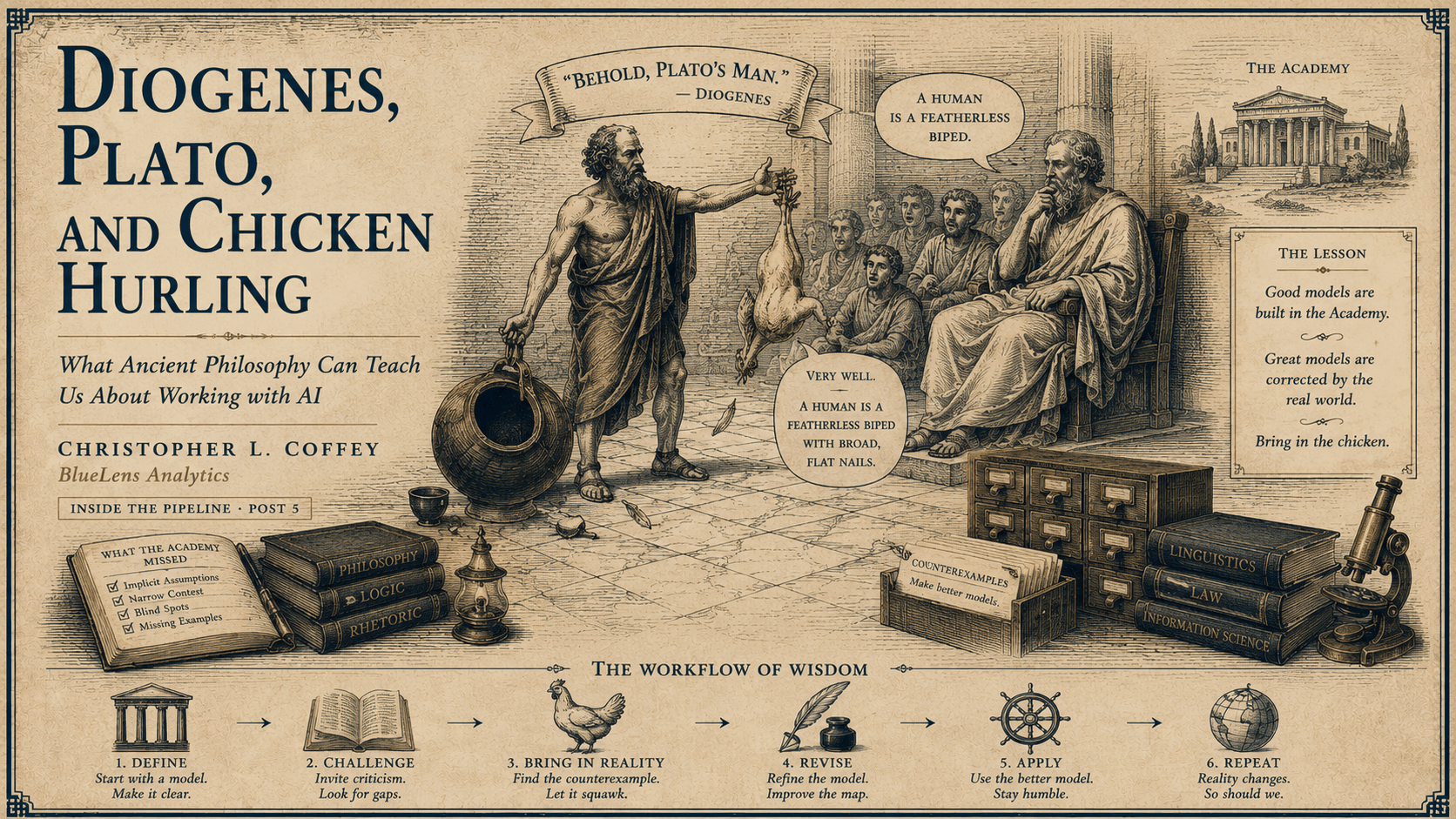
In the last piece I closed with a line about Diogenes throwing a plucked chicken at Plato. It was a throwaway image, but it has been sitting with me since. What Diogenes was doing is similar to what many of us are asking the genAI systems we work with every day to do, and we are often doing it badly. When we get weird results from our models, we’re quick to blame the machine, but it’s often our own constructs / structures / rubrics / prompts / architectures / etc.
So let me tell the story properly, and slowly, and then say what I think it means.
Plato, at some point in the long career of the Academy, took up the question of what a human being actually is. He was a definer by temperament. He believed that the things in the world were imperfect shadows of perfect categories, and that the philosopher’s job was to ascend from the shadows to the things themselves, which is to say to the definitions. Human beings for example… A human being, said Plato, is a featherless biped. Walks on two legs. Has no feathers. The definition is elegant, it is exclusive, it does the necessary work of separating us from the birds and from the four-legged beasts, and on its face it is hard to argue with.
Diogenes was not a student at the Academy. He lived, by his own choice and by way of demonstration, in a clay storage jar in the marketplace. He owned a cup until he saw a child drink from cupped hands, at which point he smashed the cup. He carried a lit lamp through the streets in broad daylight, and when people asked him what he was doing he told them he was looking for an honest man. Plato, who was not without humor, once called him Socrates gone mad. The compliment was sincere and so was the diagnosis.
When word reached Diogenes of Plato’s new definition, he went to the market and purchased a chicken. He plucked it. He walked across town, entered the Academy in the middle of a lecture, dropped the bird on the floor in front of everyone who had been nodding along, and said, “Behold, Plato’s man.” And Plato, to his lasting credit as a philosopher, did not have him removed. He amended the definition. A human, said Plato, is a featherless biped with broad, flat nails.
There is a great deal in that small scene, and I want to slow down on it for a moment, because it contains almost everything I want to say about how we should be working with artificial intelligence right now.
The first thing in the scene is that Plato’s original definition was not wrong in any way that mattered to its users. Inside the Academy, among people who already knew what a human was and were only trying to articulate it, the definition functioned. It was clean. It was useful. It looked like knowledge. And it had inside it a fatal blind spot that no one in the room was positioned to see, because everyone in the room had assumed there was some implicit advance agreement that the conversation was about humans and not about chickens.
The second thing in the scene is that Diogenes did not refute Plato by argument. He could have. He was capable of it. He chose instead to introduce, into a room full of careful reasoners, a single material object whose existence the definition had failed to anticipate. The plucked chicken is not a counterargument. It is a counterexample with feet. It walks itself into the abstraction and ruins it. No amount of further reasoning inside the Academy would have produced that bird, because the Academy was not the kind of place that produced birds. The bird had to come from outside.
The third thing in the scene is that Plato accepted the correction. He did not pretend the chicken was not there. He revised. The system worked, but only because Diogenes was in it, and Diogenes was in it only because he refused to behave the way the rest of the Academy behaved. And Plato accepted that and refined his definition/model accordingly.
I have come to think this is a near-perfect description of the situation we are in with large language models.
These systems are extraordinary at the work that happens inside the Academy. Given a well-formed problem and a body of relevant prior work, they will reason carefully, propose definitions, refine them under questioning, catch their own small errors, and produce output that is in most respects better than what a careful junior analyst would produce in twice the time. I use them every day for exactly this kind of work, and I am not embarrassed to say that they have made me both faster and in some cases sharper than I was before them. The doom-mongering on this point is overblown. These are tools, and they are good tools, and a person who refuses to learn to use them now will be at a disadvantage soon, the same way a draftsman who refused to learn AutoCAD in 1992 was at a disadvantage by 1995.
But the systems cannot, on their own, produce the chicken.
They cannot, because the chicken is by definition the thing the system was not built to see. The chicken is the material counterexample to the agreed-upon abstraction, and the agreed-upon abstraction is precisely what the model was trained to reproduce. You can ask a model to red-team a proposal and it will give you a list of concerns, but the concerns will be drawn from the same intellectual neighborhood as the proposal itself, because the model has read all the proposals and all the critiques and has learned the shape of the conversation. It will hand you back the Academy’s own self-corrections, which are useful but not sufficient. It will not pluck a chicken. It will not walk into the room. It does not live in a barrel and it has nothing to lose.
This is a structural feature of how these systems work, and pretending otherwise is what leads people either to overtrust the output or to panic about machines that are about to wake up and rule us. Neither posture is warranted. The accurate posture is more sober and more interesting, which is that we now have a remarkable new kind of colleague, a colleague who has read everything and forgotten nothing and who will help us think more carefully than we could alone, and who nevertheless requires us, the humans, to keep doing the one piece of work that has always been ours to do, which is to bring in the chicken. The machine cannot see the absurd. And the absurd is sometimes the truth. Border cases and outliers are still part of that dataset.
That work is creative. It is contrary. It is sometimes rude. It tends to come from people who are not fully socialized into the institution they are correcting, which is why the institution finds them annoying and also why it cannot do without them. It involves looking at a clean definition and asking what walks into the room and ruins it. It involves a willingness to be the person who shows up to the lecture with a bird.
I do not think machines will ever do this part well. I am not sure they should. The value of the human in the loop is not that the human is faster or more accurate, because by most measures the human is now neither. The value of the human is that the human is unpredictable in a way that an averaging machine cannot be unpredictable, and that this unpredictability is the only known reliable source of the kind of correction that the Academy/Businesses/Humans/Society/insert-group-here, left to itself, could not produce. Groupthink does not lead to good adversarial teaming nor does it lead to innovation.
So I am not worried about being replaced. And neither should you. I am a bit worried about being forgotten. I am worried about a generation of analysts and writers and engineers who come up using these systems and never learn to bring the chicken, because the system never asked them to and the institution never made them. That would be a real loss, and it would not be the machines’ fault. It would be ours, for having confused fluency with judgment, and the polished output of a well-trained model with the harder and stranger work of thinking against the grain.
Plato amended the definition. He did not have to. He could have had Diogenes removed. The whole history of the West turns a little, in that small moment, on his choosing to accept the correction. That is the posture I want from us now. Keep the machines. Use them well. And keep the door of the Academy open for the man with the bird. Society always needs cranks.