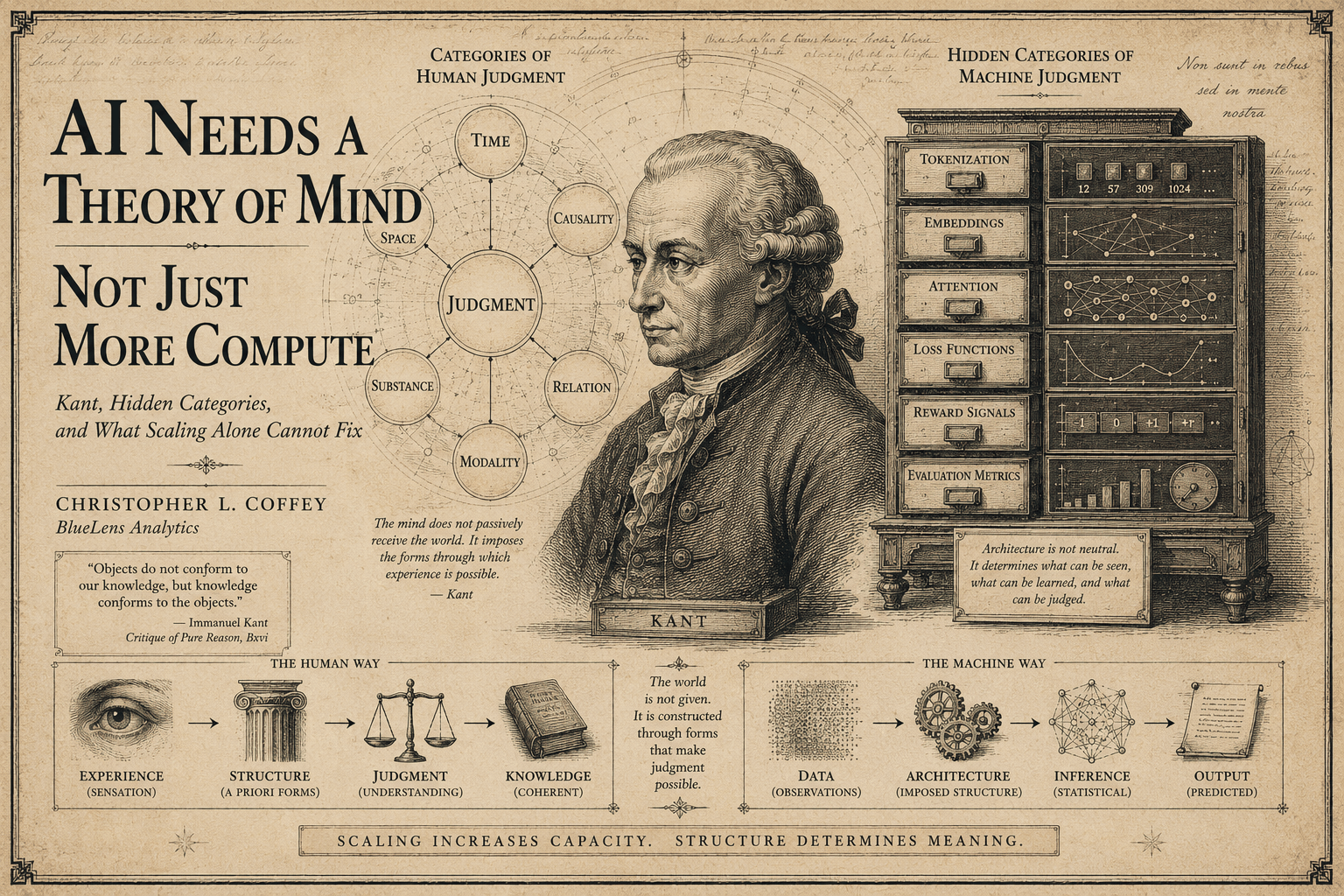
The modern conversation about AI still makes the same mistake over and over again: it treats intelligence like a scaling problem. Add more data, add more parameters, add more GPUs, and somehow understanding will emerge from the pile. That framing is useful up to a point, but it hides the real issue. AI systems do not simply absorb the world as it is. They can only process the world through structures that have already been imposed on it.
That is where Kant becomes unexpectedly useful.
Immanuel Kant argued that the human mind does not passively receive reality. It organizes experience through forms and categories that make coherent judgment possible in the first place. Space, time, causality, substance, possibility, necessity. These are not optional decorations added after perception. They are part of the machinery that allows experience to show up as intelligible at all.
That is also a surprisingly good way to think about AI.
Modern AI systems are full of hidden categories. They have architectures that determine what kinds of patterns can even be represented. They have tokenization schemes, embeddings, loss functions, interface constraints, reinforcement targets, and evaluation metrics that decide what counts as relevant, true, useful, or successful. Those are not just engineering details. They are the conditions under which machine judgment becomes possible.
Once that becomes clear, a lot of today’s AI failures stop looking mysterious. Hallucination, brittleness, poor transfer across domains, shallow reasoning, false confidence, and alignment drift are often treated as isolated technical bugs. In many cases they are better understood as failures in the foundational structure of the system itself. The model is not merely missing facts. It has been given the wrong way to organize experience.
That is why AI is not just computer science. It is also epistemology, cognitive architecture, and philosophy. Whether engineers use that language or not, every nontrivial AI system carries an implicit theory of how the world is supposed to be represented and how valid conclusions are supposed to be formed.
Kant’s insight in plain language
Kant’s central move in the Critique of Pure Reason was to ask a different kind of question than the philosophers around him were asking. Instead of asking only what can be known, he asked what must already be true about the structure of the mind in order for coherent knowledge to be possible at all. That is the transcendental move: start with the fact that judgment and experience occur, then ask what conditions make them possible.
His answer was that experience is not just raw sensation. The mind synthesizes experience. It binds sensations together, orders them in time, places them in space, and interprets them through categories such as quantity, quality, relation, and modality. Under those headings sit distinctions like unity and plurality, cause and effect, substance and accident, possibility and necessity.
The point is not that people consciously walk around applying a spreadsheet of philosophical labels to the world. The point is that no coherent experience happens without some organizing framework. A world without causality, identity, sequence, persistence, and relation would not be a world that could be judged. It would be noise.
That idea matters because AI researchers often talk as if cognition were mainly a matter of exposure. Feed enough examples into a sufficiently large model and intelligence will take care of itself. But exposure without structure does not produce judgment. It produces statistical adaptation inside a framework that has already been chosen.
AI systems already have a priori structure
One of the strange habits of modern AI discourse is that it treats everything learned from data as substantive, while everything built into the system gets treated as implementation. That division is too convenient. The built-in parts are doing philosophical work.
Take a transformer model. Before it ever sees a single token, someone has already decided that language will be broken into tokens, that tokens will be embedded into vectors, that sequence will be handled with positional mechanisms, that attention will determine contextual relevance, and that training success will be measured by predictive loss. None of that is discovered by the model through open-ended experience. It is imposed in advance as the form under which any later learning becomes possible.
The same is true far beyond language models. A computer vision system inherits assumptions about salience, spatial locality, object boundaries, and feature hierarchy through its architecture and preprocessing. A geospatial model inherits assumptions about scale, adjacency, temporal persistence, coordinate systems, and what kinds of changes count as meaningful. A decision-support system inherits assumptions about risk, utility, acceptability, and error tolerance through its objectives and user interface. These are not neutral choices. They are categories in practice.
This is why the phrase “data-driven” can be misleading. Data never arrives without a frame. It is already discretized, labeled, filtered, segmented, ranked, and routed through a schema that determines what can count as an observation. In Kantian terms, there is no machine experience without an imposed form of possible experience.
Hallucination is not just bad memory
Consider hallucination in large language models. The common description is that the model “makes things up.” That is true at the level of symptoms, but it does not go deep enough.
A model that produces fluent falsehoods is not simply failing to retrieve the right fact. It is often operating under a weak distinction between coherence and being reality bound. Its categories of judgment are tuned toward producing plausible continuations under learned statistical regularities, not toward establishing warranted relation to an external object of reference. In plain English, it has a strong category for “this sounds like an answer” and a weak category for “this is actually tied to reality.” It has no perception of “reality,” nor whether constructs of reality are based on subjective, objective, scientific, narrative, fictional, myth, or other framework terms that humans use to describe the thing they label as “reality.”
That is not merely a retrieval problem. It is a structural problem in how evidence, confidence, and reference are integrated. If a system has no strong internal mechanism that distinguishes appearance from warranted assertion, then hallucination should be expected rather than treated as a surprising edge case.
Kant would recognize the problem immediately. Judgment requires more than association. It requires lawful synthesis under rules that can justify the connection between concept and object. Current AI systems are often excellent at the appearance of synthesis while remaining weak at the justification of synthesis.
Brittleness is a mismatch in forms of intuition
This same framework helps explain why models that perform well in one environment often fall apart in another.
A vision model trained on everyday photographic imagery may do well on consumer photos and fail badly on SAR, multispectral, or medical imagery. A language model that writes competent business prose may struggle with tightly constrained legal reasoning or domain-specific operational planning. Those failures are usually blamed on insufficient fine-tuning, and sometimes that is true, but often the deeper issue is that the system’s basic representational scheme was fitted to the wrong kind of world.
Kant’s language of Forms of Intuition is useful here even if it is used loosely. A system only “sees” through the structure by which its input is rendered intelligible. If the relevant phenomena depend on forms the system does not preserve well — temporal continuity, geometric invariance, causal ordering, multiscale spatial relation, physical persistence — then the system will be brittle no matter how impressive it looked on benchmark tasks.
That point matters a great deal in remote sensing and geospatial work. The world in those domains is not just a pile of images. It is an evolving spatial-temporal field shaped by sensor geometry, revisit cycles, occlusion, terrain, weather, human activity, and domain constraints. If the model’s imposed categories do not line up with that reality, it will produce outputs that look sophisticated while remaining conceptually shallow. Seemingly precise. And completely inaccurate.
Alignment problems are failures of normative structure
The same Kantian lens also sharpens the alignment discussion.
Most alignment talk focuses on keeping AI systems from doing things people do not want. That is a valid concern, but it often gets framed as though values are external instructions pasted onto an otherwise complete intelligence. In practice, values enter much earlier than that. They are built into reward functions, ranking criteria, moderation rules, acceptance thresholds, optimization targets, and definitions of successful behavior.
That means alignment is not just about limiting outputs. It is about the normative architecture that determines what the system treats as permissible, necessary, valuable, or ignorable. In Kantian language, modality matters. A system needs more than predictive competence. It needs structured relations among possibility, actuality, obligation, and constraint if it is going to participate in decision contexts that affect real people.
When those normative categories are thin, proxy-driven, or poorly matched to the real environment, the system does exactly what it was built to do and still fails in practice. That is why reward hacking and goal misspecification are so common. The issue is not that the system escaped structure. The issue is that it inherited the wrong one.
What a Kantian AI method would look like
If this framing is right, then better AI design starts earlier than model selection. It starts with structured thinking about the conditions under which valid machine judgment is even possible.
A Kantian approach to AI would begin by identifying the phenomenon of interest in a disciplined way. What kind of world is the system supposed to engage with? What entities persist across time? What counts as an event, an object, a relation, a cause, an anomaly, a decision, a failure? If those are left vague, then the downstream system will compensate with statistical shortcuts.
The next step would be to define the system’s forms of intuition. In less philosophical language, that means deciding how the world will be rendered into a machine-usable structure. Is the task inherently spatial, temporal, causal, relational, or multimodal? Is it better represented as a sequence, a graph, a field, a scene, a set of objects, or some hybrid of those? These are not minor implementation choices. They determine what kinds of judgment the system can even attempt.
After that come the categories. The project team should explicitly name the conceptual distinctions the system must be able to make. In a geospatial context those might include stable infrastructure versus transient clutter, meaningful change versus sensor artifact, object identity versus mere spatial coincidence, correlation versus causal mechanism. In a medical system they might include symptom, diagnosis, intervention, contraindication, uncertainty, and urgency. In an enterprise workflow they might include authority, exception, obligation, dependency, and risk. If these categories remain implicit, they will still exist, but they will exist accidentally.
Then comes the normative layer. What counts as success? What kinds of error are tolerable, and under what circumstances? Which mistakes are annoying, which are dangerous, which are unacceptable? What level of confidence is required before an output should affect action? Most AI systems still treat these as late-stage product questions when they should be part of the conceptual design from the beginning.
Only after that should the discussion move to model class, training strategy, and scale. That does not mean data and compute do not matter. It means they matter inside a prior framework that decides what the system is even trying to become.
A practical checklist for AI teams
A useful way to turn this into something operational is to ask five questions before building or deploying a system.
- What is the phenomenon? What slice of reality is being modeled, and what assumptions are already being made about objects, events, and boundaries?
- How will the system experience it? What representational form makes the domain intelligible: sequence, graph, raster, vector, scene graph, temporal event chain, physical simulation, or some combination?
- What judgments must it be able to make? What categories are non-negotiable for valid reasoning in this domain: causality, identity, persistence, anomaly, responsibility, uncertainty, necessity?
- What makes a judgment valid? What counts as evidence, what grounds confidence, and what distinguishes plausible output from justified output?
- What norms constrain action? Which errors are acceptable, which are costly, and which must be structurally prevented rather than statistically minimized?
Those questions sound philosophical because they are philosophical. They are also practical engineering questions. Teams that answer them explicitly are more likely to build systems that generalize well, fail more predictably, and remain interpretable under pressure.
Why this matters now
The current AI wave has produced remarkable capabilities, but it has also encouraged a kind of conceptual laziness. Systems are often evaluated by benchmark performance, demo polish, and marketable fluency rather than by whether they possess the right underlying structure for the judgments they are being asked to make. That is risky.
As AI moves into domains like intelligence analysis, medicine, logistics, infrastructure, law, and public decision-making, the cost of wrong categories goes up. A system that cannot distinguish evidence from pattern completion, signal from artifact, causal process from surface correlation, or obligation from optimization target is not merely incomplete. It is confused in a way that scaling alone may never fix.
Kant is useful here not because eighteenth-century philosophy contains a hidden blueprint for machine learning, but because it forces a more disciplined question. Before asking whether a system is accurate, ask what has to be true for its outputs to count as judgments in the first place. Before asking whether it is aligned, ask what normative structure has already been built into it. Before asking whether it can reason, ask what categories of reasoning its architecture actually makes possible.
That shift in emphasis matters. It moves the conversation away from the fantasy that intelligence is just enough data poured into enough compute. It directs attention back to the architecture of thought itself.
AI does not just need more scale. It needs a better theory of what it means to experience, organize, and judge a world.
That is not a retreat from engineering. It is the next stage of taking engineering seriously.