Over the past few weeks, while reviewing work around IRAC-style legal reasoning frameworks for AI systems, I kept finding myself thinking about something larger:
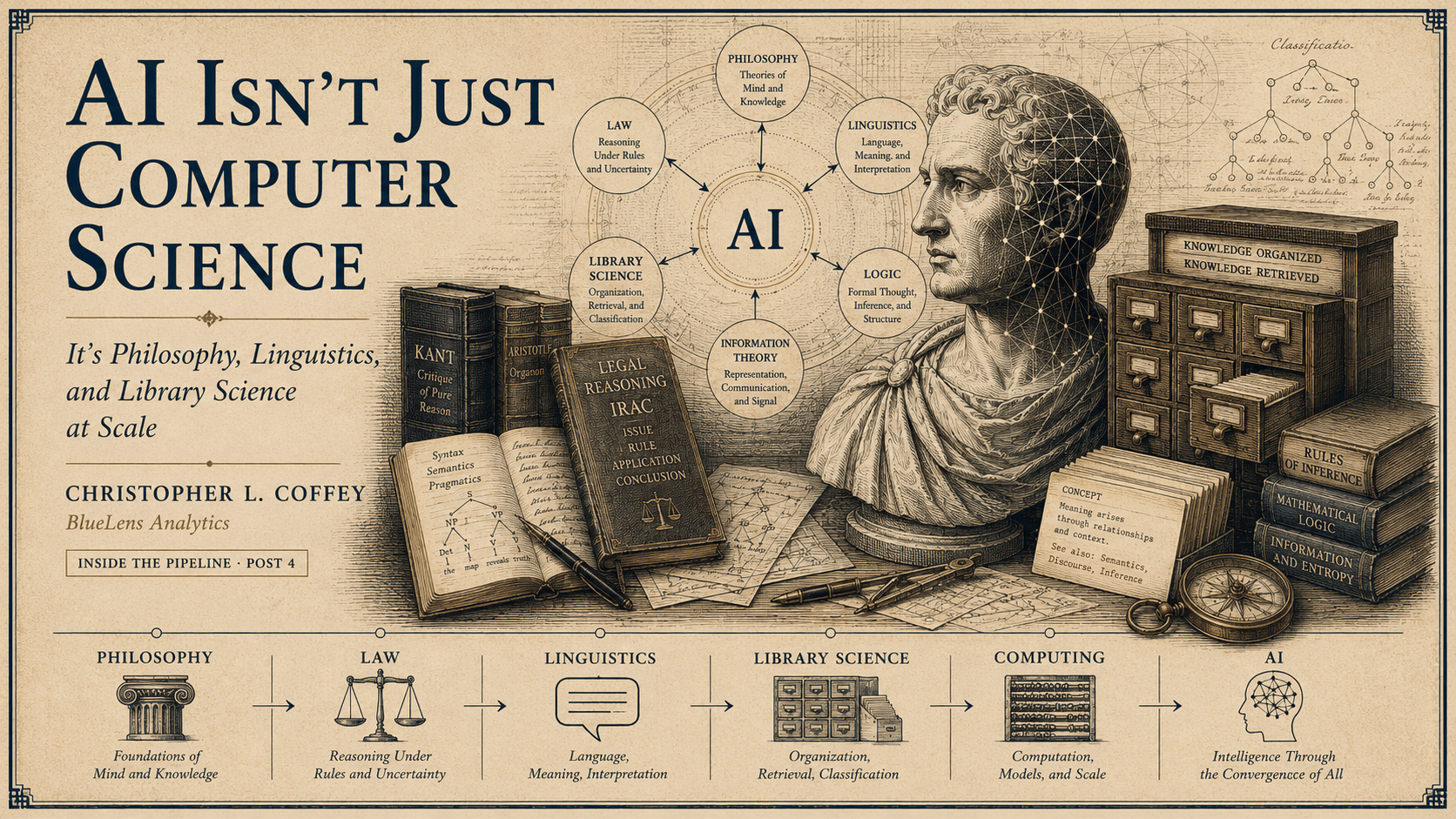
Modern frontier AI systems are not just engineering achievements. They are deeply connected to centuries of work in philosophy, linguistics, law, and information science.
A lot of the current AI conversation focuses on:
- scaling laws
- parameters
- GPUs
- architectures
- benchmark scores
But underneath all of that, many of the most powerful ideas in modern AI are actually rediscoveries of much older intellectual frameworks.
Why Legal Reasoning Works So Well for AI
One thing that immediately stood out to me was how naturally legal reasoning structures map onto AI workflows.
Frameworks like IRAC — Issue, Rule, Application, Conclusion — are effective because they impose structure onto reasoning. They create a predictable cognitive path through ambiguity.
That matters enormously for AI systems.
Large language models are incredibly capable, but they are also probabilistic. Without structure, reasoning can drift, skip steps, or collapse into vague synthesis. IRAC works because it externalizes reasoning into discrete stages:
- identify the problem
- identify governing principles
- apply those principles
- produce a conclusion
In many ways, this resembles a lightweight cognitive architecture layered on top of a language model.
Law itself is actually one of humanity’s most refined systems for handling:
- incomplete information
- competing interpretations
- uncertainty
- precedent
- probabilistic judgment
- adversarial analysis
Those are exactly the kinds of environments frontier AI systems struggle with today.
The Hidden Influence of Philosophy
The more I thought about this, the more it became clear that many modern AI concepts have philosophical roots.
Descartes and Procedural Reasoning
Descartes emphasized breaking complex problems into smaller components and reasoning through them methodically.
That feels remarkably similar to:
- chain-of-thought prompting
- decomposition strategies
- agentic workflows
- iterative verification systems
Modern AI often performs better when it is encouraged to “think step by step,” which is fundamentally procedural reasoning.
Kant and Structured Perception
Kant may be even more relevant.
Kant argued that humans do not perceive reality directly. Instead, the mind organizes experience through internal categories and conceptual structures.
That idea maps surprisingly well onto transformer models.
LLMs do not “understand” meaning directly in the human sense. Meaning emerges relationally through:
- context
- association
- latent structure
- token relationships
In other words, interpretation is shaped by internal representational frameworks rather than direct access to objective reality.
In a strange way, transformers are highly Kantian systems.
Linguistics Is Everywhere in AI
The relationship between linguistics and AI is more obvious, but I still think it is underappreciated.
Modern language models operate directly inside problems that linguists have explored for decades:
- syntax
- semantics
- pragmatics
- discourse
- ambiguity
- contextual meaning
Even ideas from semiotics and discourse theory appear everywhere once you start looking:
- meaning through relationships
- context-dependent interpretation
- symbolic representation
- implied meaning and inference
LLMs are not just generating text. They are operating inside massive probabilistic systems of language interpretation.
The Overlooked Role of Library Science
This may be the most underrated influence of all.
A lot of what we now call:
- retrieval-augmented generation (RAG)
- embeddings
- vector databases
- semantic retrieval
- ontology mapping
has deep parallels with library and information science.
Long before AI, librarians and information scientists were solving problems like:
- classification
- indexing
- metadata
- retrieval
- authority control
- semantic relationships between concepts
In some ways, vector search is a machine-scale reinvention of catalog science.
We often treat these ideas as purely technical innovations, but many are rooted in older disciplines concerned with organizing and retrieving knowledge.
AI as the Convergence of Human Knowledge Systems
The more I think about it, the less AI feels like a field that emerged independently from computer science alone.
It increasingly feels like computation absorbing the accumulated cognitive infrastructure of civilization.
Frontier AI systems sit at the intersection of:
- philosophy
- law
- linguistics
- psychology
- library science
- logic
- rhetoric
- information theory
And that may explain why interdisciplinary thinking matters so much right now.
The next breakthroughs may not come only from larger models or more compute, but from integrating richer theories of:
- reasoning
- interpretation
- memory
- knowledge organization
- human cognition
Final Thought
One of the most interesting things about modern AI is that it is quietly forcing technical fields back into conversation with the humanities.
For years, philosophy, linguistics, and information science were often treated as adjacent or even secondary to engineering disciplines.
But AI is revealing that these fields were never peripheral.
They were foundational all along.